“The Ballad of Kerry Collins”

Ethan Trex wrote that “if Tom Waits ever writes a sad song about an exhausted journeyman quarterback, it will almost certainly be called ‘The Ballad of Kerry Collins.’”
Bubbling up in the bloggochatter since the announcement this week that the former Titans, Raiders, Giants, and Panthers quarterback was going to join the Indianapolis Colts have been comparisons between Collins and former Packers, Jets, and Vikings quarterback Brett Favre, and that’s unfortunate for everyone.

I first noticed it when a reader pointed me to Jim Wyatt’s post on the Titans Insider blog, and I saw it again in Trex’s post on The Triangle, quoted above. Wyatt hit the theme heavily, opening his post with,

Quarterback Kerry Collins insisted back in July he wouldn’t pull a Brett Favre. “No, no,” he said. “I’m done.”

Yet on Wednesday he pulled a Favre, coming out of retirement and agreeing to terms with the Colts. Collins said in July he was retiring after 16 NFL seasons, including the last five with the Titans. A call from the Colts, who are dealing with lingering injury issues with quarterback Peyton Manning, changed his mind.

Trex started out with a Favre theme as well, although, to his credit, he didn’t attempt to coin a phrase when he lamented:

Great, now we’re going to have to put up with the Great Kerry Collins Un-Retirement Watch every August until the end of time. We finally get Brett Favre’s career put in the ground, and you job us like this, Kerry?

Admittedly, Collins shares some things in common with Favre, like persistent, gray, stubbly facial hair. But we shouldn’t be so quick to apply the “pulling a Favre” label every time a player unretires. What’s important to remember about Favre is how he went about his “retiring” and “unretiring,” if it even can be called that. He never really shut the door at the end of a season. He kept himself in the spotlight through strategic PR moves. In short, he milked it. And he did it multiple times.

If we have to talk about “pulling a Favre” every time a player comes out of retirement, we unfairly cast a negative light on something that need not be negative at all, and we diminish the magnitude of the terribleness that was the actual Favre’s retirement process. To even approach Favre status, Collins is going to have to do this a few more times and make a bigger stink about it. Until then, he’ll just be the next guy to try to “pull a Testaverde.”

The Weekend Interview: Roger Goodell

Roger Goodell has been the commissioner of the National Football League since August of 2006. During those five years, Goodell has sought to leave his mark on the game in a number of ways, first among them being his attempt to control and improve the image of the league through tough punishments for player misbehavior on and off the field. Other notable goals include increasing the global reach of the game– London, Mexico City, and Toronto all have hosted games– and expanding the regular season to from sixteen to eighteen games, something he failed to achieve during the summer’s labor disputes.

Goodell has been a controversial figure with players almost since the beginning of his tenure, and the summer’s labor disputes carried the natural consequence of ill will from fans. His most recent decision regarding supplemental draft hopeful Terrelle Pryor has drawn heavy criticism from players, fans, and media observers. Yet the game has done anything but flounder under his watch. For this imagined interview, I caught up with Goodell in the Mile High City, which he was visiting in advance of tonight’s Bills-Broncos game.  Keep reading…

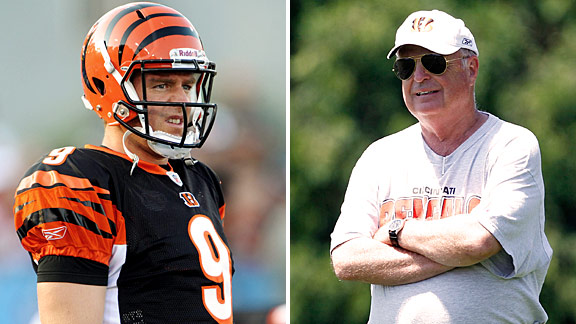
Horrible Bosses: Bengals’ Mike Brown (via ESPN.com)

Yes, Palmer has four years left on his nine-year, $118 million deal. You signed the contract, you say. Live up to it. In fact, that’s what Brown has said. “He gave his word. … He’s going to walk away from his commitment. We aren’t going to reward him for doing it.”

But Brown is a hypocrite. He has cut hundreds of players before their contract was up and given them nothing. Why should Palmer live up to a deal that works only one way? If Palmer should suddenly go blind, would Brown still give him the money? Are you kidding? Brown is cheaper than your local Goodwill. … Read More

via ESPN.com

Why is Roger Goodell carrying water for the NCAA?

After delaying the supplemental draft to hear ovations from disgraced former Ohio State University quarterback Terrelle Pryor, NFL Commissioner Roger Goodell decided, contrary to the apparent application of NFL rules, that Pryor would be allowed to enter that draft, and, contrary to ready explanation, that Pryor would be suspended for the first five games of the regular season.

That Goodell would allow Pryor into the supplemental draft was not a surprise. Despite a likely inability to make the requisite showing of “changed circumstances,” Pryor was too (in)famous to be left out, and some teams had whispered an interest in him.

What is surprising, though, is the condition Goodell imposed on Pryor’s eligibility: a five game suspension. Indeed, Pryor cannot even practice with the team that drafts him–assuming a team drafts him– until Week 6 of the regular season. Pryor’s high-profile agent, Drew Rosenhaus, appeared to accept the terms of admission graciously: “We accept that voluntarily. It’s a small price to pay for him to have a chance to pursue his dream of playing in the NFL.” Pryor’s attorney was less gracious: “Terrelle is going to [the] NFL because the NCAA mandated that he feed their families but he couldn’t feed his own.”

The five-week suspension just so happens to exactly mirror the suspension Pryor would have faced had he returned to play at Ohio State, assuming he would face no further sanctioning. It’s unlikely that this is a coincidence, since it is a disproportionately heavy punishment when compared with other NFL game suspensions.

The obvious and unanswered question about the conditions of Pryor’s eligibility is, “why?” Goodell’s reputation, as established early and often through his treatment of players like Pacman Jones and Michael Vick, is as a tough, paternalistic disciplinarian. Players who violate league policy or the law can expect to be punished by the NFL under Goodell’s watch.

What was completely unexpected, however, was that Goodell would act to enforce violations of NCAA policy. Pryor has violated no laws, and no policies of the NFL. Why, then, is Goodell punishing him?

The only answer can be that Goodell is punishing Pryor for violating NCAA policies, something that 1) is absolutely beyond his authority, and 2) sets an untenable and inappropriate standard as applied to events in the recent past and the potential near future.

For example, what of Seattle Seahawks head coach Pete Carroll, who fled Los Angeles as his USC program went down in NCAA-sanction flames (to say nothing of Reggie Bush)? What if the new NCAA investigation of the University of Miami finds that current NFL players who played there violated NCAA rules? What if the NCAA’s ongoing investigation of Auburn turns up infractions by Cam Newton, the Carolina Panthers’ new starting quarterback?

Does this new aspect of the Goodell Doctrine, the Pryor Precedent, mean that all NCAA rule breakers who go to the NFL now can expect to face punishment from the professional league as well? And why wasn’t Pryor himself entitled to notice of this new punishment policy?

Finally, it is notable just how transparent a departure the suspension was from anything resembling the norm. After hearing the news of Pryor’s conditional eligibility at lunch yesterday and going to post a 140-character version of this post on Twitter, I found the feed full of links to similar reactions. Even for those on board with Goodell’s “new sheriff in town” approach before this week, I imagine this is a departure too attenuated to justify. What, after all, was Goodell’s motive here?

The Weekend Interview: Chris Johnson

After heading north of the border for last week’s interview, it only seemed right to turn things around and seek some warmer weather and talk to a current– if temporarily, but willfully inactive– player named Chris: Tennessee Titans running back Chris Johnson.

Arguably the league’s fastest and best running back since the Titans drafted him out of East Carolina University prior to the 2008 season, Johnson currently is holding out from this year’s lockout-compressed training camp in the hopes of securing something around $30 million in guaranteed money.

This isn’t CJ’s first contract dispute either. 2009 was a record-setting year for him (2,006 rushing yards, 2,509 total yards, 14 touchdowns, 5.6 yards/carry), and he demanded a restructured contract before the 2010 season, and the Titans ultimately gave in. Johnson’s prediction that he would shatter Eric Dickerson’s single-season rushing record (2,105 yards) by rushing for 2,500 yards in 2010. Instead, he had 1,364 yards on the ground (1,609 total), well short of the record and his personal goal, though still good numbers.

For this imagined interview, I agreed to meet Johnson for lunch at McDougal’s in Nashville…  Keep reading…

The ends of their ropes?

The sports world finds itself with a couple of active streaks that are starting to reach lengths that make people a little antsy. New Patriots DL Albert Haynesworth hasn’t been in practice since last week, Titans running back Chris Johnson continues to hold out as part of a contract bargaining strategy, and, in more positive news, Braves infielder Dan Uggla extended his consecutive-game hitting streak to 31.

The question is, which run will be the first to end?

Register your vote by electronic entry, below.

Philadelphia dreamin’, on such a summer’s day

It’s been over a year since “The Decision.” Thirteen months since Miami’s “Big Three” hit South Beach. Two months since the Heat lost in the NBA Finals. One month since the NFL lockout ended. In other words, it’s time for the media to reprise the dream team motif that paid their bills through the NBA season. NFL free agency, though compressed, has been slow, with one exception. Keep reading…

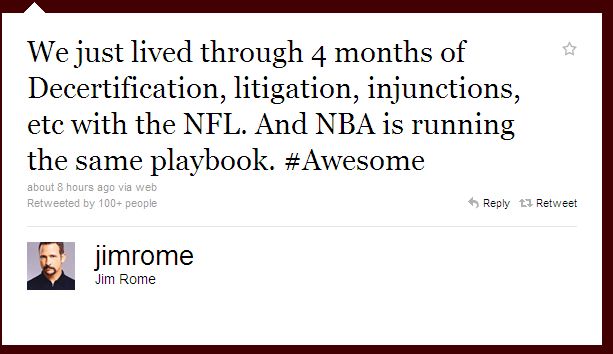
Jim Rome compares, laments league work stoppages


Last night, radio and television host Jim Rome lamented the fact that, following the NFL’s recently resolved labor conflicts, the “NBA is running the same playbook.” I understand that, for people like Rome, whose livelihood depends on there being actual NFL and NBA seasons for them to talk and twit about, even the specter of a season cancelled is a valid reason to fret. But for those of us with a little more distance from the sport, the NFL’s off-season negotiations were just that– off-season negotiations. Sure, Tennessee’s Bud Adams had to formally hang onto Vince Young a few months longer than he wanted, but nobody else was making moves either, and VY landed in what now may be the illest of delphs with no more skin of the Titans’ backs, and the season will start on time, this compressed free-agency period is more exciting than infrequent summer updates (“Sportscenter’s top story for June 21, third-string DT to K.C.”), and most of the players held training camps on their own despite their complaints in the negotiations about having to do off-season training camps (and there’s no need to flood the comments about cancelling the Hall of Fame Game). I’m not saying we ought to do this every year, but I am saying that if you tune back into the NFL when it’s supposed to be getting underway again, things look pretty normal. Keep reading…

Abstinence education in Oakland

No, this has nothing to do with this video. Lost in the general, blind excitement over the NFL’s season starting on time, more or less as it would have without the dispute between the players and owners, was the approach taken by the Oakland Raiders’ management during the final, critical vote to approve the new deal with the players that would allow the league to resume operations.

Rather than vote to approve the plan, or even to vote against it, the Raiders decided to abstain. As covered in the exclusive report by Comcast SportsNet, Amy Trask, CEO of the Raiders, “explained the abstention thusly”:

We have profound philosophical differences on a number of issues — both of a football and economic nature. We have consistently expressed our views on these matters to the league.

Even though I am disappointed that it was Trask, and not owner Al Davis, who provided the explanation of the team’s position, I like the Raiders taking a principled stance here for no other reason that they’re the Raiders. (It also reminded me of two-time Oakland head coach Art Shell’s principled stance against any form of clock management.) Along with the rest of the league, and whether they want it or not, or if they even know what they want anymore, Da Raidas are back.