Kansas trick kick-return play validates Mountain West’s hazing of Boise State

One of the first stories we covered at this site occurred back in 2011, when the Mountain West Conference hazed new member Boise State by prohibiting them from wearing their blue uniforms in home conference games, claiming that the uniforms gave the Broncos “a competitive edge” in games played on their blue home turf, all while permitting charter conference member Colorado State to wear green uniforms in all of their conference games played on green turf. The MWC position was such a sham that even the NCAA could see it was a bad idea.

On Saturday night, though, the otherwise hapless Kansas Jayhawks showed that there might be something to this turf camouflage concern:

Not bad, but it won’t help KU hide from Charlie Weis, to whom the university still owes money.

Mike Leach Prefers Solo Cougars

1567162_still

We all know Washington State head football coach Mike Leach to be a sensible and worldly man, and that’s true even when it comes to the selection of his team’s captain. In an age when most teams send out four or more captains (plus honorary captains) to handle the game’s preliminary procedural matters, Leach prefers a simpler and more direct approach:

Makes sense to me. According to contemporary reports, Morrow readied himself for the show like the future D-I football captain he would become by watching lots of film: “Jamal did not come to the show unprepared. A week prior, he watched every Price is Right episode he could get his hands on.” He ended up winning “almost $2,000 worth of clothes.” (If you’re a TV weirdo, here‘s some kind of hyper-detailed breakdown of the episode.) The NCAA investigative report on whether this constituted an improper benefit remains outstanding.

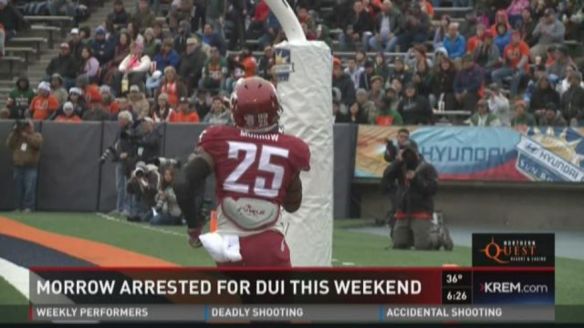
At this time, our staff has been unable to locate video of Morrow’s appearance on “The Price is Right,” but we did find this visual still and commend Morrow’s attire.

Morrow took the over on the price of a Toyota Corolla on the show in 2013 and the over on his BAC in his own car in 2016.

Our staff also has been unable to locate coin toss results for the 2016 season, but, under Leach and Morrow, Washington State has won five games in a row and is undefeated (4-0) in conference play. Only two currently ranked opponents– Colorado and Washington– remain on their schedule. They play Oregon State this Saturday night on ESPN2.

____________________________________________________

Previously
Mike Leach: Prospective time traveler
Mike Leach officially ushers in the 2015 college football season
Cougar dating tips from Mike Leach
Mike Leach Favors Cougars

John Calipari, hero anti-NCAA crusader?

NCAA Men's Championship Game - Kansas v Kentucky

Those who oppose the NCAA as an old-fashioned, draconian regulatory body designed for the sole purpose of maintaining profit-driven financial control over a highly valuable workforce are praising yesterday’s comments by University of Kentucky men’s basketball coach John Calipari, who addressed a basketball-related change in NCAA rules that will allow college players to declare for the NBA draft and, if invited, attend the NBA combine before they have to decide whether to withdraw from the draft in order to maintain their collegiate eligibility as follows:

Met with our team today. Told them that during the season it’s about the team and sacrificing for each other – which they did this year. When the season’s over, it’s about each individual player and what’s right for them and their families.

With that being said, every player who is eligible for the draft, including our walk-ons, will submit their names for the NBA Draft in hopes of being invited to the combine in May. The new rule states they can submit their name a total of three times. If they choose to withdraw, they have until 10 days after the combine. It’s a true win-win for the student-athlete.

Just so you know, having every kid put their name in the draft is about all players getting the right information. Players not invited to the combine know what that means. Players invited to the combine and told to go back to school know that that means. As I said, it’s a win-win for the student athletes. I like the rule.

(Emphasis added.)

On one hand, Calipari is right to encourage his players to gain as much information as they can about their professional prospects, especially where there is no penalty to the player for seeking that information. The new regime– allowing players to wait until after the combine to decide whether to withdraw from the draft– provides players considering continuing their basketball careers on a professional level a valuable option.

Calipari isn’t merely praising this change as a beneficial option for “student-athletes,” however. Continue reading

Madness: The NCAA Tournament’s structural flaw

The organizing principle of a competition arranged in the fashion of the NCAA men’s basketball tournament is that better teams should have easier paths for advancement, the goal being for the best teams to meet as late as possible. Tournament organizers therefore employ a seeding system that awards teams believed to be the strongest with the best seeds (i.e., the lowest numbers) and first pits them against teams believed to be the weakest.This is sensible, logical, and good. Anything can happen once the games begin, of course, but if Michigan State and Kansas, for example, are the best teams in this year’s tournament, the tournament should be designed such that those two teams are most likely to face off in the final, championship round. Generally speaking, this is how the NCAA tournament is organized.

From 1985 until 2000, the tournament’s field held steady at sixty-four total teams. In 2001, it expanded to sixty-five teams, adding a single play-in game to determine which team would be the sixteenth seed to face the number one overall seed. In 2011, the tournament field expanded to sixty-eight teams, its current size, with four play-in games.

Many people dislike the fact that the tournament has expanded beyond a seemingly optimal sixty-four-team field, but all should agree that, however many teams and play-in games are included, the tournament should be organized such that the projected difficulty of each team’s path through the tournament is inversely proportional to its seed position. As currently constructed, however, the tournament deviates from this basic principle.

All play-in games are not created equal. Two of the four fill sixteenth-seeded positions, while the other two fill eleventh-seeded positions, and the latter grouping is the culprit here. The NCAA and its broadcast partners no longer refer to the play-in games as the “first round,” thankfully, but, however labeled, these games constitute a significant structural hurdle for their participants. It’s difficult enough to win five consecutive games against the nation’s top competition; adding a sixth game places the play-in teams at a major disadvantage.

If a tournament organized in this fashion is to proceed with sixty-eight participants, play-in games are a necessity. The heavy burden of participating in an extra round of competition should be apportioned in accordance with the tournament’s organizing principle, however. In this instance, that should mean applying it to the lowest-seeded (i.e., highest number) teams. Using two of the play-in games to determine eleventh-seeded positions inappropriately and adversely distorts the degree of difficulty for those two positions.

2016bracket

This year, the unduly burdened teams are Vanderbilt, Wichita State, Michigan, and Tulsa, which are competing in play-in games for eleventh-seeded spots in the tournament’s first full round. Each of these teams would be better off as a twelfth, thirteenth, or even fourteenth seed (to say nothing of an eleventh seed in the West or Midwest regions, where eleven seeds are not similarly encumbered) than they are as participants in eleventh-seed play-in games.

If the tournament committee really believes each of those four teams belongs in the tournament and is deserving of an eleven seed, or thereabouts, it should pick one from each pairing– Vandy/WSU and Michigan/Tulsa– to be the eleventh seed, make the other the twelfth, bump the remaining lower seeds in the region down by one, and have the existing fifteenth seed play the existing sixteenth seed in a play-in game instead. (This wouldn’t be a clean fix in the East region, which already has a Florida Gulf Coast/Fairleigh Dickinson play-in game for the sixteenth seed, but the Midwest region has no play-in games, so one of Michigan/Tulsa could be moved to the eleventh or twelfth seed there, bumping Hampton and MTSU into a play-in game for the sixteenth-seed position in that region.)

Two of the eleventh-seed play-in participants, Vanderbilt and Michigan, likely were two of the last teams to earn at-large bids to this year’s tournament. Even if that’s true, though, it shouldn’t matter. The in/out decision is binary: a team is either in the tournament or it isn’t. Once the field is determined, the committee then should seed the teams based on their basketball merit. If the committee thinks so little of Vanderbilt, Wichita State, Michigan, and Tulsa that it wants to put them through the paces of a play-in game, it should have seeded them lower than eleventh.

The current arrangement of the NCAA tournament play-in games constitutes a structural flaw not because those preliminary games exist, but because of the seed positions they involve. If the NCAA insists on using the play-in-game arrangement to include sixty-eight teams in the tournament, it should use those play-in games in a manner that aligns with the tournament’s overall organizing principle of strength-based seeding. In practice, no tournament of this sort will be perfectly balanced in its initial arrangement, but the current structure clearly is contrary to that fundamental organizational principle and unnecessarily distorts the balance of the entire tournament.
The NCAA still wants you to believe its rules carry the force of law

This is a topic that probably deserves further extrapolation, but for now, just take a moment to remember that a violation of NCAA rules, to which most of us are not subject, is not the same thing as violating the law. This was the lesson of the Nevin Shapiro foul-up. That doesn’t mean that the NCAA doesn’t want you to think they can’t act with the force of law, though. [Note that lawyers receive bonus law points for triple negatives. – Ed.] The latest example came this afternoon:

That’s the NCAA’s official news account, and the tweet contains a link to the NCAA’s Sports Wagering Brochure, which is not a legal advice document from a lawyer or the government. Its text says that a variety of gambling-related acts may constitute violations of NCAA rules. That’s fine. So is eating too much pasta.

The brochure’s images and layout attempt to tell a different story, though:

ncaawageringshaving

Point shaving is a federal crime, and sports gambling, like just about everything else, is a regulated activity. To say that the NCAA’s brochure clearly parses people’s obligations under the law, as compared with their obligations under the NCAA’s rules is as much of an understatement as Mercer is an underdog to win the NCAA tournament. Take a look at the full brochure layout and see if you agree.

Do you think the NCAA cares that it might have caused confusion about the extent of its enforcement authority vis-a-vis state and federal law? Don’t bet on it.

Instant analysis: Manziel suspended; NCAA bylaw 12.5.2.1

johnnydaveYes, that Johnny Manziel. ESPN confirmed that the NCAA and Texas A&M agreed that the defending Heisman Trophy winner will be suspended for the first half of the Aggies’ season-opener against Rice. Although the joint statement said that there was “no evidence that Manziel received payment for signing autographs,” Manziel nevertheless faces punishment because he violated NCAA bylaw 12.5.2.1. That rule prohibits student-athletes from permitting others to use the student-athletes’ names or likenesses for commercial purposes. I don’t think anyone who doesn’t subscribe to TexAgs.com disagrees that Manziel violated that rule.

In full, bylaw 12.5.2.1 provides:

After becoming a student-athlete, an individual shall not be eligible for participation in intercollegiate athletics if the individual:

(a) Accepts any remuneration for or permits the use of his or her name or picture to advertise, recommend or promote directly the sale or use of a commercial product or service of any kind; or

(b) Receives remuneration for endorsing a commercial product or service through the individual’s use of such product or service.

Because the NCAA has no evidence that Manziel actually received money for the thousands of autographs he signed for a few professional memorabilia dealers, it’s clear he’s being punished under the portion of subsection (a) that declares ineligible a student-athlete who “permits the use of his or her name or picture to advertise, recommend or promote directly the sale or use of a commercial product or service of any kind.”

The problem for the NCAA is that every student-athlete is in violation of bylaw 12.5.2.1 simply by willingly participating in college athletics. Thanks to the various licensing agreements of the NCAA and colleges, to say nothing of tickets to games, matches, and meets, every student-athlete “permits the use of his or her name or picture to advertise, recommend or promote directly the sale or use of a commercial product or service” simply by being a student-athlete competing in NCAA-sanctioned athletic events.

At the very least, the NCAA is guilty of selective enforcement in this instance by singling out Manziel for his violation of bylaw 12.5.2.1 when every other student-athlete also is in violation of the rule. The NCAA has three obvious options at this point: 1) lift the arbitrary and capricious Manziel suspension; 2) dissolve itself; or 3) suspend every student-athlete for the first half of the Texas A&M-Rice game.

On paying college athletes: Schools’ obligations under the status quo

Last week, Clay Travis argued, credibly, that all Wonderlic Test scores should be made public. For whatever reason, these scores are the only NFL combine results not made public. Every year, though, someone leaks a few of the scores to the media, and this year was no exception. According to the testing company, a score of ten indicates literacy, while a twenty indicates average intelligence. The three leaked scores were a twelve (Justin Hunter, Tennessee), an eleven (Cordarrelle Patterson, Tennessee), and a seven (Tavon Austin, West Virginia). Travis explained his larger takeaway point:

So all three of these wide receivers tested borderline literate, and substantially less intelligent than an average security guard would test.

Yet all three receivers have been eligible to play college football for years.

Isn’t this prima facie evidence of academic fraud? I mean, if you can barely read the Wonderlic test, how in the world have you been eligible at a four year college without significant cheating?

Travis goes on to writhe in the muckety muck of “academic fraud . . . one of the great untold stories of major college athletics” and cast  now-common aspersions on the NCAA.

It’s the NCAA that tends to bear the brunt of the building criticism of the college athletics status quo from the likes of Travis and his former employer, Deadspin, and the NCAA probably deserves most of that criticism. On this issue, though, it’s the schools themselves that deserve a critical assessment, not the NCAA.

The boom-bust cycle that is the volume of the discussion over whether college athletes should be paid is in a boom phase at the moment, but the substance of the conversation has not changed much over the years. Those in favor of paying college athletes point to the large revenue streams college athletics produce for schools and the NCAA and argue that it’s wrong that the athletes are not allowed to share in those profits; those opposed argue that the student-athletes are being compensated in the form of a free college education. The two sides actually seem to agree, at least implicitly, on the fundamental premise that college athletes should be compensated, and their disagreement is with the degree to and manner in which the athletes should be compensated: Proponents want new cash payments, perhaps held in trust, for the students, while opponents believe a free education constitutes sufficient compensation.

Test results indicating that students are flirting with illiteracy after three or four years of college are evidence that schools are not even keeping up their bargain to provide student-athletes with an education.

Give The Man His Due (via Sports On Earth)

LAS VEGAS — Jerry Tarkanian shifted in his easy chair to find a place it didn’t hurt so much. “My butt is sore,” he said. It’s what happens when you’re 82 years old and you fell four years ago. Back in the day, Jerry Tarkanian roared. On this day, his voice was a whisper, tiny and airy as a child’s.

“He’s worn out by physical therapy this morning,” his wife, Lois, said.

Maybe it’d be better to talk another day?

“No, no, he needs this,” she said.

In early April, for the first time, Tarkanian will be a  finalist for election to the Naismith Basketball Hall of Fame.

A question to him: Would you like to be in?

His lips barely moved. “It’d be nice,” he said.

What would your players think?

Again, a faint breath of air. “They would like it.”

We should shout it out. Jerry Tarkanian belongs in every basketball Hall of Fame. He built teams at the University of Nevada-Las Vegas that were wonders of the craft. They were at once aggressive and careful, disciplined and relentless. To see UNLV leave Duke alongside the road in the 1990 NCAA championship game, 103-73, was to see basketball made beautiful. In 31 seasons at Long Beach, UNLV and at his alma mater, Fresno State, Tarkanian’s teams won 778 games. He took UNLV to the Final Four four times.

This is also worth a shout: Tark was right all along. He called the NCAA corrupt long before such thinking was fashionable. … Read More

(via Sports On Earth)

NCAA issues its best decision…ever?

In a story breaking late Friday evening, the NCAA “denied the Football Rules Committee’s proposal to require an institution’s uniform to be a different color from the field of play.” This means that Boise State can wear its blue uniforms at home games, at least as far as the NCAA is concerned.

This is one of the first topics ALDLAND tackled, way back on August 3, 2011. At that time, BSU was just about to start its first season as a member of the Mountain West Conference, which didn’t make its new member feel welcome by issuing a bill of attainder prohibiting the Broncos from wearing blue at home conference games. As I pointed out then, the rule made no sense, since the conference permitted member Colorado State to wear their green uniforms at home conference games, and CSU has a green field. It’s also as good a time as any to remind people that the players don’t operate from the vantage point of the Goodyear Blimp while playing the game.

The NCAA’s recent decision to reject a proposal that ALDLAND has shown to be nonsensical, unworkable, and flawed may be the best decision in its history. As the internet will tell you, though, the bar is pretty low. We nevertheless take a moment this evening to applaud the high point of Mark Emmert’s tenure as NCAA president. This pour of Woodford is not for you, Mark, because that would constitute an improper benefit.

_____________________________________________________

Previously
There’s a new dress code in the Mountain West Conference