Hollywood Nights: A Magic Haiku

Last night, an ownership group led by Magic Johnson bought the Los Angeles Dodgers for $2 billion, the largest amount ever paid for a sports franchise.

____________________________________________________

Magic bought the Dodgers.
Media really loves this story,
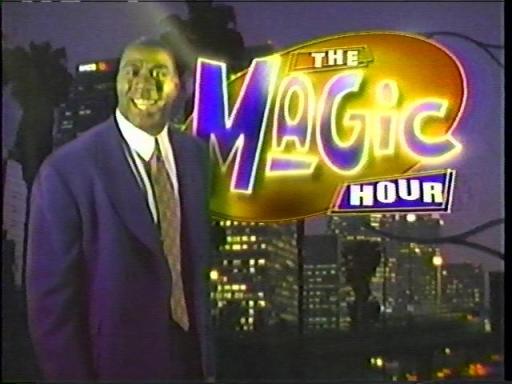
forgets The Magic Hour.

____________________________________________________

Previously:
Hollywood Nights: Z-Bo and Bishop Don The Magic Juan

Hollywood Nights: Z-Bo and Bishop Don The Magic Juan

Apparently we’re just posting pictures now. This one’s a little less self-evident than the last one, so here’s the accompanying explanation from Chris Ryan, writing about Sunday night’s Grizzlies-Lakers game in L.A.:

Staples Center celeb sightings were pretty fun, if random, last night, with Ashton Kutcher, John McEnroe, David Beckham, and Gerard Butler (gone blond) lighting up courtside with their wattage. But the best appearance of the evening went to a man who seemed to be cheering for the Grizz: Snoop Dogg compatriot Don Magic Juan. Don’t know if there’s ever been a better union of team and fan. Oh, and he seemed to have a preexisting relationship with Zach Randolph, because of course he did.

Mundane Monday

For the first time ever, rain delayed the Daytona 500 such that no laps were run yesterday. NASCAR announced that the race would resume at noon today, although early indications today are that it’s unlikely to start until tonight. (UPDATE: The race will start at 7:02 pm.) A thank you to those readers who joined the thrilling live blog of the rain delay yesterday.

In college basketball, Vanderbilt fell again to Kentucky, this time at Rupp Arena, which is the only place in the SEC where Vandy’s seniors have not won. Not too many visiting teams win at Rupp, though, and the game was a close one. On Saturday night, Michigan State got all over Nebraska, beating them 62-34 in a game in which Draymond Green became just the fourth Spartan ever to record 1,000 career rebounds. Elsewhere in the Big Ten, Wisconsin beat a free-falling Ohio State in Columbus, and Michigan’s Jon Horford is out for the season with injuries.

This past weekend was the NBA’s All-Star Weekend, something I find largely unwatchable. I saw a headline that said that Kobe Bryant broke his nose in the live-action slam dunk contestAll-Star game last night, and apparently LeBron James passed up a shot at the end, which surprised no one.

The NFL draft combine was this weekend as well, and Robert Griffin III ran the forty-yard dash very quickly.

Silent Film Series: Baron Davis (Oakland, CA 2007)

The writers and readers of this site tend to be employed or otherwise disposed during the day such that watching video clips on full volume usually doesn’t happen. If there’s something I really want to hear, I save it for lunch or the end of the day, and I suspect a lot of people do the same thing. This means that there are a lot of us watching a lot of videos– the general tenor of the internet being what it is– on mute. Conventional wisdom suggests that this practice detracts from our experience of these videos. Conventional wisdom also suggests that you never get involved in a land war in Asia, but is Afghanistan even in Asia and anyway that’s not what we’re talking about because the fact is that conventional wisdom can be wrong about videos and about wars (but not about videos of wars), which is why we’re introducing the ALDLAND Silent Film Series.

The concept is simple: some videos are better without sound. Whether they’re made that way or are seen that way for some variation on the modern reality alluded to above, this addition-by-subtraction effect is very real.

The Series’ inaugural feature comes from Oakland, California in 2007. Yesterday afternoon, Amos Barshad included the clip in his possibly prescient (given the Knicks’ loss in Miami last night) contingency plan for the end of Linsanity. It stars a somewhat (i.e., five-years) younger Baron Davis in his role as point guard for the Golden State Warriors, and it comes in the final minutes of a 20+ point win over the visiting Utah Jazz.

I neither am nor aspire to be Chuck Klosterman: a second-by-second analysis of this video hardly seems necessary. Instead, as you watch it (sans audio!, of course), appreciate the silent cinemagic of every shot of Davis, his teammates, Andrei Kirilenko, the fans, and the referee. Sound can improve these visuals in zero ways.

LeBron James is the best professional basketball player ever

It might not seem like it, but, as discussed on ESPN Radio’s Mike & Mike this morning, LeBron James’ current season is the best season a professional player has ever had. John Hollinger, also of ESPN, created the Player Efficiency Rating (PER) metric for basketball players. In (his) general terms, “the PER sums up all a player’s positive accomplishments, subtracts the negative accomplishments, and returns a per-minute rating of a player’s performance.” It’s an advanced metric, and really, it’s a doubly advanced metric because it’s derivative of other advanced metrics. If you want it, the nitty gritty is here, but what PER allows us to do is compare individual players with their contemporaries and with those from other eras on equal footing.

The following is a list of the top individual full-season performances, based on PER, in the history of the NBA and ABA:

Rank    Player PER Season Tm
1. Wilt Chamberlain 31.84 1962-63 SFW
2. Wilt Chamberlain 31.76 1961-62 PHW
3. Michael Jordan 31.71 1987-88 CHI
4. LeBron James 31.67 2008-09 CLE
5. Wilt Chamberlain 31.64 1963-64 SFW
6. Michael Jordan 31.63 1990-91 CHI
7. Michael Jordan 31.19 1989-90 CHI
8. Michael Jordan 31.14 1988-89 CHI
9. LeBron James 31.10 2009-10 CLE
10. David Robinson 30.66 1993-94 SAS

The full list from Basketball-Reference is here.

James already has two of the ten best seasons, and he’s the only active player in that group. (His teammate, Dwayne Wade, is the next active player listed, at 13.) If the current season ended today, though, James would post a PER of 32.8, by far the highest mark ever recorded.

Perception is a valid and important check on the things statistics tell us. I feel like there are a million things one could write about James and perception, expectations, image, and legacy, all of which would get at the fact that the title of this post is something I’d guess most people reject as an initial, gut reaction but also something we all expected we would read, write, or say at some point. There are myriad potential lessons here. One is that these advanced metrics are a way of witnessing history in the moment, something that’s difficult to do based upon perception alone. Another is that, darn it, I hate LeBron and sabermetrics are for idiot-nerds. A third raises questions about the value we place on winning championships as a component of individual players’ legacies. A fourth is that Patrick Ewing, whose best season comes in at #117 on the big list, might not be the Dan Marino of the 1980s and 1990s NBA, and Kobe Bryant, whose best season so far comes in at #51, isn’t quite the heir to His Airness’ throne, or even Shaq’s big seat. And on and on.
Brian Phillips on Kobe Bryant and outer space

In terms of watchability, the Lakers are a miserable team this year, even by NBA standards, and the pre-season rap that the (well, more than) once-great team was little more than an aging-but-relevant superstar loner, a largely unsupportive (and largely unrecognizable) supporting cast, and a coach not named Phil Jackson has borne out. Even the team’s most famous fan thinks these Lakers are a snooze-fest.

But what about Kobe this year? First, he was visibly upset about the dismissal of Lamar Odom. More recently, he was visibly ignorant of Jeremy Lin. Slightly more recently, he was the victim of Jeremy Lin’s best career NBA performance. The uniform he’s wearing this year is too big. He seems to lack context, even for himself. What’s his story this year?

Kobe has arguably reached the end of his prime, and while it’s fascinating to watch him hoop with somebody’s swooning great aunt, you can’t help but feel like the moment deserves higher stakes. Kobe’s relentlessness has always been his most celebrated quality, but this season, he’s starting to remind me of one of those space probes that somehow keep feeding back data even after they’ve gone out twice as far as the zone where they were supposed to break down. You know these stories — no one at NASA can believe it, every day they come into work expecting the line to be dead, but somehow, the beeps and blorps keep coming through. Maybe half the transmissions get lost these days, or break up around the moons of Jupiter, but somehow, this piece of isolated metal keeps functioning on a cold fringe of the solar system that no human eyes have seen.

That’s Kobe, right? While the rest of the Lakers look increasingly anxious and time-bound, he just keeps gliding farther out, like some kind of experiment to see whether never having a single feeling can make you immortal. He’s barely preserving radio contact with anyone else at this point, but basketball scientists who’ve seen fragments of his diagnostic readouts report that the numbers are heartening. It’s bizarre. He’s simultaneously the main character in the Lakers’ drama and someone who seems to have nothing to do with the narrative logic of the post-Phil team. Whatever the Mike Brown era is, he’s got no point of contact with it. Even Gasol and Bynum, his best supporting players, essentially just concentrate on not interfering with his flight path. Everyone stays out of his way, which is easy, because “his way” is a couple of billion miles from the rest of the Lakers.

So writes Brian Phillips for Grantland, in a piece arguing that the Lakers have nothing to lose by adding Gilbert Arenas right now.

I’m not sure what I think about Agent Zero these days, I do know that I think Phillips pretty much nailed it with that description. 2012 Kobe is playing like carry-the-team-on-my-back Kobe, except that he doesn’t seem too concerned about whether he’s actually dragging the team along behind him. Spike Lee’s Kobe Doin’ Work was about the 2008 playoffs, but the title might more aptly describe this season, where Kobe’s blue collar isn’t so much the value and virtue-laden, American proverbial blue collar as it is an indication that he’s merely punching the clock.