Mike Ilitch’s baseball bona fides

avilamaddog

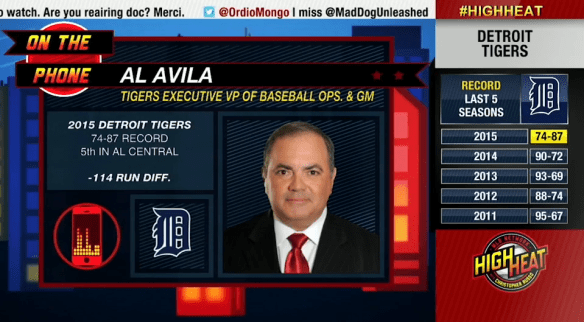
Everyone knows Mike Ilitch as the wealthy pizza baron who owns the Detroit Tigers and Red Wings, but when new Tigers General Manager Al Avila appeared on Christopher “Mad Dog” Russo’s television show today, he revealed something about Mr. I that most folks probably don’t know: Ilitch is a former professional baseball player.

Ilitch played four seasons of minor-league ball in the mid-1950s. He split the 1952 season between the Jamestown, NY Falcons, a Tigers affiliate, as chance would have it, and the unaffiliated Hot Springs, AR Bathers. He spent the entirety of the 1953 season with the unaffiliated Tampa, FL Smokers, where he was the starting second baseman and his .310 batting average was second-best on the team. In 1954, Ilitch divided his time between the Smokers and the unaffiliated Miami Beach/Greater Miami Flamingos in what would prove to be the Flamingos’ final season of existence. He continued to demonstrate an ability to hit for average, if not power (his sole home run of the season was just the second of his career to that point), finishing 1954 with a .324/.375/.400 line, the best of his career. 1955 was Ilitch’s final year as a professional baseball player. He appeared in just sixty-two games while playing for three different teams: the unaffiliated St. Petersburg, FL Saints, the Norfolk, VA Tars (Yankees), and the Charlotte, NC Hornets (Senators). Ilitch’s offense slipped in his final season, in which he hit his third career home run and batted .255/.328/.273 for the Tars (incomplete records from the other teams suggest this line is representative of his performance for the Saints and Hornets as well).

The knee injury that ended Ilitch’s playing career in 1955 probably explains the decline in his offensive production. Four years later, he and his wife opened the first Little Caesars Pizza restaurant. They bought the Red Wings in 1982 and the Tigers– from Domino’s Pizza founder Tom Monaghan– in 1992.

2016 Detroit Tigers still in search of man out standing in (left) field

After a disappointing 2015 season, which included some odd maneuvering at the trade deadline, the Detroit Tigers entered the offseason with a significant to-do list. They’ve already made acquisitions designed to address needs in the bullpen and starting pitching rotation, but, with three months until opening day, the team still has one major hole to fill.   Continue reading

Behavioral Economics and the Rise of the Player Opt-Out (via Baseball Prospectus)

“The logic of the opt-out clauses for the club escapes me.” —Commissioner Rob Manfred

Nothing gets the baseball internet writer hot like a newly popularized contract structure. Rob Neyer has weighed in on the potential benefit to team of a player opt-out, and Dave Cameron has weighed in on how these cannot be seen as anything but additional costs. Neyer’s point is that giving a player an opt-out is often preferable to giving a player more money. Cameron’s point is that giving a player an opt-out is less preferable than not giving a player an opt-out. Both points are correct. Like most things, if we change the perspective, then we can look at anything as a positive or a negative. More simply, everything is better than a worse scenario and everything is worse than a better scenario.

So why the need for another article? Because unaddressed remains the most curious question about the player option: Why has it become so popular? Put differently, what benefit does the structure provide for each side as an alternative (in most mega-deals) to just agreeing on more money? … Read More

(via Baseball Prospectus)

The Braves are failing on their own terms

fireworks-burn-flag

It’s no mystery that I’m not crazy about the business decisions made by the Atlanta Braves’ leadership in the last few years. When I arrived in Atlanta, the Braves were a playoff team. Three years later, they’re a fourth-place team in their own division, nearly unrecognizable both in terms of record and roster. So many familiar faces are gone (only five players on Atlanta’s 2013 40-man roster remain, and the best of that bunch, Freddie Freeman, is the subject of daily trade rumors, while three of them might not belong on any major-league roster), and the team’s new, suburban stadium project, which was wrong-headed from day one, isn’t looking any better at last check.

I’m willing to concede that reasonable people can disagree about the wisdom of the Braves’ recent management decisions, though. The problem for proponents of the Braves’ plan to put a winner on the new field in 2017, all other attendant circumstances be damned, however, is that they aren’t even doing that right:

The Braves are set to move into a new, publicly funded stadium in Cobb County in 2017, and even if the rebuild goes smoothly, they seem unlikely to be in a position to win by then. There’s an unwritten rule to the art of stadium-building that says if you’re going to use the public’s money to fund shiny new digs (and you bet the Braves are), you at least have to make a good-faith effort to put a solid product on the field. The Braves are trending in the opposite direction, cutting payroll and trading off cornerstone players while construction crews are turning the $672 million SunTrust Park from blueprint to reality.

On average, a team’s payroll increased 21 percent the year it moved into a new stadium, and it jumped a staggering 57 percent during the four-year span prior to Opening Day in the new park—there’s some plain ol’ inflation mixed in there, but much of the increase is due to owners willing to shell out big contracts in exchange for the discount on a franchise-altering stadium deal.

It typically costs money to build winning baseball teams, and spend money is what teams usually do when they want to have a winning team playing its home games in their new stadium. Atlanta, by contrast, has been reducing payroll in all of its recent transactions. In other words, they aren’t doing the thing other teams do when they’re doing the thing the Braves say they’re doing.

_____________________________________________________________

Previously
New Braves stadium project continues to falter
Georgia Supreme Court Upholds Cobb’s Braves Stadium Bond Deal
Braves Break Ground on Baseball Boondoggle
The yard sale at Upton Abbey continues
From Barves to Burbs: What’s happening to baseball in Atlanta?

Lose money playing DraftKings or FanDuel? File a lawsuit.

Want to skip the silly personal story and get to the details? Click here.

Back in April, I deposited $10 into a new DraftKings account. I already knew I wasn’t good at sports gambling, as my record on free wagering games like ESPN’s Streak for the Cash attests, but I gave the money to DraftKings because it got me a year’s subscription to BaseballProspectus.com, something that ordinarily costs $30. I’d already won!

Having secured the benefit of my bargain, I decided to try to win my money back (in reality, a windfall) by playing some DraftKings baseball contests. I needed to turn my $10 into at least $20, that being the site’s minimum cash-out amount. (So risk-adverse am I, I didn’t want to try depositing an additional $10 to see if that would do the trick.)

Early results, like my undisciplined “strategy,” were mixed, but mostly negative, as you know because I did not appear on any commercials this fall holding a Publishers Clearing House check.

In August, FanGraphs began hosting something called SaberSim, a daily analysis of all baseball players driven by matchups and sabermetrics, all stated in terms of projected value based on the way DraftKings and FanDuel each award fantasy points. I decided to use the remainder of the MLB season to put SaberSim to the test. I’d strictly adhere to its optimized lineup, even if its counsel conflicted with my (demonstrably feeble) intuition.

Early results under the SaberSim test remained mixed but were far more positive than before. I soon climbed close– so close!– to that $20 mark. DraftKings’ transaction history log makes it difficult to track these things with precision, but at one point in late August I hit $19.40 (or so). I had one month of regular-season MLB games left to earn less than $1. I did not achieve my revised goal.

After reaching that high-water mark, results, while still mixed, turned decidedly negative, and I finished the season with $0.80, too little to enter another contest without depositing more money, something I have no intention of doing.

When I discovered SaberSim, I had visions of writing a fun post here on how best to use the new tool to make a little money in daily fantasy sports. Instead, all you get is this piddling tale.

Something you also get is a link to my latest post at TechGraphs, an overview of two new lawsuits filed against DraftKings and FanDuel by a person who lost money on both sites.

The full post is available here.
Johnny Cueto vs. Daniel Murphy: World Series, Game 2

Last night, Johnny Cueto returned to the confident, successful form the Kansas City Royals expected when they traded for him earlier this season, allowing just one run and two hits (both soft singles by Lucas Duda) in the course of completing a 122-pitch complete game victory.

Early on, home-plate umpire Mark Carlson seemed to be calling a fairly large strike zone, which appeared to tighten as the game progressed. No Mets hitter looked to be more frustrated by Carlson’s calls than the suddenly homer-starved Daniel Murphy, who struck out twice and walked twice, failing to register a hit (or put the ball in play) for the first time this postseason.

What follows is a quick look at each of Murphy’s four plate appearances last night, with the goal of determining whether he or Cueto received any benefit from Carlson’s as-called strike zone.   Continue reading

MLB fan safety lawsuit update

The latest on Payne v. MLB, about which I previously wrote, is the subject of my most recent post at TechGraphs. The league has moved to dismiss the lawsuit, which seeks increased safety netting at ballparks. Separately, MLB Commissioner Rob Manfred has made public comments on the subject that suggest that changes may be coming next season.

The full post is available here.

Injury Report Jam

It was a tough week on the health front for a couple folks we keep track of here at ALDLAND. First, Phil Lesh, best known as the bass player for the Grateful Dead, announced that he has bladder cancer. Lesh previously was forced to undergo a liver transplant due to a hepatitis C infection, so word of a new, serious condition was worrisome. The good news is that Phil’s cancer is “non aggressive,” and it sounds like he plans to make a full recovery soon.

Three days later, new Detroit Tigers pitcher Daniel Norris revealed that he’d been battling thyroid cancer this season. Norris’ cancer is malignant, and he will be undergoing treatment in the offseason.

For this week’s Jam, here’s Phil doing his warbly best with the Grateful Dead, twenty years ago in Memphis: