The Baseball 88

Today, Banished to the Pen hosted a remembrance of the 1988 baseball season, to which I contributed a review of the movie Bull Durham, which was released that year. The ’88 season was a big one for baseball: lights at Wrigley Field, Kirk Gibson’s famous World Series home run, and Jose Canseco becoming the first player ever to hit forty homers and steal forty bases in the same season.

The full post is available here.

Yogi Berra, by the numbers

The most famous Yankee catcher, a veteran of twenty-one World Series and one World War, died yesterday at the age of ninety. It’s a testament to the power of Yogi Berra’s personality, which remains his strongest legacy, that it casts a shadow longer than the remarkable numbers that attempt to illustrate his baseball achievements. What follows is a sampling of those numbers:

If you’re not going to know nothing about baseball, these are some pretty good things to know. Now get on to Yogi’s funeral, or else he won’t come to yours.

New Braves stadium project continues to falter

One of the cited reasons for the unprecedented decision to relocate the Atlanta Braves from their downtown home at Turner Field to a new suburban stadium location in Cobb County was that the downtown location offered too little parking for fans. After the new stadium deal was approved, however, it was revealed that the new location would offer even less parking than currently available at Turner Field. That, together with Cobb County’s continued resistance to public transportation service, undoubtedly would render the new stadium less accessible than Turner Field.

Now comes news that, when it opens in 2017, SunTrust Park will be even less accessible to fans than previously thought. That’s because funding sources and political support for a bridge connecting the stadium to fan parking has dried up, if they ever existed.

The bridge is an unquestionable necessity, because the new stadium site sits at the intersection of I-75 and I-285, and the latter, obviously an extremely busy interstate highway, separates SunTrust Park from this fan parking. Here’s an approximate view from a June 2015 Google Maps capture:
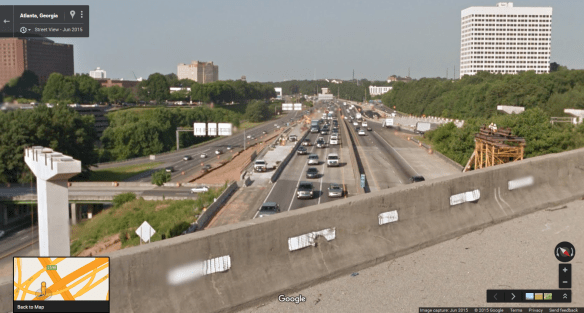
285

While the new stadium will open in April 2017, according to the latest report, the earliest the bridge would be ready is September 2017. Even that late date may be optimistic, though, as it is completely unclear from available information that any reliable sources of funding– or even a consistent cost estimate– exist. Until the bridge is complete, fans will be left to ford the above-depicted urban river by their wits alone. Maybe a bicycle would help?

_____________________________________________________________

Previously
Georgia Supreme Court Upholds Cobb’s Braves Stadium Bond Deal
Braves Break Ground on Baseball Boondoggle
The yard sale at Upton Abbey continues
From Barves to Burbs: What’s happening to baseball in Atlanta?

Another audible discussion of current baseball stories

While the ALDLAND Podcast‘s technical hiatus continues, I returned as a guest on this week’s episode of the Banished to the Pen podcast, where we discussed current baseball stories, including the latest Dave Dombrowski news, the status and outlook of frequent trading partners the Detroit Tigers and Toronto Blue Jays, and issues surrounding the possible expansion of safety netting in MLB stadiums.

You can download or stream the entire podcast here.

One thing that is not among the Three Failures That Doomed Doug Melvin

Yesterday, the Milwaukee Brewers relieved General Manager Doug Melvin of his general managing duties. Today, Dave Cameron, writing for JABO, detailed “Three Failures That Doomed” Doug Melvin. (To save you a click: poor drafting, trading Zack Greinke for peanuts, and retaining a bunch of bad players.) One thing that is not one of the Three Failures That Doomed Doug Melvin is the simple fact that he looks like Kurt Vonnegut If Kurt Vonnegut Had Been Born And Lived His Life In Wisconsin.

melvegut

(Here note for the sake of completeness that Dave Cameron also is not one of the Three Failures That Doomed Doug Melvin.)

_________________________________________________________________

Previously
Phil Jackson is Ron Burgandy?
Visualizing NFL Politics (Mike Smith is John McCain?)

Window Shopping: Step Back From the Window, or, Thank You Very Much, Mr. Rebooto

The July 31 non-waiver trade deadline was an especially active period for the Detroit Tigers franchise, which made big moves both with player and front-office personnel.

Detroit traded three of the best players on its 2015 roster in the days and minutes prior to the trade deadline. The team’s biggest move, and arguably the biggest of one of the most active trade-deadline periods ever, was their decision to trade number-one starter David Price to the Toronto Blue Jays. They also sent closer Joakim Soria to Pittsburgh, and, in the final moments before the deadline, Yoenis Cespedes to the Mets.

The basic logic behind each of these moves is that, even prior to these trades, each of these players was, for all practical purposes, not going to be a member of the Detroit Tigers in 2016. That’s because each is in the final year of his current contract, meaning that each becomes a free agent at the end of this season. The Tigers would have no special ability to keep Price, Cespedes, or Soria in Detroit after the end of the 2015 season, and, given their individual successes, each is likely to fetch contract offers on the free market too rich even for Mike Ilitch’s blood. Rather than keep Price, Cespedes, and Soria for August and September on a team that’s unlikely to even make the playoffs, only to watch them walk away in the winter, the Tigers, with an eye on the post-2015 future, decided to cash in some of the value of these assets by trading them now. In doing so, Detroit converted these three expiring assets into six prospects, including five pitchers and one infielder.

Baseball analysts widely praised these transactions as beneficial to the Tigers, who, general manager Dave Dombrowski announced were “rebooting,” selling with the goal of remaining competitive in the near term, rather than undergoing a full rebuilding. The top return for Detroit was Daniel Norris, a now-former Blue Jay who lives in a van and shaves his beard with an ax. They also received Matt Boyd from Toronto, a younger starter who, in his recent Tigers’ debut, beat Johnny Cueto and the Royals.

Of course, the only real question for Detroit was not whom to trade but whether to trade. As July 31 approached, that question divided fans and, it later would be revealed, members of the team’s front office and ownership. As for the former group, most fans recognized the Tigers’ slim playoff odds and supported selling, although a minority that included this writer held out hope that the team could make one more postseason push before initiating a rebuild. Ultimately, Dombrowski’s “rebooting” seemed to satisfy both camps: Detroit would get close-to-ready prospects in exchange for their expiring assets. No long rebuilding process– a full surrender– was in store, just a quick retooling.

Two additional notes in the context of these trades: 1) one week before the trade deadline, Toronto, the biggest buyers, and Detroit, the biggest sellers, sat four and five games out of the last American League wild card position, respectively, and 2) while it isn’t at all likely that Price, Soria, or Cespedes will return to Detroit in the offseason, the effect of an unusual clause in Cespedes’ contract is that the Tigers actually increased whatever chance they have of resigning Cespedes by trading him.

_________________________________________

As the Tigers and their fans were settling into life without Price, Soria, and Cespedes, and enjoying their first trial run with Norris, who had a strong start on Sunday in Baltimore, unbeknownst to them, even more action was afoot behind the scenes.    Continue reading