Catching Fire: Brad Ausmus is not saying, he’s just saying

ausmus tantrum

The Detroit Tigers were winning last night, but then they lost. This is not a new narrative for this team, for which unrecoverable, late-inning blown leads are a recurring symptom of an unstable bullpen that’s as much a part of this era’s Detroit baseball identity as Miguel Cabrera and Justin Verlander.

Incidentally, it was Verlander who started last night’s game, the first of a road series against the Blue Jays. He did well to hold Toronto to two runs, but he had to exit in the sixth inning, having thrown 103 pitches. At that point, the Tigers led 3-2. They extended the lead to 4-2 in the next inning, thanks to an Ian Kinsler RBI GDIP.

When Shane Greene allowed a run in the bottom of the seventh, Justin Wilson relieved him, getting two key outs and preserving what then was a 4-3 Detroit lead.

After newish Toronto reliever Jason Grilli made disappointingly light work of the meat of the Tigers lineup, Wilson came back out to pitch the bottom of the eighth. Allowing two quick hits that gave the Blue Jays men on first and third with nobody out, Wilson suddenly found himself in an extremely tight position. He did very well to strike out the always-dangerous Edwin Encarnacion for the first out of the inning, and a well-handled grounder by Cabrera allowed James McCann to employ a nice bit of pickle strategy to nab the runner on third, who had attempted to score, for the second out.

Two outs, but still, two on base. Make that three on base, after Wilson walked the next batter on five pitches. “Time for a new pitcher,” one person in our residence said. The other agreed, as did Brad Ausmus, who pulled Wilson for…Alex Wilson. That Wilson promptly allowed a two-RBI single, providing the Jays a 5-4 lead they would not surrender.

chart

Some immediately wondered why Ausmus turned to Alex Wilson in what, as illustrated above, was the highest leverage moment of the game (7.88 LI), rather than Francisco Rodriguez, who is the team’s nominal closer. K-Rod was very well-rested and has been performing very well in recent weeks. To all but the most rigid of old-school managers, this seemed like a fairly obvious move. Ausmus addressed the subject in his post-game media conference:   Continue reading

Catching Fire: Pelf on the shelf

Minnesota Twins v Chicago White Sox

With the 2016 MLB season roughly one-third complete, this series has touched on possible changes the Detroit Tigers might make at the catcher and shortstop positions and now turns to the starting pitching rotation.

To begin with the good news about the Detroit Tigers’ pitching, we almost have to begin with the bad news, which is that the presumptive lock for an above-slot number three starter, Anibal Sanchez, was so bad through his first eleven starts that he’s been demoted to the bullpen. Another potential starter, Shane Greene, has continued to be unable to prove he can hold down a starter role, and still-semi-prospect Daniel Norris has battled injury and efficiency problems that, so far, have kept him in Toledo and out of a rotation spot in Detroit. Thankfully, Jordan Zimmermann and Justin Verlander have, for the most part, been very solid in the first two spots, and rookies Michael Fulmer and, to a lesser extent, Matt Boyd, have arrived this year as big-league-ready starters.

bgkw8px

A weakness common to all Tigers starters this year has been an inability to pitch late into games, but the arrival of Fulmer in particular has allowed the team to bolster an already-improved bullpen with extra tweener (i.e., not quite starter material yet/anymore) arms like Sanchez and Greene, with Boyd, who has been a bit homer-prone of late, a possibility to join them in the near future. Brad Ausmus and Al Avila have done a good job of rotating these arms through a suddenly thick bullpen, making frequent use of Toledo options where available, to the point that many Tigers fans are experiencing a creeping and unfamiliar sensation of actual comfort with their team’s pitching staff. These are strange days indeed.

If they want to return to the familiar, however, they need not look too hard, because every fifth game or so begins with Mike Pelfrey on the mound.   Continue reading

Highlights from MLB Network’s visit to Detroit Tigers spring training

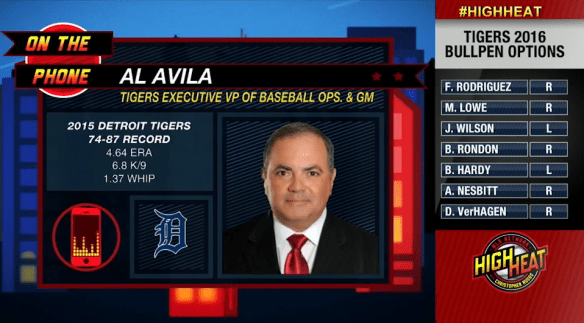
avilamaddog2

As it has done in the past, MLB Network’s “30 Clubs in 30 Days” feature spends a day with each major-league team during spring training. They spent St. Patrick’s Day with the Detroit Tigers in Lakeland, Florida. Here are the highlights:   Continue reading

Window Shopping: Pigs in the Pen

It’s July, which means it’s time for MLB teams to sort out their trade-deadline strategy. While fans distract themselves with All-Star festivities, general managers are preparing to execute player transactions in attempts to load up for a playoff run or, in acceptance of their near-term fates as noncontenders, build for the future.

In this context, the Detroit Tigers find themselves in a bit of a bind. After a very strong start, they’ve slid back to a .500 record and have been entrenched in the middle of the AL Central, never too far out of first place, but never really within striking distance. Would a first-place finish from this position be unprecedented? Hardly. Can they claim a fifth-consecutive division title without making a significant trade this summer? Almost certainly not. The Tigers’ record is not a product of underperforming their potential; instead, it likely is a reasonably accurate reflection of this team’s collective ability to date, warts, lower-body injuries, and all.

There is no question that the Tigers should be buyers this month, however thin their wallet may be with currency in the form of desirable prospects. I can’t say with any certainty whom Detroit should acquire this month– starting pitchers Johnny Cueto and Cole Hamels are the most valuable targets on the market, but the sellers’ prices may be too rich for the blood of the Tigers’ farm system– but I do agree with the prevailing preference for bolstering the pitching rotation. Shane Greene‘s floor proved too low to allow the team to continue to wait to see how high his ceiling might go, Alfredo Simon’s regressed to the very average levels we should have expected out of him as a starter, and, with appearances in just four games in 2015, Justin Verlander’s projected resurgence isn’t happening. The return of game-calling extraordinaire Alex Avila to his precarious post behind the plate can’t fix that many holes, and neither, I suspect, can J.D. Martinez‘s unsustainable home-run rate. Detroit needs to find another starter.

The trade-deadline attention on the pitching rotation represents a shift of attention away from their bullpen, the conventionally identified leading source of all of the Tigers’ problems. Continue reading

Window Shopping: Shut the Door, Tip Your Cap

As I write this, his elbow likely is spontaneously combusting, but it’s beginning to look like the Detroit Tigers finally have a reliable closer. Joakim Soria has been both busy and successful this season, appearing in twenty-two of the Tigers’ forty-eight games so far, allowing just three runs and one blown save in that span. Eight of his twenty-two appearances have been on no rest, and six more were after just one day of rest. Since Joe Nathan went down with a season-ending injury, the ninth inning has belonged to Soria, and, on a couple recent occasions, part of the eighth inning as well. Soria’s success is quite welcome, and this expanded use of his closer also reflects well on manager Brad Ausmus, who was criticized for what appeared to be inartful handling of his relievers last year.

Whatever the cause of Soria’s rediscovered success this year, along with the positive contributions of his fellow relief pitchers, the Tigers suddenly find themselves with one of the best bullpens in baseball, as measured by ERA. (They were fourth-worst in 2014.) This reversal comes not a moment too soon for Detroit, where, with Victor Martinez back on the DL, the offense has evaporated like a mid-May snow melt. Thanks in no small part to Soria, though, the team was able to win two of three in Oakland while scoring just four runs in the entire series. The closer appeared on Tuesday night and Wednesday afternoon, allowing two hits, one walk, and no runs in 2.1 innings pitched to seal both victories. Below is the final pitch of yesterday’s game, which is not unpleasing to watch.

Continue reading

Window Shopping: Tigers Roaring Out of the Gate

At one month old, the MLB season now has accrued a sufficient sample size of free time to permit me to compile the opening post of this site’s regular Detroit Tigers series for 2015, Window Shopping. Last year, I came out of the gate a bit too hot, burned out, and had to take the month of June off. This year finds your resident Tiger tracker more balanced and measured in his approach. This year’s Detroit Baseball Tigers have a more balanced look too.   Continue reading

The Criminal Mind: Measuring Radical Changes in Base-Thieving Habits

https://www.youtube.com/watch?v=4-yDZdHn6mw

My latest post at Banished to the Pen highlights those teams that made the most radical changes in their base-stealing proclivities from one season to another.

The full post is available here.

Flying Tigers: Closing the Book on 2013

https://www.youtube.com/watch?v=fdkVsnZk2MI

Rock and Roll never forgets, and neither does ALDLAND. Last season, I took a look at whether the Tigers struggled to score later in games, a trend that, if shown and in combination with the team’s bullpen woes, would make comeback wins less likely. While the preliminary numbers suggested I was onto something, the trend appeared even more pronounced with one-hundred games’ worth of data. The purpose of this post is to make good on the promise implicit in that last one by completing the full season’s worth of data.

First, an aside on data collection. I previously gathered and organized these inning-by-inning run totals by hand because I didn’t realize Baseball Reference actually tracks that information. In order to maintain the same error potential, and because B-R doesn’t separate the runs/inning between wins and losses, I’ve updated (a simplified version of) my chart as I did before.

r-in 2013

Continue reading

The Forgettable Gene Lamont

These days, Gene Lamont is known, if at all, as one of the holdover members of Jim Leyland’s merry band of ice-cream-nibbling baseball veterans, now filling the role of bench coach for rookie Tigers manager Brad Ausmus. Attentive fans might know that he, along with former first base coach Andy Van Slyke, were together with Leyland in Pittsburgh when the skipper managed the Pirates, and even that Lamont himself managed those Pirates when Leyland left Pittsburgh to manage the Marlins and Rockies. If the Tigers fan we’re describing is me, then that’s pretty much the extent of common Gene Lamont knowledge.

As I wrote last month, if baseball fans think of one thing when they think of 1994, they think of the Montreal Expos. Everyone agrees they had the best team in baseball during that shortened season and would’ve won the franchise’s only World Series had it not been cancelled due to a labor dispute, potentially changing the course of baseball history in the process. Everyone, that is, except for Gene Lamont.

On Sunday, FanGraphs posted an interview with Lamont, who was the manager of the Chicago White Sox from 1992-95. Excerpts from that post follow:    Continue reading

Flying Tigers: Waiting for Takeoff

A month into the season, the Detroit Tigers sit atop the tightly bunched AL Central with a tenuous 12-9 record. The team, guided by first-time manager Brad Ausmus, looks and feels much different than it did over the last two years. Whether due to the change at the helm or a not-quite-coherent set of offseason moves, the 2014 Tigers appear to have traded identity for tactics and strategy. Thus begins Flying Tigers,* our third Detroit baseball series.

__________________________________________________________

When Jim Leyland announced his retirement following the end of the 2013 season, we knew Motor City baseball would be different in 2014, but we didn’t realize just how different it would be.     Continue reading