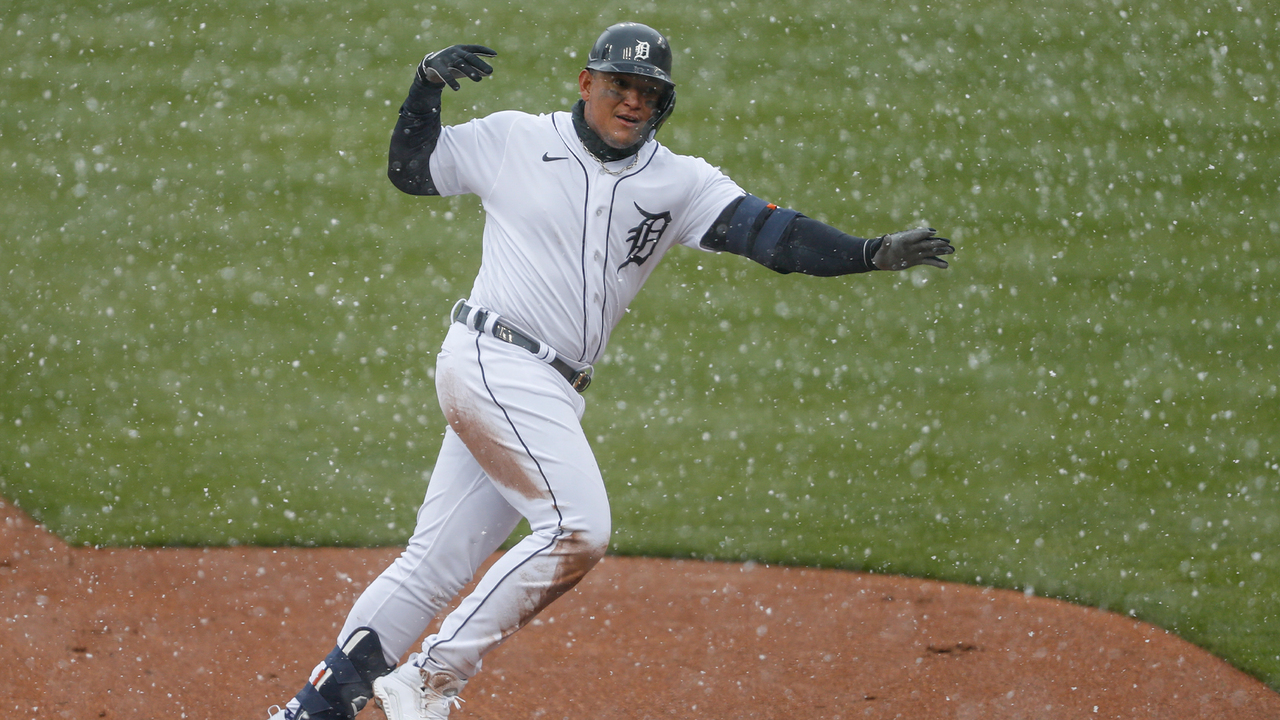
On baseball robots, probabilities, and getting fooled again

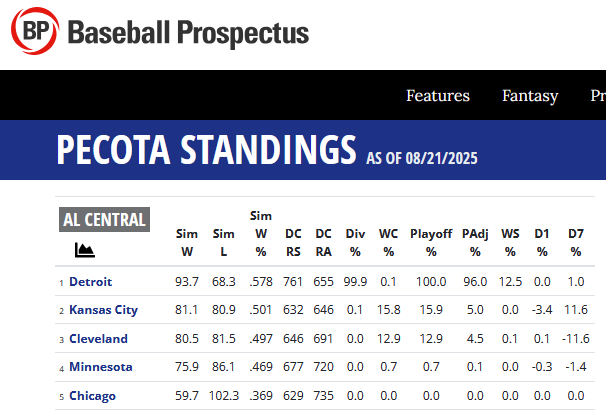
What is this nonsense? Last week, Baseball Prospectus’ PECOTA declared it a one-hundred-percent certainty that the Detroit Tigers would appear in the 2025 MLB playoffs. Today, though, the ostensible gold standard in baseball-projection machines has engaged in a very unfortunate bit of retrenchment:
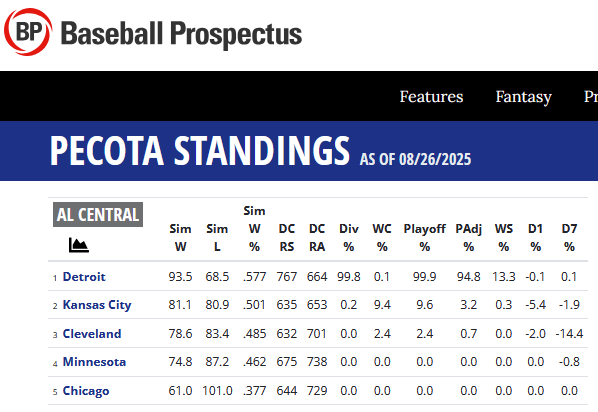
To be sure, I would not blame anybody for downgrading Detroit after Tarik Skubal surrendered a grand slam during a five-run seventh inning that ignominiously crowned a Tigers loss last night to a vagrant team playing in a minor-league park. Far from the August heater the team generated to fuel their run to the 2024 postseason, however, these Tigers have struggled in the second half with the likes of the Twins, Pirates, and A’s in a manner belying a true talent level perhaps somewhere below their overall winning percentage. And Javy Baez doing that bad thing again feels like a microcosm of team-wide regression trends in action:

But BP’s PECOTA conceded none of that reasonable skepticism. It said this final outcome was a guaranteed certainty; no hedge, error margin, or other reservation of any kind. Presumably, it knew that Skubal could have a bad night, Baez could turn back into a pumpkin, and Jack Flaherty could continue to melt down, but it said it was not concerned. Having crossed that triple-digit threshold of certitude, it probably did not love what it saw in Sacramento last night, but one envisioned PECOTA taking that on the chin with an unwavering forward stare into a known and unavoidable future.

In short, once you go to 100%, you simply cannot go back. Again a concession from me: I will grant force majeure: If the season suddenly and prematurely ended due to a public-health catastrophe, war, or series of natural or Manfred-made disasters, then PECOTA probably gets a pass. Short of that, though? If 100% means Fool me once, shame on you. But fool me twice, baseball robot? My promise to the ALDLAND readers is that I will not be fooled again.

___________________________________________________________________

Previously
Death, Taxes, and the Detroit Tigers in the 2025 MLB playoffs?
More Likely Than Not: The 2025 Detroit Tigers are winning, and winning matters
Maximum Tork: How Spencer Torkelson is cranking up his hot start in 2025

Before you accuse me, take a look at Jake Rogers
Is it Tiger Time? Tarik Skubal says so

Death, Taxes, and the Detroit Tigers in the 2025 MLB Playoffs?

You serious, Clark? Yes. As basically first reported by ALDLAND.com months ago, the Detroit Tigers have clinched a spot in the 2025 MLB playoffs. Look for yourself:

If that isn’t surprising to you, I am projecting with 100% certainty that’s so because you are an ALDLAND reader. Before the current season even started, we told you that Baseball Prospectus told you that Detroit had close to no shot– 19.9%!– at returning to the playoffs. At the same time, we also told you why that was very wrong. For their part, the Tigers immediately began proving us very right and Baseball Prospectus very wrong. And now, at last, Baseball Prospectus has thrown in the towel: Rob Manfred himself cannot stop this team.

Arrange your affairs accordingly. We’ll see you in October.

___________________________________________________________________

Previously
More Likely Than Not: The 2025 Detroit Tigers are winning, and winning matters
Maximum Tork: How Spencer Torkelson is cranking up his hot start in 2025

Before you accuse me, take a look at Jake Rogers
Is it Tiger Time? Tarik Skubal says so

More Likely Than Not: The 2025 Detroit Tigers are winning, and winning matters

Before the start of the 2025 MLB season, I noted the relatively dim projections of the Detroit Tigers’ chances to earn a postseason berth for the second consecutive season. And while I also noted a reason to be skeptical of those dour forecasts, I cannot say I thought things would turn so rosy so quickly.

Entering Opening Day, Baseball Prospectus’ PECOTA announced the Tigers’ playoff odds at below twenty-percent. FanGraphs’ ZiPS, while less hateful, still came in worse than a coin flip at under forty-four-percent. Then Detroit started playing the games. And then they started winning the games. In fact, they won nineteen games before May 1 for the first time in their 124-year history, and, the next day, they became the first AL team to reach twenty wins on the season.

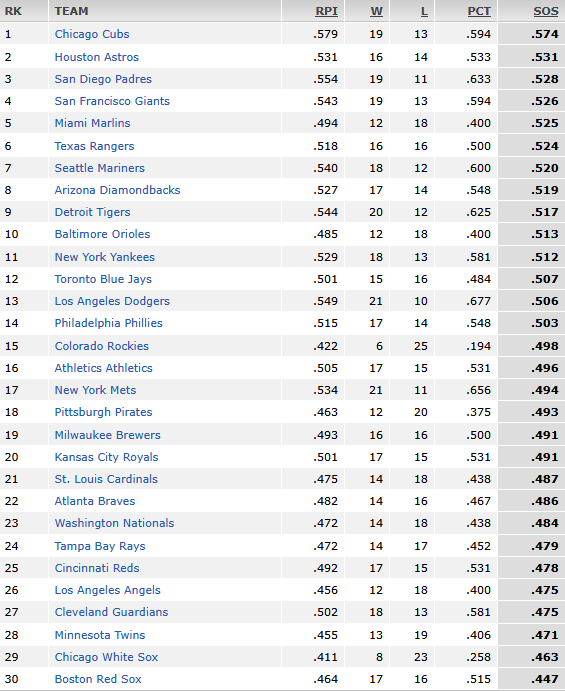
Some bitter Cleveland fans pointed out that Detroit has notched all of those wins while playing a lot of teams with sub-.500 records. That may be true. I don’t know. I do know that, according to ESPN, the Tigers overall have faced the tenth-toughest opponent schedule to date, while the rest of the AL Central has been coasting on cupcakes:

Regardless, postseason eligibility depends on standings, and standings depend only on wins, and wins are wins, and the Tigers now have twenty wins in a month’s worth of games that even PECOTA and ZiPS can’t ignore. As a result, those playoff odds have skyrocketed. BP is up from 19.9% to 61.1%, and FanGraphs is up from 43.6% to 81.1%!

There inevitably will be fluctuations, but banked wins cannot be unwon, and if relative breakouts from the on-the-ropes gang of Javy Baez, Spencer Torkelson, and Casey Mize can last, so too can this team. At least for right now, this is the fun baseball place.

___________________________________________________________________

Previously
Maximum Tork: How Spencer Torkelson is cranking up his hot start in 2025
Before you accuse me, take a look at Jake Rogers
Is it Tiger Time? Tarik Skubal says so

Before you accuse me, take a look at Jake Rogers

As highlighted in our 2025 Opening Day post, PECOTA, the projection engine at Baseball Prospectus, sees the Detroit Tigers with a less than one-in-five chance of returning to the playoffs in 2025, the longest odds it projected for any team that also appeared in the 2024 postseason. That feels like a personal attack.

But how much weight should Tigers fans accord this relatively dim outlook? In a field of competing inexact-science offerings, PECOTA has earned a reputation as one of the least-inexact baseball projectors. It still makes mistakes, though. Would it be relevant to those Tigers’ fans’ answers to the immediately preceding question that PECOTA recently produced another extreme, negative projection about the team that turned out to be very wrong? If your answer to the now-immediately preceding question is “yes,” then read on.

Our preview of the Detroit Tigers’ 2024 season also included some PECOTA nuggets, one of which involved catcher Jake Rogers’ projected defensive contributions:

PECOTA sees Detroit’s likely starting backstop completely forgetting how to catch in 2024:

Rogers was a top-ten defensive catcher in 2023. (The BP website has different defensive numbers for Rogers and other catchers than those appearing in the book. I’ve inquired and it sounds like their stats team made some post-publication tweaks to their average benchmarks that may account for the variance.) Most of this projected thirteen-point drop comes in the form of a projected swing from being a top-ten framer to a bottom-thirty guy at that skill. Ironically, Rogers’ BP annual blurb mentions his “unseat[ing of] Eric Haase for the starting catching job” even as PECOTA projects him to frame as poorly as Haase did in 2023. (To fully square this circle, Haase’s 2024 framing projection is -3.2 runs.)

This is not the first time PECOTA has thought lowly of Rogers’ defense. In the 2023 BP annual, for example, it forecast him for -7 DRP, with a -6.5 on the framing component, both huge misses. Undaunted, the computer has doubled down for 2024.

Everyone in baseball will tell you that defensive metrics are especially difficult to define and measure and therefore probably should be regarded a little more cautiously than other performance metrics. That’s sensible and unobjectionable. What creates undue difficulty, in my opinion, is what seem like wild year-to-year oscillations in players’ defensive numbers. Of course players aren’t going to be exactly the same person every season, and many factors– injury, age, chance, drugs, etc.– can cause production value to vary outside a “normal” career development curve. Breakouts can happen quickly. Careers can end quickly. When we’re told a player’s defensive performance has yo-yoed erratically from season to season without ready explanation, though, it makes it very difficult to ascribe any meaning to defensive metrics, even on their own terms and within their own contexts. Maybe Rogers really is a definitively unremarkable catcher who just had his Brady Anderson framing season. Probably not, though.

Indeed not. Not only did 2024 Rogers retain his defensive prowess exhibited in 2023, he substantially improved upon it. And looking just at pitch-framing, the particular skill driving the projected drop in his overall defensive value, Rogers actually proved to be a top-three framer in all of baseball last year.

If that big whiff is enough of a reason for you to throw out the 2025 PECOTA projections in their entirety, I won’t stop you. So far as the actual team is concerned, though, there’s not going to be anything good left to project if they don’t start winning. The Tigers, still hunting their first win, are back in action tonight in Seattle after a Sunday of rest following a tough Dodgers’ sweep.

___________________________________________________________________

Previously
Is it Tiger Time? Tarik Skubal says so

Is it Tiger Time? Tarik Skubal says so

On the eve of his Opening Day start, the second of his career and just the fourth time a reigning Cy Young winner will make his season debut against the defending World Series champions, Tarik Skubal published an open letter in which he declared the beginning of “a new era of Tigers baseball.” After last year’s surprise sprint to the playoffs and win over the Houston Astros, this is exciting stuff. Skubal’s declaration addresses the current moment and looks forward, his letter also predicting this team’s “eventual greatness.”

What does the future hold for the Detroit Tigers? Skubal has more influence on that than most, so his pronouncement carries great weight. Other observers are a bit more cautious than him, though. FanGraphs (ZiPS) projects an 81-81 record and a 43.6% chance of making the playoffs. Baseball Prospectus (PECOTA) is much less optimistic, chiming in at 78.5-83.5, with just a 19.9% chance of making the playoffs.

There’s quite a bit of variance between those two systems’ projections, particularly with respect to the likelihood Detroit makes it back to the postseason again this year. Considering the path the Tigers took to get there last year, catching fire in mid-August and never looking back, it’s reasonable to wonder whether that was a fluke. With due respect to Alex Cobb, Gleyber Torres, Tommy Kahnle, Jack Flaherty (welcome back!), Bailey Horn (welcome back, sort of!), Andrew Chafin (welcome back again again!), Jose Urquidy, and Manuel Margot, you can be excused for thinking the Tigers underwhelmed in the building-on-success department. There’s also a ripe case of subtraction by addition in the outfield, which is where you’ll see Javier Baez, just coincidentally absent for Detroit’s amazing August-October run last year, returning and making his debut as a real live outfielder. (In case you were wondering, yes, Baez remains under contract through 2027.)

Last year’s team went 86-76. They were 78-84 in 2023. The combination of late overachievement; middling offseason moves plus absence of history of strong in-season moves from current ownership and management; Meadows-family injuries; emerging whispers of Riley Greene fragility; and the return of Baez have me projecting an 80-82 record.

No affiliate links here, but multiple sports books currently have Detroit’s win-total line at 83.5.

The Tigers’ season opens tonight on the road against the Los Angeles Dodgers on ESPN. After three games in LA, they head north for three games in Seattle before opening at home against the Chicago White Sox on the afternoon of Friday, April 4. If nothing else, keep an eye on Skubal: he’s increased his production value each season. Repeating that feat this season would mark a very special performance.

Everyone’s Going to be Worse: 2024 Detroit Tigers Season Preview Notes

Many have published their previews of the 2024 Detroit Tigers season. What follows are my notes from those previews, primarily the corresponding Baseball Prospectus annual chapter and its PECOTA projections, along with my own annotations and recent news updates.

Everyone’s Going to be Worse

Only the really hopeless Athletics and White Sox scored fewer runs than the Tigers in 2023. The reason the Tigers’ offensive outlook today isn’t hopeless (as any good Detroit fan will tell you too many times) is because Spencer Torkelson had a really good second half last season, and that’s going to be his new baseline for his major-league career, which really will begin this year. His 121 wRC+ and a homer every 16.2 plate appearances– his second half– sounds a lot more like a good first baseman than a 95 wRC+ and a homer every 31.3 plate appearances– his first half. Torkelson is the case study that proves Tigers fans’ optimism for 2024 is grounded in reality: all good trends will be banked as established new normals, while any bad trends have reasonable explanations and therefore safely may and should be ignored.

The cold baseball computer isn’t buying the Midwestern thaw. PECOTA projects every Tigers hitter listed in the team’s BP annual chapter to be worse in 2024 than he was in 2023. Can that sentence really be true? I don’t know whether it can but it is. Sure, some of these guys are Not Ready For Primetime Players, minors types whose prospect statuses merit their mention but, at least for this year, understandably don’t project as majors talent. But it really is bad news for all of the alleged major-league talent.

Continue reading

One Man’s Treasure: Checking in on the top MLB prospects of 2019

Cleaning out a bookshelf I discovered a pristine copy of the Baseball Prospectus Futures Guide from 2019, a book the primary function of which is to present BP’s top 101 MLB prospects headed into the 2019 season. By the time I started reading the book (last month), the guys on that list had had five seasons in which to make good, bad, or otherwise on their cited major-league potential. How well did they– and the BP prospect team– actually perform? I now can tell you with some ease and endeavor to do so here. What follows is my present-day annotation of that 2019 list, featuring total WARP from 2019 to present and quotations from BP’s own commentary then and now (i.e., prior to the 2023 season, since the public continues to await the arrival of the 2024 BP Annual).

Quick hits:

  • Biggest miss? Probably Jo Adell (#2, -0.9 WARP) or Forrest Whitley (#7, yet to debut).
  • Biggest diss? Maybe Sean Murphy (#95, 11.9 WARP, by far the lowest-ranked prospect to earn an all-star nod) or Sandy Alcantara (#73, 15.5 WARP, with a Cy Young award and two all-star appearances).
  • Of the 101 prospects listed, five (Whitley, Seuly Matias (#52), Victor Victor Mesa (#71, just ahead of Alcantara), Kristian Robinson (#100), and Kyler Murray (#101, yes that Kyler Murray) have not appeared in the majors, and eleven others have been worse than replacement level. On the other side, eleven have accumulated double-digit WARP.
  • Distribution of double-digit WARPers (and sub-2 WARP or N/A) [and free agents/not debuted]:
    • 1-10: 2 (4) [1]
    • 11-20: 3 (3) [1]
    • 21-30: 1 (5) [2]
    • 31-40: 1 (3) [0]
    • 41-50: 1 (5) [2]
    • 51-60: 1 (4) [2]
    • 61-70: 0 (7) [1]
    • 71-80: 1 (6) [2]
    • 81-90: 0 (7) [3]
    • 91-101: 1 (10) [3]

Does this suggest you’re as likely to land on a star as a black hole no matter where you place on this list? The graph at the end of this post generally illustrates that there’s more value in the top half, though still a good mix of mediocrity and land mines. And the second half isn’t exactly dumpster diving, even if name recognition does fall off precipitously.

What should someone holding BP’s 2024 prospect list learn from this exercise? Your time may be better spent elsewhere. If you insist on reading it, maybe stop once you hit the sixties, and don’t parse the individual player comments. For better or worse, even the professionals can’t really predict baseball.

Continue reading

Miguel Cabrera stays positive in 2021, and the Detroit Tigers outperform expectations

Before the 2021 season began, we, along with everyone else, predicted that it would be a historic season for Miguel Cabrera. The team’s veteran anchor had within range two of baseball’s all-time career benchmarks: 500 home runs and 3,000 hits. On August 22, Cabrera knocked his 500th career homer over the right-center fence in Toronto, becoming just the twenty-eighth player in MLB history to accomplish that feat. And, even in the face of declining batting average and power production, Cabrera came within a baker’s dozen of 3,000 hits. He finished the year with a career total of 2,987, teeing up another exciting celebration for early in the 2022 season.

Also significant: according to WARP, Cabrera was a positive-value contributor to the Tigers in 2021. While not remotely glamorous, his 0.7 WARP represented his best seasonal performance by that metric since 2016. It also marks his nineteenth-consecutive year as a positive WARP contributor, keeping alive the possibility he finishes his career among the elite, selective group of players who played at least twenty-one seasons without tallying a negative in the wins-above-replacement column. Among active players, only Yadier Molina (eighteen seasons of positive WARP); Robinson Cano (sixteen seasons of non-negative WARP); and Joey Votto (fifteen seasons of non-negative WARP) even are candidates to join this group in the next six years, and the best bet probably is that none of them will make it. As much as anything, Cabrera’s contract, under which he’s signed through his twenty-first season (with extremely unlikely to vest options for more beyond that), makes this achievement a possibility.

As for the rest of the team, there were some other things to like in 2021 too. Other outlets have covered player and prospect development more comprehensively, so I’ll just add a note that the team as a whole outperformed the major projection systems’ preseason expectations (PECOTA: sixty-six wins; FanGraphs: seventy-one wins) by notching a lofty seventy-seven wins. There were some nice winning stretches this season, including a hot start to the second half, which afforded them, with five games to go, mathematical possibilities of finishing with a .500 record and second place in the division (alas, neither of those things occurred).

Finally, on the subject of projections and expectations, had 2021 played out the way PECOTA saw it before the season started, we would have seen some special oddities:

Cabrera didn’t hit a triple, and Buck Farmer did not earn his first career save, the latter a big miss for our readers, especially since the Tigers released Farmer in mid-August after just 35.1 innings pitched. Jeimer Candelario was not caught stealing all year, though, and Matthew Boyd at last notched a sub-4.00 ERA season. Not bad!

As nice as those small accomplishments appear, their respective contexts provide additional color. For Candelario, it was a nothing-ventured-nothing-lost situation. While he wasn’t caught stealing for the first time since 2017, nor did he successfully steal a base, something that also last occurred in 2017. Candelario, it appears, was not part of A.J. Hinch’s base-stealing revolution in Detroit. For Boyd, his 3.89 ERA made for a career-best mark, but it wasn’t a career-best season for him, as the Opening Day starter appeared in just fifteen games and pitched fewer than eighty innings, missing all of July and nearly all of August and September due to soreness in his throwing elbow. Boyd, who may be headed to free agency, likely would’ve traded a slightly worse ERA for a full season of healthy starts in 2021. A difficult reminder that PECOTA may be able to tell us the what (at least fifty percent of the time, anyway), but not the how or why.

Now it’s onto the postseason (the AL wild card round begins tonight) and, hopefully, an exciting and active offseason for the Tigers, who appear ripe to move aggressively back into contention for the division in 2022.

The ongoing saga of Charlie Blackmon’s 1979 Pontiac Trans Am gets COVID

Thanks in significant part to the historic woes of the Arizona Diamondbacks, owners of an active road losing streak twenty-three games in length, the Colorado Rockies have risen out of last place in the National League West, though their 30-43 record wouldn’t place them in any better position in any other MLB division. Star outfielder Charlie Blackmon has significantly improved his personal situation, however. What in early May looked like the worst season of his career (e.g., 58 OPS+/56 wRC+) now shapes up as merely league average. Maybe DRC+ (then the outlier at 108, now roughly steady at 112) knows something after all, and the fact that Blackmon maintained an on-base streak almost as long as Arizona’s losing streak certainly helped.

The Rockies don’t face the Atlanta Braves until September, by which time Blackmon likely hopes his Georgia-based legal troubles will have been resolved. ALDLAND remains–weirdly– your exclusive source for coverage of the legal saga of Blackmon’s 1979 Pontiac Trans Am. After Blackmon sued a Georgia man and his company in January, alleging that they refused to either complete work on or return his vintage vehicle, it looked like the case was steering toward a fast resolution when the defendants fumbled their opportunities to respond to the lawsuit. As predicted in these very digital pages, Blackmon then asked the Superior Court of Cherokee County, Georgia, to grant him a default judgment against both the individual defendant, Michael Ramsey, and the corporate defendant, Ramsey Performance. My assessment of the case at that point:

Judge [David] Cannon certainly has plenty of latitude to grant a default judgment in Blackmon’s favor here. The easiest part to resolve should be a ruling on the question of a default judgment against Ramsey’s company, which, in Georgia, must be represented by a lawyer. Apparently open questions about the precise nature of the remedy or remedies Blackmon seeks (e.g., Does he just want his car back? Does he want money from Ramsey, and, if so, exactly how much?) may complicate the situation for Blackmon, however, and complications and uncertainties usually are not helpful to a party seeking entry of a default judgment.

Now, in his first edict in this case on the subject of the defendants’ default, Judge Cannon indeed seized upon that easiest portion of the issue before him, but not quite in the manner Blackmon probably wished. Acknowledging that Georgia law requires Ramsey Performance to be represented by an attorney in litigation in that state, the court’s notice nevertheless states that, in consideration of general guidance from the Supreme Court of Georgia favoring generosity in granting extensions of time during pandemic conditions, it will permit Ramsey Performance nearly another month to find a lawyer.

While this is a significant reprieve for Ramsey Performance, the relief may be short-lived. The mere participation of an attorney on the company’s behalf alone will not cure the company’s problems in this case, and that attorney still will be in the difficult position of having to convince Judge Cannon that he should excuse Ramsey Performance’s failures to respond to Blackmon’s complaint and motion for default judgment. To the extent settlement remains on the table, this may push Ramsey, who has repeatedly expressed his displeasure with the notion of having to pay for a lawyer, closer to a deal.

So pump the brakes for now, attentive public, and navigate your browser back here in a few weeks for our continuing exclusive coverage of arguably the summer’s biggest sports law story.

_________________________________________________________

Previously
A predictable turn in the ongoing saga of Charlie Blackmon’s 1979 Pontiac Trans Am
A reminder that it’s spring training for automotive shop workers too: The ongoing saga of Charlie Blackmon’s 1979 Pontiac Trans Am
The ongoing saga of Charlie Blackmon’s 1979 Pontiac Trans Am

No Spin Mizer: If the glove doesn’t stick, we must acquit; or, Spin Doctors: Tracking possible reactions to MLB’s announced crackdown on pitchers using foreign substances

On June 2, 2021, MLB’s rumored crackdown on pitcher use of foreign substances took a significant step toward reality. That morning, USA Today published a story describing the enforcement of the policy as “imminent.” The same day, four minor-league pitchers who had been ejected from games during the preceding weekend for using foreign substances received ten-game suspensions.

MLB pitchers, it seemed, took note. To many, Gerrit Cole, now the top starter in the New York Yankees rotation, has become the face of elite spin rates, and he was continuing to earn that reputation in 2021. In his first start after June 2, however, his spin rate plunged.

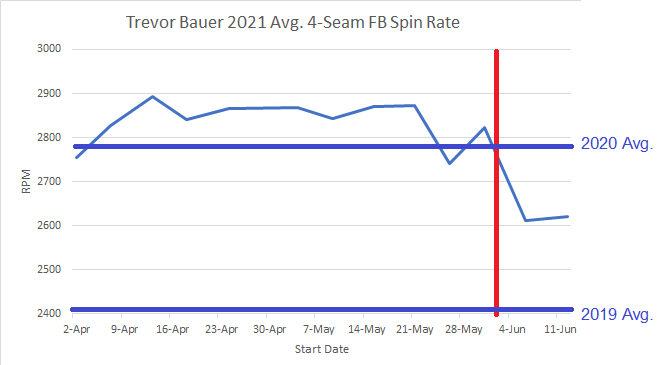
Trevor Bauer, the defending NL Cy Young winner now pitching for the Los Angeles Dodgers, forced his way into the group of spin-rate leaders last season following years of public comments criticizing pitchers who used foreign substances to increase their spin rates. Like Cole, Bauer saw his spin rate plummet after June 2.

Another leader in this category in recent seasons is Yu Darvish, now a starter for the San Diego Padres. Unlike Cole and Bauer, Darvish appeared unfazed by the June 2 announcement, at least judging by the relative consistency in his spin rates this season.

Since the June 2 announcement and enforcement of minor-league suspensions, MLB yesterday announced that it would apply the ten-game-suspension policy to major leaguers as well, with a progressive-discipline scheme for repeat offenders.

While a variety of factors can affect measured spin rates, it’s difficult to interpret the spin-rate dips from Cole and Bauer in their post-June-2 starts as anything other than an acknowledgement of the use of substances that go beyond providing the sort of control-improving grip that even batters appreciate from a safety standpoint and facilitate extreme spin rates (Spider Tack has become the brand name associated with that latter variety of substance). Cole and Bauer don’t come to this point by the same route, however. Bauer’s well-documented history of criticizing Cole and his former teammates in Houston for what Bauer strongly implied– and later seemed to demonstrate in a live-action experiment– were artificially high spin rates arguably places him in a different category than others in this conversation. On the other hand, perhaps he’s just more media-savvy. Should it make a difference if Bauer publicly changed his game to capitalize on and make a point of highlighting MLB’s underenforcement of foreign-substance rules, while Cole did, well, whatever this is?

Nor can we draw any firm conclusions from Darvish’s spin-rate graph. Not only did Darvish’s RPMs not drop after June 2, but they continued to climb. Was he undaunted by the “imminent” threat of enforcement, and, if so, why?

All of this brings us to Casey Mize’s start last night, immediately following MLB’s declaration that it would begin enforcement of its zero-tolerance policy against major-league pitchers. In his short professional career, Mize has not been a high spin guy, nor has he been publicly associated with what he calls the “sticky.” Which is why he was so upset when an umpire forced him to change gloves during the game:

Mize was walking off the mound following the first inning of his start on Tuesday in Kansas City against the Royals, when John Tumpane stopped him for what looked like a friendly conversation.

According to Mize, Tumpane said Mize’s glove was too light-colored.

Mize said the glove, which he’s worn for every one of his big-league starts, was originally charcoal-colored, but may have faded a bit in the sun.

“He said the gray color was too light,” Mize said.

Color judgement aside, Mize was most angry because Tumpane’s order came on the same day that Major League Baseball announced a widespread crackdown on the use of sticky substances that some pitchers have used to help them grip the baseball and increase the spin rate on their pitches.

“I assume everyone thinks that I was using sticky stuff now, which I was not,” Mize said. “So I just thought the timing of it was pretty (expletive), honestly. The umpires need to get on the same page, because I’ve made 12 starts (in 2021) and everybody was fine with (the glove). Or John Tumpane just needs to have some feel and just let me pitch with the glove that the other team did not complain about. (Tumpane) brought it up himself. John’s a good umpire and a very nice guy. But I mean, just have some feel for the situation because I hate that I’m in a position now where I assume everyone thinks I was using sticky when in reality, that was not the situation at all.”

First, for visual illustration, some relevant images of Mize’s mitt:

Without more information, this seems like a questionable decision by the umpire, and, whatever his motivation, the decision did drag Mize into the broader conversation about foreign substances. So what do the spin measurements say about Mize’s pitches? Most obviously, he operates in a much lower band of RPMs than the likes of Cole, Bauer, and Darvish. That alone may be more than enough for many to exonerate him. And while Mize’s average spin rates did decline between his May 28 start and his June 3 start, the magnitude of the change was negligible relative to those Cole and Bauer exhibited. If his data suggest anything, it’s that Mize is telling the truth.

However irked Mize was after being forced into a mid-game glove change, it did not appear to alter his performance. He completed 6.2 innings, threw a season-high 103 pitches, and allowed three runs on the way to a 4-3 Tigers win in Kansas City.

To this point in the season, Mize has been the best of Detroit’s young pitchers, and he trails only Spencer Turnbull in WARP. He’s following up an interesting if inconsistent debut in 2020 with across-the-board improvements in major statistical categories. While veterans attempting to be crafty and the commissioner’s office duke it out over Spider Tack, here’s hoping Mize can avoid that fray and continue to find his footing as a leading member of Detroit’s rotation.