This Jam is Over Jam

Americans awoke this morning to news that the United Kingdom’s membership in the European Union is over, which makes today not unlike Wednesday, when Americans awoke to news that Iggy and The Stooges were “over.” Guitarist James Williamson explained: “Basically, everybody’s dead except for Iggy and I, so it would be sort of ludicrous to try to tour as Iggy And The Stooges.” There’s some logic there, which rarely is the case when it comes to Iggy Pop, who continues to tour the world with his solo band: the Asheton brothers and Dave Alexander, the founding members of The Stooges, indeed have been dead for at least a few years. In fact, many casual fans may have been surprised to learn that The Stooges still were a thing in 2016.

Steve Miller (not that one) has an oral history of the Detroit rock scene beginning in the 1960s, when Iggy and The Stooges were coming up along with other Ann Arbor/Flint/Detroit acts such as Ted Nugent, Bob Seger, Mitch Ryder, the MC5, and many, many others who never made it out, chronicled, in the early 70s, by noted critic Lester Bangs and Creem magazine. Miller’s book paints a fairly dark, violent, angry, and desperate picture of the music scene in Southeast Michigan, including the blend of hard rock and punk that developed there. Iggy’s picture adorns the cover of that book.

Interestingly, Pop also developed a working partnership with David Bowie, who undoubtedly was drawn to and encouraged elements of Pop’s stage performances. Decades later, a new generation would discover the music of both when an Iggy and The Stooges song, “Search and Destroy,” appeared on the Bowie-heavy soundtrack to the Wes Anderson movie The Life Aquatic. Among his most popular songs, “Lust for Life,” a solo effort, is the most upbeat, but for this space, “Search and Destroy,” from The Stooges’ 1973 Raw Power album, is the selection:

Catching Fire: Night of a thousand feet of home runs

If not winning, the Detroit Tigers certainly have been doing a lot of home-run hitting over the last week or so, and, after some extra-inning disappointments during that stretch, they finally put it all together last night for an overtime win last night in a home series opener against the Seattle Mariners. That game featured three Tigers homers, each of which gave the team the lead. Especially exciting for Detroit was that two of them came off the bat of Justin Upton, who finally appears to be heating up for his new team after suffering one of the worst offensive stretches of his career.

jupwrc20gmavg

Upton’s first of the night was a dead-center bomb in the seventh that gave the Tigers a 7-6 lead, and his second, which clinched the game in walk-off fashion in the twelfth, landed beyond the bullpen in left. There likely is no one happier about this apparent return to power than Upton himself, and, especially with J.D. Martinez out with an elbow injury, it couldn’t be more timely for the team.

Upton’s homers last night inspired celebration, but Miguel Cabrera’s, which gave the Tigers a 2-0 lead in the first inning, inspired awe. I’ve never seen a Comerica Park home run hit where Cabrera hit his last night. No one has.

Have a look:   Continue reading

Catching Fire: Pelf on the shelf

Minnesota Twins v Chicago White Sox

With the 2016 MLB season roughly one-third complete, this series has touched on possible changes the Detroit Tigers might make at the catcher and shortstop positions and now turns to the starting pitching rotation.

To begin with the good news about the Detroit Tigers’ pitching, we almost have to begin with the bad news, which is that the presumptive lock for an above-slot number three starter, Anibal Sanchez, was so bad through his first eleven starts that he’s been demoted to the bullpen. Another potential starter, Shane Greene, has continued to be unable to prove he can hold down a starter role, and still-semi-prospect Daniel Norris has battled injury and efficiency problems that, so far, have kept him in Toledo and out of a rotation spot in Detroit. Thankfully, Jordan Zimmermann and Justin Verlander have, for the most part, been very solid in the first two spots, and rookies Michael Fulmer and, to a lesser extent, Matt Boyd, have arrived this year as big-league-ready starters.

bgkw8px

A weakness common to all Tigers starters this year has been an inability to pitch late into games, but the arrival of Fulmer in particular has allowed the team to bolster an already-improved bullpen with extra tweener (i.e., not quite starter material yet/anymore) arms like Sanchez and Greene, with Boyd, who has been a bit homer-prone of late, a possibility to join them in the near future. Brad Ausmus and Al Avila have done a good job of rotating these arms through a suddenly thick bullpen, making frequent use of Toledo options where available, to the point that many Tigers fans are experiencing a creeping and unfamiliar sensation of actual comfort with their team’s pitching staff. These are strange days indeed.

If they want to return to the familiar, however, they need not look too hard, because every fifth game or so begins with Mike Pelfrey on the mound.   Continue reading

Catching Fire: When is it okay to stop short?

iglesias_nosepick

A quick glance at the Detroit Tigers’ seemingly unremarkable current record– 33-31, good enough for third place in a tight AL Central pack– likely would fail to reveal the fairly high degree of volatility that has defined the first two months of the team’s 2016 campaign, including long losing streaks punctuated by spurts of blowout wins and more changes in the pitching staff than, seemingly, in the last three years combined.

All of this– the pitching changes serving as a positive reminder of the relationship between rotational and bullpen depth–  largely has distracted from the things that haven’t changed since the season began. One is the catcher position, which I’ve contended since season-preview time is ripe for an in-season upgrade if this team is going to continue to pursue a championship. Recent numbers only serve to confirm this:

2016-team-extra-strikes

2016teamextrastrikes

What this graph and this chart from this recent article illustrate is that Detroit has operated under a severe strike-zone disadvantage thus far in 2016. As the breakdown chart shows, the blame for that disadvantage falls at the feet of their (catching) defense. We knew James McCann and Jarrod Saltalamacchia were bad pitch framers. Now we can begin to see the relative consequences of that weakness.

Another thing we can and may want to do at this juncture is ask whether it’s time for a change at the shortstop position. When the Tigers traded for Jose Iglesias as a replacement for the then-suspended Jhonny Peralta in 2013, we figured they were acquiring a defense-first short stop with a probably unsustainably high batting average.

Almost three years later, that basic assessment remains essentially correct. Iglesias wowed early and often with highlight-reel plays in the field and keeping his average up at the plate, hitting .300 again in 2015 after missing all of 2014 with ankle injuries. He was an All Star last year, whatever that means anymore, but 2016 is shaping up a bit differently.   Continue reading

Where the Soul of Nashville Never Dies (via The Bitter Southerner)

rymanAs Nashville undergoes a whiplash of change under a web of steel cranes, the Ryman stands sturdy among the neon and glass. Hallowed halls like “the mother church of country music” can’t merely be built like a skyscraper or condo complex after all. They must become — painted with layers of experience and mystery over time. Try to uncover the meaning in their spirit by peeling back the paint, and you’ll only find another color, deeper and richer, worn in.
The Ryman is a physical emblem of the spiritual — a reminder that takes us beyond ourselves. And as former Nashville Mayor Bill Purcell put it, the Ryman reminds us, looking forward, of who we still want to be. Through two renovations — one in 1994 and another last year — the building helps tell the story of this place from the performers who graced the stage to the men and women who built and ran the place. But it also offers a comeback story of Nashville, saving a piece of its soul. Because in the 1990s, after a century of becoming, the old lady Ryman had nearly come to her end. … Read More

(via The Bitter Southerner)

Muhammad Ali: Champion of the World (via The Ringer)

z9eyq7uMaybe there was a conventional explanation provided by a heightened mutual empathy and his ability to instantly connect with others, a super skill not found in one man out of a billion. But no one who met him nor even came close to him in a crowd would deny that Ali seemed to glow, or transmit, or vibrate in some nonverbal way. You could see him with your eyes closed. You could hear him when he wasn’t speaking. … Read More

(via The Ringer)

The only rule is you have to listen

onlyrule

You don’t have to if you don’t want to, of course, but if you would like to hear me on the latest episode of the Banished to the Pen Podcast, listening is required. Baseball discussion topics include my recent research on switch hitters and the defensive shift, as well as the new book from Ben Lindbergh and Sam Miller, The Only Rule Is It Has To Work.

The podcast episode is available for downloading or streaming here.

Catching Fire: Heading for the exit velocity

vacation-walley-matte-today-150527_25aa56597af71bd8b926763d3272e7cd-today-inline-large

Thanks to MLB Advanced Media’s new Statcast technology, fans can learn more than ever about the activity taking place on the field (and off it) during a baseball game. One such aspect into which Statcast offers insight is exit velocity, which refers to the speed with which a batted ball leaves a hitter’s bat. These velocities can communicate something meaningful about batter success. (Very generally, and possibly very obviously, higher exit velocity is better.)

Statcast came on-line last season, but there were significant flaws in its batted-ball data gathering in 2015. The shortcomings in the 2015 data will affect any analysis that relies on Statcast information from that season, and while Statcast seems to be doing a better job of gathering a more complete set of batted-ball data this year, some imperfections remain. Fortunately, it appears that those imperfections– apparently due in part to differences in hardware installations at each park– can be accounted for. Baseball Prospectus now publishes something called adjusted exit velocity, which aims to control for various influences on Statcast-measured exit velocity that are outside batters’ control. (None of those adjustments can recapture the data the system failed to collect in 2015, of course.)

Early in the season, I went to the Statcast well to compare home runs by Anthony Gose and Giancarlo Stanton. The purpose of this post is not to undermine lazy media narratives but to present a simple comparison between various Detroit Tigers’ adjusted exit velocities in 2015 and so far in 2016.

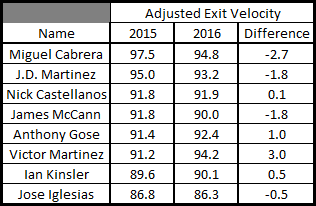
Keeping in mind the imperfections in the source data, here are the 2015 and to-date 2016 adjusted exit velocities (in miles per hour) of the Tigers’ primary hitters who played for the team in both seasons:

adjev15-16det

While recalling that we still are dealing with small sample sizes for 2016, particularly for James McCann, who’s spent much of the young season injured, and Anthony Gose, who now is down in the minors, I’d guess that the differences in adjusted exit velocity roughly comport with how well fans think each hitter is performing this year: Miguel Cabrera hasn’t heated up yet; J.D. Martinez has been struggling since moving to the second spot in the lineup after a hot start batting deeper in the order; Nick Castellanos has been breaking out; Victor Martinez is healthy again and showing it; Ian Kinsler seems to be in fine form yet again (credit those Jack White-designed bats?); and Jose Iglesias is continuing to rely on weak contact.

Cabrera was second overall in adjusted exit velocity last season, so his drop-off seems like a possible source of concern. Sluggers like Cabrera can take a while to warm up, though, so it’s not unreasonable to think that his adjusted exit velocity will climb as the current season progresses. (Cf. Giancarlo Stanton, 2015’s adjusted exit velocity champ, who, so far in 2016, is down 9.4 MPH.)

The elder Martinez has the largest change of any of the highlighted batters in either direction, but his 2015 doesn’t offer much of a baseline because he was playing through obvious injury. It therefore is reasonable to assume that some portion of that +3.0 MPH of adjusted exit velocity is due to a return to health.

Not only do these changes in adjusted exit velocity correlate with anecdotal observations of these players this season, but they also– loosely but consistently across this sample– track changes in raw power (measured as isolated power, or ISO):   Continue reading