The Rev. Al Green reminds us why a prophet is not accepted in his hometown

Jesus said to them, “Surely you will quote this proverb to me: ‘Physician, heal yourself! Do here in your hometown what we have heard that you did in Capernaum.’ I tell you the truth,” he continued, “no prophet is accepted in his hometown.” – Luke 4:23-24.

Legendary soul singer Al Green was born in Arkansas, and he’s an ordained pastor at a Memphis church, but Grand Rapids, Michigan is his hometown. He grew up here from a young age, and he attended the same now-defunct high school as Gerald Ford.

But when Rev. Green returned to GR for the first time in over ten years, he mailed in his homecoming. After starting more than an hour and fifteen minutes late, Green played for not more than an hour and offered no encore, though after a brief, mostly flat performance, the disappointed audience’s request for an encore was pretty tepid.

Yes, Green still has his vocal range, if not a youthful stamina, and his twelve-piece band was fine. He sang “Let’s Stay Together,” and he did a disjointed medley of Motown snippets, but his brief set left the audience wanting a lot more. That may be an appropriate strategy for an up-and-coming act playing small clubs and building a following. It really isn’t an appropriate strategy for an established stars playing to a sold-out crowd, each of whom ended up paying more than a dollar a minute for Green to coast through his light performance.

While the, “It sure is great to be here in [fill in the blank city]!” is a throwaway line musicians use at every stop on a tour, it is a meaningful ritual because the audience really does love it, and because observing its execution can offer insight into the performer’s commitment to the individual performance. Whatever its value, Green didn’t make it easy to definitively answer the question, “does he know where he is?”, scattering his geographical shout-outs across the state. Although a tally of municipal mentions upon review of the concert transcript (those exist, right??) likely favored Grand Rapids, Green acknowledged Ann Arbor, Flint, Lansing, Muskegon, and other locales during his time on stage. The number of Michigan cities he named may have outpaced the number of songs he performed, which actually might sort of be a backhanded compliment to the Michigander audience in light of the state’s inferiority complex. Green sufficiently resolved whatever uncertainty existed in the fans’ minds when he sent us off with, “Good night Pontiac!”, though. Regardless of whether he knew where he was, he didn’t care, and that was illustrative of his approach to the night as a whole.

___________________________________________________

Previously
Hang out at the Hangout
ALDLAND’s 2011 live music reviews

Hit Bull, Win Steak: A meaty review of Bull Durham

I was in Durham earlier this month, and my gracious hosts sent me on my way with a copy of Bull Durham, the 1988 baseball film shot on location and starring Kevin Costner, Susan Sarandon, and Tim Robbins, and featuring William O’Leary, and I’m glad they did.

I don’t watch enough movies to make for a legitimate writer of movie reviews– a sketchy draft writeup on Slap Shot has been gathering e-dust since my first viewing last fall– but I know enough to know an enjoyable movie when I see one, and Bull Durham is that. Keep reading…

The U.S. Open golf tournament turned interesting shortly after it ended

Maybe obviously, I am not a big fan of golf. I did play it yesterday, though, which is but one of the many things I prefer to watching it.

As luck would have it, there actually was an interesting moment at the U.S. Open, though fans had to wait for the trophy presentation to see it. That was when someone named Jungle Bird— apparently an anti-deforestation activist– involved himself in said trophy presentation. Awful Announcing has some details and video.

If there was one thing I hated more than golf, it was deforestation. Added to the list of things I hate more than golf: golf without Jungle Bird.

Juuuuuunnnior!

After four years and 143 races, Dale Earnhardt Jr.’s winning drought is over. It ended at the same track where he got his last win, in June of 2008: Michigan International Speedway. Once the rains cleared in Brooklyn, MI, Junior roared out to lead 95 of 200 laps and ran away from Tony Stewart and the rest of the field on the way to a comfortable victory, with speeds topping out at 212 mph along the long straightaway.

The 88 team has been having a good year. After 15 races, they have 11 top ten finishes, 8 of which were top fives, one of which was yesterday’s victory. This win has been a long time coming not only because it has been a long time since Junior’s won, but because he’s run pretty solidly during those four years, and particularly last year and this year, and he seems to have encountered more than his fair share of bad luck. The stretch, while probably longer than anyone would’ve liked it to be, did give Earnhardt the opportunity to show his critics that wasn’t going to lose due to being immature or a bad teammate. It’s been a long time since anybody could legitimately accuse him of being either. (And the persistent immaturity of the Busch brothers certainly provides a helpful foil.)

In the end, though, I feel pretty good saying that the reason Earnhardt Jr. finally broke through and made it back to victory lane was due to the black paint scheme on his Chevrolet yesterday.

Middle Relief: The Legend of Vlad in Winter (via Grantland)

From the first time the baseball world got a look at Vlad, it was clear we were dealing with a very different kind of subject. Read Dan Le Batard’s Guerrero profile from 10 years ago and you begin to understand why. There are the usual stories of future sports stars growing up in poverty … and then there’s Vlad, who drank from puddles as a child and had to share two beds with six other family members after a hurricane blew the roof off the Guerreros’ shack. There are the usual disconnects between English-speaking reporters and Spanish-speaking players … and then there’s Vlad, who’s so shy about his lack of education and a fear he’ll be perceived as unintelligent that he rarely talks to anyone outside his immediate circle.

And yes, he approached the game differently from anyone else, including sizing up opposing pitchers by facing them on his PlayStation. One of the oldest axioms in sports is to practice the way you play. No problem for Vlad. He swung at everything on PlayStation, too.

People tell stories about Vlad the way they might about Roy Hobbs, if he were real. I once saw Vlad make a diving catch over an alligator in right-center. Oh yeah? I once saw him hit a ball that landed in Moose Jaw. Pfft! You weren’t there when he threw a guy out at home while lying in a sleeping bag in the right-field bleachers while his mom read him ghost stories.

Thing is, everything short of gators and Moose Jaw and sleeping bags actually happened. … Read More

(via Grantland)

Churchill Downs to initiate NASCAR-like regular season in 2013

The Courier-Journal reports:

In one of the most significant changes in the 139-year history of the Kentucky Derby, Churchill Downs will determine the 20-horse field for next year’s event through points accrued in selected prep races.

The points system, to be known as the “Road to the Kentucky Derby” and intended to build advance fan interest, will begin this fall, with 2-year-olds able to earn points for the May 4 Derby in designated races.

Churchill’s management believes the new structure, which it plans to announce today, organizes the preps into the equivalent of a regular season and playoffs, to which fans can relate. Ever since the field has been limited to 20 horses, some form of earnings has been used to determine the field. Since 1986, Churchill has used graded-stakes earnings.

The plan calls for 36 races, as opposed to about 185 races worldwide that counted toward Derby selection under the previous arrangement.

The campaign of races leading up to the Derby is being divided into four phases with different point scales.

The first is called the Kentucky Derby Prep Season, typically spanning stakes from late September through late February. That will offer a 10-4-2-1 point scale for the top four finishers.

Next is the first of a three-phase Kentucky Derby Championship Season, which typically will span the 10-week run-up to the Derby. Races in the first phase of the Championshp [sic] Season will offer a 50-20-10-5 point scale.

That’s followed by the most important part of the Championship Season. These races will encompass the biggest events: the Florida Derby, Wood Memorial, Santa Anita Derby, Arkansas Derby, Toyota Blue Grass and Louisiana Derby, while also including the $2 million UAE Derby in Dubai. Those races will offer a 100-40-20-10 point scale.

Finally, there’s a last chance “wild-card setup” — Keeneland’s Lexington Stakes two weeks before the Derby and Churchill Downs’ opening-night Derby Trial a week before the Run for the Roses. Those points (20-8-4-2) could put a “bubble” horse over the top.

I like this idea. I don’t know if the audience for horse racing is growing, and I suspect it is not, but this will help in two ways: 1) it will help people focus on and understand the value and importance of certain pre-Derby races, and 2) it will enhance the experience of watching the Derby and the other Triple Crown races by contextualizing them, familiarizing fans with the participants further in advance of the big races. The further hope is that this will lead to broader television coverage. I look forward to learning more about Saratoga, Santa Anita, Arkansas, and, of course, Keenland. Not so much Pantoji.

2-4-1 Beers with Bryce Harper and Sir Charles

When a certain Nashville restaurant decided to stop being an obvious organized crime front and take the business above board, one of the succession of attempted ventures in the space was a sports bar so desperate for customers it was almost giving away beer. The question was, is “two-for-one” beer the same thing as half-off beer, and if not, which is preferable?

Anyway, you need not choose, because here in a single post are two quick hits about beer and guys who don’t want any of it. First up is the now “viral” (HT: Laura) Bryce Harper:

Straight up Gongshow.

Next is a guy we hope isn’t viral, even if his late-night driving errands suggest he’s at an increased risk:

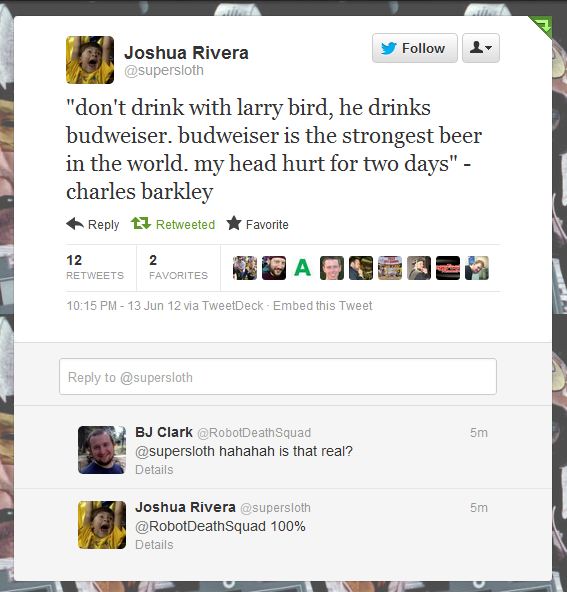
I don’t know about you, but I’m ready to revoke the Round Mound’s knighthood.

The 2012 NBA finals: Resurrecting the Zombie Sonics allows attention-seeking bloggers to go all-in on LeBron James

The very elemental 2012 NBA finals tip off tonight between the Heat and Thunder, and while we don’t know which way Captain Planet’s going with this one, I did think everybody outside of South Beach was on board with cheering for Oklahoma City. Probably more accurately, I thought everybody was on board with rooting against LeBron James & co.

Now that King James is (again, admittedly) on the verge of winning his first NBA championship, the internet’s writing hands are rushing to join his camp. Whether they really are tired of harping on James for The Decision, the pep rally, and his promise of eight championships in Miami or they’re just following the old, adhere to one view for a long time and then publicly and suddenly change positions to get attention model, or maybe they see that James’ time is here and they want to be on the right side of history, everybody’s suddenly all-in on LeBron James.

How to accomplish this switch? Remind everybody saying OKC “did it the right way” that OKC did it the wrong way first, by ripping the franchise out of Seattle. Continue reading

Uncovering John Calipari’s true motivations and machinations

This week’s issue of Sports Illustrated includes a transcript of Dan Patrick’s interview with former Kentucky Wildcat and presumptive New Orleans Hornet Anthony Davis. Included was this exchange, initiated by DP’s curiously worded question:

Patrick: Did you tell Kentucky Coach John Calipari you were going to go pro or did he tell you?

Davis: He told me. He told me to [come into his office]. When I walked in, first thing he said: “Look, Ant, you have to leave. You did too many great things this year. Won a national championship, got every award. There’s no point in you coming back.” I started laughing. But he had no smile on his face. He was dead serious.

Patrick: Did you want to stay at Kentucky?

Davis: I wanted to stay. Great team, great coach. But the way life is, you have to move on.

It’s tough to know how much to make of this out-of-context exchange. When Coach Cal called Davis into his office, was that the first time they talked about the star freshman’s departure? When Davis laughed, was it because he found the suggestion outlandish and wanted to stay, or was he just being sheepish? When Davis told DP he wanted to stay, was he being serious?

Still, there’s a persistent feeling that Cal really was kicking the kid on down the line to make room for the next crop of high-profile players. In a program operated on a one-and-done model, having a player of Davis’ talent stick around for another season could mean that UK would lose at least one of its top recruits, who commit to Kentucky because they want to shine for a single season and move along to the league where players get paid above the table.

Gender Politics in a Cheerleader Jam….Maybe?

During last weekend’s Pop Music Symposium at SUNY Clinton, I heard for the first time Carly Rae Jepsen’s “Call Me Maybe,” and late Wednesday night, reader Cactus William sent a/the music video, which will serve as this week’s Jam.

There’s a lot at play here. First, the song itself: I’ve only listened to it twice, and for different reasons, neither listen was a careful one, but it seems to be comprised of two fairly devastating pop hooks cycled as many times as three minutes and change will allow, and one less interesting bridge-ish segment with lyrics confusing in light of the purported plot. As for the singer herself, I’ve never heard of Jepsen before, and I can only assume that she comes from the Rebecca Black School of Corporate Music Manchurian Candidates, a vehicle to deliver said hooks and smile as her creators reel in the money.

Still, the financial circumstances of a song’s conception need not dictate its real value, and here I think we may have something of broader importance. I wrote earlier that Brad Paisley’s channeling of Arthur Conley with “Old Alabama” signaled country music’s arrival as America’s popular music genre, and I think something very roughly analogous is happening with “Call Me Maybe” vis-a-vis dynamics in popular gender politics. The thesis is that this song stands for a tipping point in male-female relations that sees a woman asserting herself, though just barely, as the first mover in the courtship context, contrary to traditional expectations. This thesis doesn’t ignore strong, demanding women of the past (Janis, “Tell Mama”) or even aggressive women of the present (e.g., Carrie Underwood, “Before He Cheats”), but it is operable to the extent it can bracket such apparent counterexamples as being either out of the mainstream or persistently reactionary despite their aggressiveness and focus its comparative backdrop on the likes of Taylor Swift, ALDLAND’s favorite anthro-feminine alien. On the other hand, this paragraph may have set back gender relations by a few decades or at least demonstrated my ignorance of contemporary popular music. Moving right along.

Next is the video, which stars members of the Miami Dolphins cheerleading squad. The first question here is, what motivated this? Was this just a sunny day romp around South Beach after cheer camp let out? Or, in Bring It On/Mean Girls fashion, was this a response to the leaked photo shoot of Lauren Tannehill, wife of Miami’s rookie quarterback and number eight overall draft pick Ryan Tannehill (who, if he didn’t outkick his coverage with his bride, certainly did with his draft position), in varying amounts of Dolphins-colored gear? To the extent this is knowable, determining the answer would initially involve comparing the dates of the leaking of the photos and the posting of the video, something I’m not going to do. Precision like that likely becomes less important when you’re striving for attention and HBO’s cameras are rolling.

To the extent that there’s any sports angle here, this video eventually will make you remember that, whether it’s the Hard Knocks curse, the implications of merely having cheerleaders, or the fact that Miami actually drafted Ryan Tannehill, the Dolphins are not going to be good this year, so enjoy this while you can, which is forever, because the internet is forever, unlike Dan Marino: