Why does ESPN hate Detroit?

I’ve written before about Detroit’s “inferiority/superiority complex, and one of the ways that manifests itself is in Detroiters’ (and Michiganders’) belief that national media sources ignore or marginalize them.

The reality is that it’s a big country and there’s plenty happening all over the place to fill national media broadcasts. People also probably get tired of hearing about how life is tough in the Motor City. But ESPN’s emphasis on the coastal cities, especially New York and Boston, whether things are good, bad, or uninteresting there, feels like it belies the notion that the Worldwide Leader is looking to spread its coverage evenly and objectively. There’s probably somebody who’s spent too much time next to the Belle Isle salt lick with a scientific analysis of the network’s Motown slights. Thankfully I don’t have anything like that (heck, I don’t even have a television– am I qualified to write this post? any post for this website?), but I do have a lifetime of accumulated, small experiences, little things that build up over the years like plaque, arterial blockage, uric acid, or whatever early middle age male medical condition the target sports audience has, as determined by the concordant commercial advertisers.

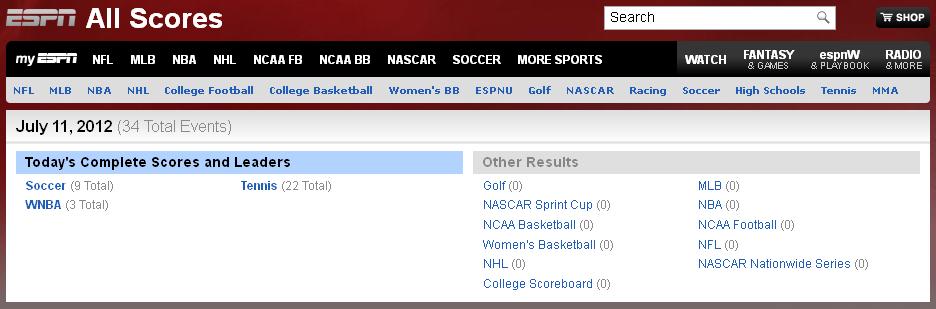
I’m not talking about being accustomed to only seeing the Lions on other teams’ highlight reels— that’s just a bad team making the film editors’ jobs easy. It’s things like the ESPN Radio “SportsCenter” segments on their morning show, Mike & Mike, always starting with the Yankees or Red Sox game and frequently omitting the Tigers’ score from the night before. And stuff like this, from two nights ago:

These are small things. Petty things. Sometimes undefinable things. But they’re real things, at least insofar as they’re experienced, or perceived to have been experienced. When things are bad, Detroiters want the attention to validate their sorrow. (That’s why I wanted the Tigers to lose 120 in 2003. At least the record books would have to bear witness to that misery.) When the supercharged Tigers got off to a disappointing start this season, was Jim Leyland “on the hot seat,” from a national perspective? No way. Bobby Valentine? Almost immediately.

Anyway, trotting out all these examples would be an unenjoyable exercise for me and unenjoyable reading for you. It’s about getting your fair attention for bad times and good. And times are pretty good right now. Justin Verlander won the Cy Young and the MVP in the same season last year! He got shelled as the All-Star game starter last night, but he’s dating Kate Upton! Miguel Cabrera is the best hitter in baseball! Calvin Johnson is the best receiver in football! (And ESPN’s Chris Carter can’t acknowledge that?)

Alright, enough.

The DET Offensive: Halfway at the Half-way

Just in time for the All-Star break, which marks the half-way point of the MLB season, the Detroit Tigers have clawed their way back to an above-.500 record, which feels like much more of an accomplishment than it should, but things really do seem to be getting back to the way they should be. The team followed up its strong showing in interleague play by finishing the first half of the season having won five straight and seven of their last nine, earning a 44-42 record. The pitchers seem to be getting settled in (Scherzer leads the AL in some strikeout statistic I forgot, Phil Coke is a workhorse, and Justin Verlander’s done well enough to earn the starting spot for the AL All Stars), and odd-walking liability Delmon Young homered in each of the last four games. Brennan Boesch still is hitting below .250, but Jhonny Peralta seems to be coming on, and Quintin Berry is a joy to watch on the basepaths. Team-wide, defense remains a very frustrating problem, however.

The Tigers’ TV play-by-play man, Mario Impemba, offered his suggestions for the team’s continued success in the second half, and they included the following observation:

The second key is the two spot in the lineup.  Quintin Berry has done a terrific job in the two-hole, but the return of Andy Dirks could help fuel the Tigers offense.  Dirks was having a tremendous impact on the numbers that Prince Fielder and Miguel Cabrera were putting up.  Below is a look at the numbers for the two sluggers with Dirks in and out of the lineup:

With Dirks batting second:                                        With other hitters batting second

Cabrera:  .344 AVG    .392 OB%                               Cabrera:    .318 AVG      .384 OB%

Fielder:    .365 AVG    .411 OB%                               Fielder:     .273 AVG      .364 OB%

While Dirks is out of the walking boot and his achilles is feeling better, getting him back before August is not a good bet at this point.

Mario also tempered the optimism headed into the second half with this note:

The last week has given the Tigers hope that a second half run is on the horizon.  The first three weeks following the break will be telling.  Detroit will play 29 straight games against teams over .500.

Finally, Prince Fielder will be participating in tonight’s home run derby, as narrated by Chris Berman, and Detroit has to hope that this doesn’t mess up a good thing for the remainder of the season.

_____________________________________________

Previously
Interleague Play – 6/26
Call the Experts!
5/26
Recipe for a Slumpbuster
– 5/2
Delmon Young Swings and Misses
 – 4/30
Brennan Boesch’s Birthday – 4/12
Tigers open 2012 season with Sawks sweep – 4/9

Think you understand the new college football playoff system?

Today, USA Today makes sure you don’t:

Endorsement is expected Tuesday for an historic four-team major college football playoff – only there’ll be more to the new system than that.

It likely will entail a total of seven games each year, including four top-tier bowls apart from the playoff, according to two officials involved in the discussions. They spoke to USA TODAY Sports on the condition of anonymity because those details haven’t been publicly released.

All told, the system would incorporate six bowls. Two would rotate each year as playoff semifinal sites, and the other four would serve as attractive landing spots for the best non-playoff teams.

The playoff final – the national championship game – would be put up for bid.

Conference commissioners endorsed the concept of a four-team playoff last week, and will meet Tuesday in Washington, D.C., with an oversight committee of university presidents and chancellors. Those CEOs have final say.

Coming out of meetings in Chicago last week, many of the details of the playoff and bowl plan remained to be worked out.

The “most likely” overall format, one of the officials told USA TODAY, would complement the three-game playoff with four bowls. Among other things, those bowls would accommodate teams that win conference championships but don’t make the playoff or can’t play in their affiliated bowl – for instance, the Rose in the case of a Big Ten champion – because the bowl is serving as a semifinal.

The system would allow the top-tier bowls and conferences to maintain their ties and continue to give marquee-league champions access to high-profile, high-paying postseason games.

This all is separate from the national championship game. An existing bowl could bid for it separately.

The full story online is here.

The DET Offensive: Interleague Play

It has been a tough first half of the season for the Detroit Tigers, who are struggling just to get to .500. I wrote before that the best way to get out of a slump is to invite the Royals to your yard. That sort of worked, but it didn’t really cure any ills in the longer term. After this month, though, I have a new recipe: play the National League.

The Tigers began interleague play on June 8 in Cincinnati, and they won each of their interleague series except for the last one, taking two of three from the Reds, Cubs, Rockies, and Cardinals and avoiding a sweep in Pittsburgh with a game three win against the Pirates, the team with the second-best home record in all of baseball. The Reds, Cardinals, and Pirates are good, and the Cubs and Rockies are quite bad, but Detroit’s performance on a given night seemed to have little correlation to the strength of their opponent. MLB, unlike the NFL or NBA, is a situation in which any team can beat any other team on a given day, but I think this is more a reflection of the Tigers’ internal struggles.

Injuries continue to be an issue, the most troublesome example of which is all-star catcher Alex Avila’s knee and leg problems. Fortunately, Gerald Laird has proven to be a more than serviceable backup, but Jim Leyland consistently and accurately insists he has yet to have his best lineup on the field for any meaningful stretch of games. Utility man Don Kelly also is out as a result of flinging his leg into a barrier at dead-sprint speed.

On the positive side, Doug Fister looks to be healthy and back on the path towards pitching effectiveness. Ditto on the latter for Max Scherzer and Rick Porcello. The shining star continues to be Austin Jackson, who is hitting very well in the lead-off spot while recording zero errors in center field.  Keep reading…

Four thoughts on the Miami Heat’s 2012 NBA championship

1. It was just last Thursday that the Miami Heat claimed the 2012 NBA championship with a blowout win over the Oklahoma City Thunder, yet it feels like it could have been six months ago. Maybe that’s because I don’t follow the NBA that carefully, but I get this feeling with nearly every passing major sports championship, and I remember it even as a kid, so it isn’t a feature of a developing perspective on time with age. It could be that the media mediates our experience of sports more than we realize. Hyperanalysis of championship games and series builds so much anticipation and tension. By the morning after the clinching game, though, the championship really does feel like yesterday’s news. Absent a controversial happening during the game, the media typically offers little beyond a standard game breakdown and an interview with a player or coach before jumping right into previewing the next season.

2. The morning-after conversation after this championship was all about LeBron James. The media’s beat on James had already begun to shift once the Heat made it to the finals, and by the time Miami clinched, they had made a complete 180 on LeBron. Had LeBron really changed, though? In some ways, probably. We’re told he developed his post game this year. That’s definitely something material. But if material, identifiable, quantifiable basketball things were the focus, his winning a championship wasn’t the point of change. He wasn’t heralded as the greatest when he was having, by the numbers, the best season in basketball history earlier this year, or when he won his third regular season MVP award, only questioned more. The nexus of the widespread criticism seemed to be personal and stem from things like the artistic merit of The Decision and The Introduction, his prediction that he’ll win eight championships, his apparent laissez-faire attitude with respect to competitiveness and the fourth quarter, his receding hairline and associated coping method, his unwillingness to shake hands when he loses, his calling the mother of his children his sidekick, etc. etc. If some or all of these are the bases for your beefs with James, though, the new ring on his finger changes nothing. Drew Magary, as usual, cuts to the chase:

There’s never been any question that LeBron James is a great basketball player. And even when he was coming up short in the playoffs, haters like myself just used those failures as an easy excuse to pile on him further, because he’s a dipsh[–] and he deserved it. The fact that he’s won a championship doesn’t fundamentally alter his character in any way. That’s the great con of sports: the idea that winners win because they have character and losers lose because they don’t. If you think LeBron is a good guy now because he won a title, then you probably had no business thinking he was a bad guy to begin with, because the outcome of a sporting event says nothing about the person within.

I never decided if I am a “LeBron hater,” which probably means I’m not. The only thing that really bugged me was his unwillingness to shake hands after he lost that championship with Cleveland. I guess I’m more agnostic about him, and I don’t think he’s more likely to win eight championships now than he was a week ago or a year ago save for the mathematical fact that he now has one of those eight.  Keep reading…