Kate Upton has a point: Writers must do better with baseball awards voting (via Fox Sports)

111716-mlb-tigers-verlander-upton-pi-vadapt-980-high-75Kate Upton had a point. Her math is off, her facts are off, but she had a point.

Sorry, Kate, no writer should be fired for failing to vote for your fiance, Justin Verlander, for the American League Cy Young Award.

But, with all due respect to the Baseball Writers Association of America — of which I am a proud member — the omission of Verlander from the ballot by both Tampa Bay voters is indeed an indication that we can do a better job choosing the voters for our awards.

Judging voters too harshly is a slippery slope: I vehemently oppose penalizing anyone for holding an unpopular or even mistaken opinion. At the same time, it is the obligation of every voter to develop a sound rationale for his or her choices. Different answers are acceptable; it’s the process that matters.

The Tampa Bay voters, Bill Chastain of MLB.com and Fred Goodall of the Associated Press, cannot be held solely responsible for Verlander’s second-place finish, despite what Upton said in her epic Twitter rant Wednesday night. Verlander would have needed third-place votes or better from both to overcome Porcello – and seven other writers placed him fourth or fifth.

Chastain told the New York Daily News that he submitted his ballot with about a week left in the regular season; a curious choice, to say the least, when Verlander’s Tigers were still fighting for a playoff berth. Goodall, one of several AP writers who vote for BBWAA awards, does not solely cover baseball; he reports on a variety of sports in the Tampa Bay area.

Ultimately, though, each writer needs to take responsibility; if you are not prepared to engage in or capable of the necessary analysis, then don’t accept the ballot. Chastain and Goodall did not make indefensible choices — Chastain went Porcello-Britton-Kluber-Sale-Masahiro Tanaka; Goodall went Porcello-Kluber-J.A. Happ-Britton-Aaron Sanchez. But the complete exclusion of Verlander by both makes little sense.

Votes are subjective, differences of opinion expected. But the BBWAA has a responsibility, too — a responsibility to make sure that we select the most qualified voters, the best of the best, to get the optimal result.

If we fail to do that, shame on us. … Read More

(via Fox Sports)

HT: LRAD/MSN.com

Michael Fulmer and the changing face of the Detroit Tigers

fulmer_poy_r6n5p8h1_j3r60e3n

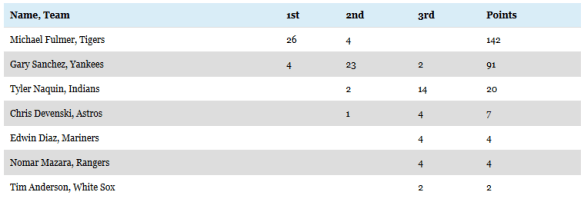
We learned Monday that Detroit Tigers starting pitcher Michael Fulmer is the 2016 American League rookie of the year. While not a unanimous selection like his National League counterpart, Corey Seager, he still claimed the award in convincing fashion:

royfulmer

Fulmer is the fifth Tiger to win the award, joining teammate Justin Verlander, Lou Whitaker, Mark Fidrych, and Harvey Kuenn. The connection between Verlander, who won his rookie of the year exactly ten years ago and is a contender for his second Cy Young award this year, and Fulmer seems to be a neat and real mentorship relationship. Here’s a snapshot statistical comparison of Verlander and Fulmer in their rookie-of-the-year seasons:

royfulmerverlander

It certainly is exciting to consider the possibility that the Tigers have found in Fulmer another Verlander, even if Fulmer’s numbers– comparatively superior to Verlander’s ROY season across the selected metrics– have some worried about his ability to repeat his rookie-year successes. (This concern boils down to the relatively large gap between Fulmer’s ERA and his FIP. It seems worth noting that Verlander had an even larger gap in 2006.) It doesn’t mean a lot, but the similarities make for a fun comparison.

Fulmer’s accolades serve as a reminder that the next generation of this Tigers team already has arrived, at least in part, and that, with business-side changes afoot, the veteran generation could be gone before we know it.   Continue reading

Offseason starts with a bang for the Detroit Tigers

maybin-gone

When the Detroit Tigers’ season ended in Atlanta last month, the message from general manager Al Avila was both clear and clearly different than it had been a season ago, when Avila took over the job from his boss, Dave Dombrowski. Then, speaking as the mouthpiece of the team’s owner, Mike Ilitch, he said that “the foot is on the pedal, hard,” and the team continued to make the kind of win-now moves that largely have defined them for the past decade. Now, though, Avila’s taking his foot off the gas and ushering in a period of austerity that’s likely to be painful. It definitely will be different.

The changes began immediately. Yesterday was the first day of the MLB offseason, and Avila wasted no time in making two of his biggest decisions on current player options. First, he “traded” center fielder Cameron Maybin to the Angels for a low-grade relief pitching prospect in a move that essentially amounts to the Tigers declining to exercise Maybin’s option.

Shortly thereafter, the team announced that it would pick up the $6 million option on closer Francisco Rodriguez. (Had they declined K-Rod’s option, they would’ve owed him a $2 million buyout.)

If, as he has said, his new mission is “making this team leaner, younger, more efficient,” I’m not certain this was the way to do it. Given the money, his track record, and his strong performance last season, I like the decision to retain Rodriguez, even considering the general year-to-year unreliability of reliever performance.

The Maybin decision is more confusing, though. By fWAR, Maybin was the Tigers’ most valuable outfielder last year, and he only played in ninety-four games. (He also was their second-best baserunner.) He missed action due to injury, but not really the kind of injury that should make teams worry. He mostly just kept getting beaned on the hands. That’s just bad luck. He’s only twenty-nine. Over the past two seasons with Atlanta and then Detroit, he finally seemed to be approaching the potential he demonstrated eleven years ago that caused the Tigers to spend the tenth overall draft pick on him in 2005. (He also was the team leader in the Instagram handle category.)

Now he’s gone again, leaving behind holes in center field and the top of the batting order. Jeff Sullivan, writing up this transaction largely from the Angels’ perspective, points a finger to JaCoby Jones as the likely replacement Avila is targeting. Jones showed memorable flashes as a late-season call-up this year, but, like many prospects, he’s still young and raw and inconsistent. The other obvious fill-in is Tyler Collins, who has the relative advantage of being a left-handed hitter but the disadvantage of being at an age and experience level where “raw” is not a baseball adjective that incorporates an element of hope.

All of this happened on offseason day number one. There will be more activity involving the Tigers this offseason, and, typically, it is wise to wait to render final judgment on a particular decision until it can be viewed within the full constellation of the team’s moves. Under austerity, though, there should be little hope for or expectation of near-term improvement through an infusion of external resources; doing better must mean doing better with what you already have. There isn’t going to be a Justin Upton trade this year (which, while we’re at it, probably will be the last year J.D. Martinez wears a Detroit uniform). What stings about the Maybin trade– besides the obvious departure of talent and the intangibles of a fun guy who seemed to be having a lot of fun himself– is that it is a move that will make the team worse in 2017, and the Tigers haven’t made too many moves like that in a good while.

Game 162: Talking baseball at the end of the 2016 regular season

Every MLB team is in action beginning at 3:00 this afternoon for the final* day of the 2016 regular season. Before heading down to Turner Field to catch the Tigers and say farewell to baseball in downtown Atlanta, I was a guest on today’s episode of the Banished to the Pen Podcast, in which I rambled about wild card scenarios and made severely underinformed playoff predictions.

Stream or download the podcast here.

* Final as to all except Detroit and Cleveland, which likely will need to play a makeup game tomorrow.

The arc of the ALDLAND universe is long, but it bends toward this weekend

maybin-upton-braves-tigers

If there are two things I’ve written about with consistency at this weblog they are 1) the Detroit Tigers and 2) the Atlanta Braves’ foolhardy abandonment of their downtown home at Turner Field. Beginning tonight, and for the next two days thereafter, these two ALDLANDic worlds will collide when the Tigers face the Braves in the final three games ever to be played at the aforementioned Turner Field. More than anything, I am grateful that we will be able to attend each of these games, live and in person. These are critical games for the 2016 Tigers, teetering as they are on the edge of postseason qualification, and they are historic games for the City of Atlanta. I have little more to add at this juncture other than that I am very excited.   Continue reading

Catching Fire: Cabrera leads by example

cabrera1280_xhyb8p9n_pe6ybg8z

In an odd way, it’s tough to find an excuse to write about Miguel Cabrera in a season series like this one, because he’s so consistently good that, within his own context, his day-to-day achievements don’t stand out. If, from a coverage perspective, the greats miss out on talent-correlated attention during the season, though, they tend to make up for it during the big moments, like playoff races and the postseason.

The Detroit Tigers are in the final countdown for the 2016 season. Monday was their last off-day until the season ends on October 2. Their playoff odds have tumbled, but they’ve managed to keep pace at about two games back of the second AL wild card spot, meaning that their postseason hopes remain very much alive. The reason those playoff odds are low, though, is because they’re running out of time. Every remaining game is of critical importance, and while the Tigers really need to win each of these games (or, at least, a vast majority of them), even doing that won’t guarantee a playoff berth unless the teams ahead of them falter.

Cabrera knew the stakes last night, during the team’s first game of this crucial final stretch. Detroit already was missing two of its biggest bats– Cabrera’s Venezuelan countryman Victor Martinez and Ian Kinsler, also an important vocal leader– due to a brutal triple HBP run by Cleveland’s Trevor Bauer (Cabrera also was a victim) in a costly win on Sunday, which meant Cabrera would need to shoulder even more of the offensive load than usual.

In the fourth inning, leading by a slim 1-0 margin, Cabrera decided to manufacture a run essentially all by himself, and not by way of a snappy home run blast. First, he stretched his single into a double; then advanced to third on a dangerously shallow fly-out; and, finally and amazingly, scored from there on an infield hit to the third baseman. Cabrera’s Billy Hamilton impression is one of the most impressive baseball moments I’ve seen this year (here’s the video), and he delivered it for the benefit of his teammates at the perfect moment. While it’s impossible to say whether the team’s subsequent offensive breakout– they ended up winning 8-1, with Cabrera also contributing a two-run homer– came as a result of this moment or the team simply (finally) catching up to bad Minnesota pitching, Cabrera’s baserunning in the fourth, which resulted in what ultimately proved to be the winning run, sent an unmistakable message to his teammates.   Continue reading

Catching Fire: It Don’t Come Easy

With just under a month remaining in the 2016 MLB season, this is a good time to take stock of the Detroit Tigers and some of their key players.

Team Playoff Odds

Today, the team sits 5.5 games back of Cleveland in the AL Central, and one game out of the second AL wild card spot, behind Boston and Baltimore. At this point, the division likely is out of reach, but the wild card is in play. Over the last two weeks, the Tigers have moved in and out of the second wild card position, and, although it’s served them well to this point, the Orioles’ volatile combination of bad starting pitching and overreliance on home runs is subject to collapse at any moment.

Three sites– Baseball Prospectus, FanGraphs, and FiveThirtyEight– take varying stances on spaces and the capitalization of letters in their names, but all three provide MLB playoff odds for every team. These represent the percent chance, based on to-date performance, that a given team will make the playoffs. Here’s how the Tigers’ playoff chances look today:   Continue reading

Catching Fire: Checking in on Justin Upton

juptigk

Everyone knows Justin Upton has had a tough go of things during his first season in Detroit, and it’s reasonable to expect that there would be an adjustment period associated with his move to the American League– new pitchers, new parks– after spending his first nine seasons in the National League.

When we last checked in on Upton, in late June, things finally seemed to be heading in the right direction:

Especially exciting for Detroit was that two of [the Tigers’ home runs in a win against the Mariners] came off the bat of Justin Upton, who finally appears to be heating up for his new team after suffering one of the worst offensive stretches of his career.

jupwrc20gmavg

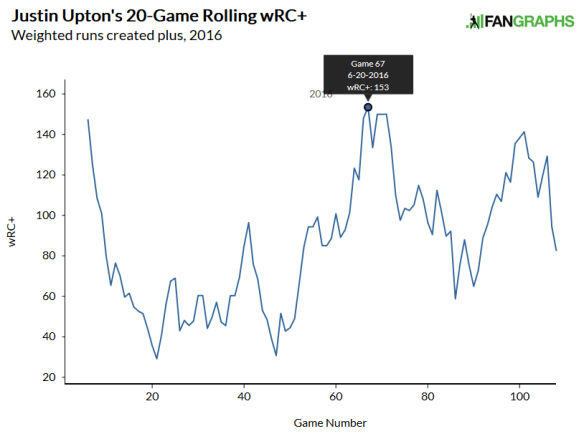
Upton has not continued in that direction, however; in fact, I seem to have caught him precisely at his peak. Here’s an updated version that same graph from the June post, above:

jupwrc20gmavgAug16

That earlier snapshot of Upton’s offensive production was through June 20, the date highlighted on this graph. Since then, Upton’s offense is declining again, and this graph (for reasons unknown to me) doesn’t even include the team’s two most-recent games, in which he went 0-7, striking out four times and grounding into two double plays.

jupmonthlysplitAug

At the moment, this season is the only full one of Upton’s career in which he has performed as a below-average batter, and, as the above all indicate, he’s been particularly bad of late. (Like, 6-wRC+-for-the-month-of-August bad.)

After the Mariners (coincidentally, the same team against which Upton appeared to break out back in June) completed a frustrating series sweep of the Tigers in Seattle early this morning, critics corralled their critical criticisms in Upton’s direction. Detroit hitting coach Wally Joyner came to Upton’s defense, however:

He’s a good player. He wasn’t sitting on the corner when they gave him the contract. He’s earned it. There’s a reason for that. Remember it. Nothing’s changed. He’s just a little bit unlucky right now.

He’s not OK with it and I’m glad he’s not OK with it. He’s working hard and he’ll be fine. He’s unlucky. He’s not playing like [crap].

Is Joyner right? Has Upton, of late, merely been unlucky?   Continue reading

Farewell, again, dear Prince

Nearly three years ago, Detroit Tigers fans said goodbye to Prince Fielder, whom the team traded in the 2013 offseason to Texas in exchange for Ian Kinsler. At the time, many were glad to see him leave, though some, including this author, were not. All must agree, however, that when Fielder left Detroit, he became barely a shadow of his former Ironman self. In his two years as a Tiger, he didn’t miss a single game. Excluding his rookie year, in the eight years he spent in Milwaukee and Detroit, he missed a total of thirteen games, playing the full 162 in four of those eight seasons. That’s an impressive accomplishment for any player.

If one wanted to be cold about it, one might note that, 2014, Fielder’s first in Texas, was a year of insult and injury for Prince. Not only did his trade replacement, Kinsler, make the All-Star team on his way to completing the second-best season of his career, but Fielder underwent season-ending neck surgery in late May, appearing in just forty-two games for his new club. He seemed to bounce back in 2015, posting a .305/.378/.463 line in 158 games, but it has been trouble again for Fielder in 2016. Despite his team’s success, Prince arguably was the worst position player of the first half of the season, and things weren’t looking up in the second half. After playing in all but five of the Rangers’ games through July 18, Fielder again went on the disabled list and, after undergoing a second neck surgery, is expected to miss the remainder of this season.

It may not just be the rest of the season he misses, however, as shocking reports emerged this afternoon that Prince’s career may be over:

If true, then, as a number of people have pointed out, Prince will finish with a .283/.382/.506 line, .304 TAv, .377 wOBA, 133 wRC+, 26.8 fWAR / 23.8 bWAR / 30.3 WARP, and 319 home runs, the same number of home runs his father, Cecil, with whom he seems to have reconciled, hit in a career just one season longer than his son’s.

Although serious injuries seemed to dim his wattage following the trade to Texas, I always will remember Prince Fielder as a complete hitter who was one of the happiest baseball players I ever saw. His friendship with Miguel Cabrera was particularly endearing.  What follows are some of my favorite images and clips from Prince’s playing days:   Continue reading

Catching Fire: The Tigers are not Utilitarians

jeremy_bentham

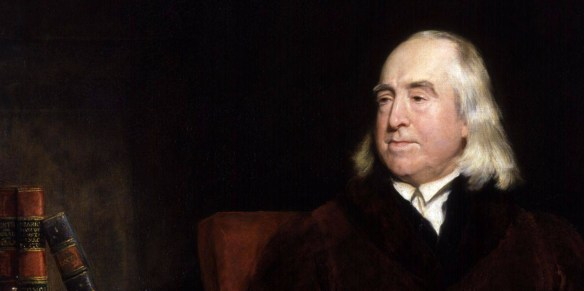
In the late 1700s, Jeremy Bentham introduced the modern world to utilitarianism, a political theory organized around the “fundamental axiom” that “it is the greatest happiness of the greatest number that is the measure of right and wrong.” Bentham believed that happiness is quantifiable (unit of measurement: util) and argued that governments should legislate so as to create the greatest amount of happiness for the greatest number of people.

Utilitarianism has its blind spots and, at least at its Benthamite core, is subject to the conceptual critique that it prioritizes majority preferences over minority rights (a classic critical example here), as well as the practical one that utils aren’t as susceptible to arithmetic in the policy-making context as other measurements of value, like, say, dollars. One of Bentham’s students, John Stuart Mill, later updated and expanded utilitarianism in an attempt to address some of its critics, and although some of the theory’s broader ideas remain in the modern political milieu, utilitarian is viewed as a relatively primitive approach today.

Mike Aviles, Andrew Romine

The 2016 Detroit Tigers are, to some extent, a team out of time. They are neither aggressively modern (e.g., Tampa Bay) nor hopelessly mired in the past (e.g., Arizona). With the trade deadline rapidly approaching, they are neither obvious buyers (e.g., Toronto) nor obvious sellers (e.g., San Diego). Observers have been declaring for years that the team’s “window is closing,” while conceding that it still is open and may remain as such for another season (in which they will repeat their hand-wringing diagnosis all over again). Given their aging roster, though, time is something out of which this team may be running.

All of that leaves the Tigers with two utility players, arguably a practical necessity in an age of limited rosters and relief pitching specialization, Andrew Romine and Mike Aviles. Unlike Bentham’s utils, it is fairly easy– and easier than ever– to calculate how much these two utility men contribute to the team. Readers may recall Aviles’ preseason scouting report (sayeth BP: “Aviles is no longer useful in a baseball sense,” and “his inability to reach base . . . makes him a complete zero on offense, while what’s left of his defensive and baserunning abilities have become liabilities”) or this more recent peek at Romine’s poor offensive numbers. To keep this part of the offensive update simple, the palindromic Romine (73 wRC+) and Aviles (37 wRC+) have been decidedly below average and aggressively below average hitters, respectively, to this point. Aviles, who’s received twice as many plate appearances as Romine, has been worse than all but ten other batters in baseball (minimum 80 PA), and four of those ten no longer have major-league jobs.

Since spring training, manager Brad Ausmus has insisted that carrying two utility players is not redundant, but the question remains: do Aviles and Romine, together, provide utility to their team?

In one basic, immediate respect, the answer clearly is no. Continue reading