Catching Fire: Night of a thousand feet of home runs

If not winning, the Detroit Tigers certainly have been doing a lot of home-run hitting over the last week or so, and, after some extra-inning disappointments during that stretch, they finally put it all together last night for an overtime win last night in a home series opener against the Seattle Mariners. That game featured three Tigers homers, each of which gave the team the lead. Especially exciting for Detroit was that two of them came off the bat of Justin Upton, who finally appears to be heating up for his new team after suffering one of the worst offensive stretches of his career.

jupwrc20gmavg

Upton’s first of the night was a dead-center bomb in the seventh that gave the Tigers a 7-6 lead, and his second, which clinched the game in walk-off fashion in the twelfth, landed beyond the bullpen in left. There likely is no one happier about this apparent return to power than Upton himself, and, especially with J.D. Martinez out with an elbow injury, it couldn’t be more timely for the team.

Upton’s homers last night inspired celebration, but Miguel Cabrera’s, which gave the Tigers a 2-0 lead in the first inning, inspired awe. I’ve never seen a Comerica Park home run hit where Cabrera hit his last night. No one has.

Have a look:   Continue reading

Red Wings’ season, playoff chances coming down to the wire

635956668550867601-ap-aptopix-red-wings-bruins

It’s easy to second-guess coaching decisions after the fact, begins many post-loss sports articles, but it was immediately clear that the Detroit Red Wings, and their recently redeemed goalie, Jimmy Howard, were not 100% last night in Boston. The direct evidence? Surrendering two goals on four Bruin shots in the first 2:44 of the game. The circumstantial evidence? A hard-fought win the night before in a game that did not start until after 8:00, delaying the team’s arrival at its Boston hotel until 2:45 yesterday morning. Howard looked sluggish, and his teammates weren’t able to bail him out. Their backs against the wall, Boston hardly let up, eventually claiming a 5-2 win.

The Howard redemption story is a nice and good one, and, if the Red Wings are able to clinch a twenty-fifth-consecutive playoff berth, there’s little reason to believe it can’t continue into the postseason, but hockey, as much as any sport, is a sucker for narratives like these, and they can color strategic decisions. Continue reading

Getting to know Jordan Zimmermann in context

talking_with_new_detroit_tigers_pitcher__0_30325097_ver1-0_640_480

I’m going to continue to link to this baseball-season countdown clock in the introductions to my baseball-related posts this month because it’s an easy way to ease into the subject matter while framing the content that follows as timely, topical, and fresh (regardless of its actual timeliness, topicality, or freshness).

The Detroit Tigers added a number of new players this past offseason in attempts to replace departures from and fix preexisting holes in each portion– offense, starting pitching, relief pitching– of their roster. Having already discussed the offense here, my focus here is on the new addition likely to have the largest effect on the pitching staff: former Washington Nationals starting pitcher Jordan Zimmermann.

As demonstrated last week in his spring training interview on MLB Network, Zimmermann has the personality of a post-Lions Silverdome hotdog, but the Tigers didn’t sign him to a five-year contract so he would challenge Miguel Cabrera in the joke-telling department. All the team is asking Zimmermann to do is replace David Price’s position in the starting rotation, which, sure, Jordan, you can borrow this book of limericks.

Zimmermann is unlikely to be mistaken for Price, but a recent comparison with another Vandy alum, Sonny Gray, can serve as an entry point to the new Tiger’s recent performance. Continue reading

Regarding the folly of believing the Falcons are good

falco

To a very casual observer, a mid-December post on the 6-7 Atlanta Falcons would cry out for a Dickensian introduction, but it simply has not been a tale of two halves for these dirtier-than-anticipated birds.

Some, like MMQB’s Andy Benoit, really wanted to believe in that Victorian-era trope, though. Three weeks ago, Atlanta, which started the season 5-0, had lost four of five games, slipping to a 6-4 record. Falcons fans were beginning to lose hope, but Benoit told them not to panic, because “a closer look reveals a different story.” Benoit’s message was compelling in its simplicity:

On film, the 1-4, Stage 2 Falcons haven’t looked significantly different from the Stage 1 Falcons who started 5-0. And, OK, maybe the Stage 1 Falcons were not quite as good as their record indicated, but those five wins are a more accurate portrayal of the 2015 Falcons than the club’s four losses. The biggest difference between Stage 1 and 2 has been the dreaded turnover.

[T]he Falcons have beaten themselves with random fumbles and a few interceptions, of which only one was a truly bad offensive play. Ryan, cerebral as he is, has always had a slight tendency to take the bait and make a foolish throw or two into disguised or tight coverages. But interceptions have never been a major bugaboo. So unless you believe this will change in the final six games of Ryan’s eighth NFL season, there’s little reason to believe turnovers will continue to plague Atlanta.

Most likely, Atlanta’s fate hinges on how well its offense functions.

Combine the Stage 1 Falcons with the Stage 2 Falcons and what you’ll likely get is a Stage 3 Falcons club that finishes 10-6 and is a dangerous Wild-Card foe.

The seductive simplicity of Benoit’s thesis really is too good to be true. It seems easy to pick on him three weeks later, when Atlanta dropped all three games in that period and has an active six-game losing streak, but his reasoning would’ve been flawed regardless. Even if it’s true that turnovers– both fumbles and interceptions– fall within the realm of luck, and even if it also is true that the Falcons’ then-recent losses were due to turnovers, Benoit ignores the possibility that the team’s early successes also were due to luck. Instead, he simply assumes, without offering any evidence to that effect, that the team was playing closest to its true-talent level when it opened up 5-0, rather than when it went 1-4 (now 1-7, the same record with which the Detroit Lions opened the season). Couldn’t good luck have played just as much a part of Atlanta’s 5-0 opening as bad luck did in their subsequent losses? Of course, but in his overly rosy evaluation of the early season Falcons, Benoit apparently didn’t consider that.

At 6-7, Atlanta isn’t mathematically eliminated from playoff contention, but, with another game against the Panthers remaining and the Seahawks surging, they’re very likely done for the year.

In erasing their 5-0 start, the Falcons’ poor play in the last few weeks likely is a closer approximation of their true talent level than their results in the first five weeks. Indeed, as these charts illustrate, they’ve been historically bad from Week Six onward.

For postseason purposes, Atlanta no longer controls its own destiny (scenarios), but, at a minimum, it will need to beat its three remaining opponents– Jacksonville, Carolina, and New Orleans– to have a shot. According to FiveThirtyEight, the Falcons have a two-percent chance of making the playoffs, and their projected win probability this week against the Jaguars is fifty percent. Not great, Bob.

On a Northbound Train: ALDLAND Goes Live to Green Bay for Lions-Packers

The Detroit Lions currently own the longest road losing streak by any team against a single opponent in NFL history, having lost twenty-four games across twenty-three years to the Packers in Green Bay. That streak is on the line again this Sunday, when the Lions play at Lambeau Field, and we will be on the ground to take in the full experience.

Breaking this losing streak will be an uphill climb for these Lions. Their 1-7 record obviously compares unfavorably to the Packers’ 6-2 mark, and there is little reason to believe those records significantly misrepresent the true talent of these teams, at least in a comparative sense.

Still, there are reasons for the Honolulu blue crew to be hopeful this week. The Packers, after starting 5-0, have lost two straight games, both away, dropping their road record this season to 2-2. Their home in Lambeau is the NFL’s original Frozen Tundra, but this November Sunday is shaping up to be a balmy one by Upper Midwestern standards, at least reminiscent of Denver and Carolina’s outdoor stadia, where the Packers just lost, if not quite the Lions’ current temperature-controlled den.

The Packers do have weaknesses. For example, no NFL team has a worse three-and-out rate in 2015, something that should offer the Detroit defense an opportunity to slow down Aaron Rodgers & co. And Rodgers’ company is in flux this season. Top receiver Jordy Nelson is out for the year due to a preseason injury, and Green Bay has yet to find consistency in the run game. This week, they demoted starter Eddie Lacy in favor of his backup, James Starks, although indications are that both backs will see action Sunday. On defense, the Packers’ recent losses also have some believing that the team is susceptible to a deep passing attack.

With an offense that continues to feature Calvin Johnson and Matthew Stafford, a deep passing attack is exactly what the Lions should be emphasizing. Following the major shakeups in the coaching staff and front office in the last two weeks, it looks like this is precisely Detroit’s plan. New offensive coordinator Jim Bob Cooter has been playing to his side’s strengths so far, and while Johnson has been limited in practice this week due to an ankle injury, there’s no indication that he’ll be unavailable Sunday.

On paper, things don’t look too good for the Lions this week, but then again, they almost never have. And besides, this game will be played on a not-so-chilly patch of Wisconsin greengrass, not paper. Anything could happen. We’ll be there to watch what happens happen. If you won’t, keep it tuned here and on twitter (@ALDLANDia) for crucial updates live from Green Bay.

Aftershocks: What is Matthew Stafford’s future with the reorganizing Lions?

marthaOne week after Detroit Lions head coach Jim Caldwell elevated Jim Bob Cooter to offensive coordinator, dispatching former OC Joe Lombardi in the process, team owner Martha Ford brought the real thunder yesterday, terminating general manager Martin Mayhew and president Tom Lewand. Other front-office employees may have been fired as well, but available reports have been unclear on further details.

This is precisely the move the Lions needed to make, and while it probably should have happened years ago, Martha Ford has signaled that, under her watch, her family no longer is willing to accept losing and will take an active approach to building a winner. The biggest question now is how the team will go about hiring its new GM, and the experts already are suggesting possible successors.

A more concerning question arose amidst the breaking Mayhew/Lewand news, however, when a reporter covering that story stated that Matthew Stafford’s future with the Lions after the current season “is very much in doubt.” That reporter attempted to elaborate later in the day with remarks that seemed to lack internal logic, claiming, on one hand, that Stafford wasn’t smart enough to understand Lombardi’s offense, while observing, on the other, that he would be one of the top free-agent quarterbacks ever if Detroit released him. Is Stafford good or bad, Mr. Rapoport? Stafford’s teammates have aggressively bitten back against this new narrative, but the initial report gives credence to some recent rumblings about the quarterback’s future in Detroit. Would the Lions really trade or release Stafford? Should they?

This at least appears to be the dawning of a new era for the Lions, so it’s too early to know what options actually will be on the table for the team’s new GM. It is clear, though, that trading or releasing Stafford should not be one of them.    Continue reading

2015 College Football Playoff: Opening Rankings and Conflict Conflicts

Last night, for the first time in the 2015 season, the College Football Playoff Selection Committee released its rankings. The Committee ranks twenty-five teams, and their top ten teams are shown in the images below.

These initial rankings offer plenty to critique about the Committee’s decisions this week and its process in general. Continue reading

Window Shopping: oY?

The notion of a “platoon split” refers to the fact that, on average, batters have more success against opposite-handed pitchers than they do against same-handed pitchers. Thus, right-handed batters generally fare better against left-handed pitching, and left-handed batters generally fare better against right-handed pitching. If you think this sounds like some Monty Hall voodoo, take a look at the numbers. It’s one of the oldest tricks in baseball.

Occasionally, however, a player will buck the trend and find himself with a reverse platoon split, meaning that he hits same-handed pitching better than opposite-handed pitching. Such appears to be the case this year for Detroit outfielder Yoenis Cespedes.

The 2015 season is shaping up to be a career-best for Cespedes. Here are his current offensive numbers:

yo2015His 3.2 fWar is good for twenty-second overall, and his 120 wRC+ (a comprehensive measure of offensive value) is third-best on his team, behind only Miguel Cabrera and the sensational J.D. Martinez. Pretty good.

What’s lurking behind those numbers, though, is something seemingly odd and definitely obviously foreshadowed by the words in this post you’ve read so far: a reverse platoon split. Cespedes bats exclusively right-handed, but, contrary to the long-prevailing trend, he has much more success against right-handed pitchers than left-handed pitchers. These are his current splits:

yo2015splitThese numbers aren’t even close. Continue reading

Window Shopping: Pigs in the Pen

It’s July, which means it’s time for MLB teams to sort out their trade-deadline strategy. While fans distract themselves with All-Star festivities, general managers are preparing to execute player transactions in attempts to load up for a playoff run or, in acceptance of their near-term fates as noncontenders, build for the future.

In this context, the Detroit Tigers find themselves in a bit of a bind. After a very strong start, they’ve slid back to a .500 record and have been entrenched in the middle of the AL Central, never too far out of first place, but never really within striking distance. Would a first-place finish from this position be unprecedented? Hardly. Can they claim a fifth-consecutive division title without making a significant trade this summer? Almost certainly not. The Tigers’ record is not a product of underperforming their potential; instead, it likely is a reasonably accurate reflection of this team’s collective ability to date, warts, lower-body injuries, and all.

There is no question that the Tigers should be buyers this month, however thin their wallet may be with currency in the form of desirable prospects. I can’t say with any certainty whom Detroit should acquire this month– starting pitchers Johnny Cueto and Cole Hamels are the most valuable targets on the market, but the sellers’ prices may be too rich for the blood of the Tigers’ farm system– but I do agree with the prevailing preference for bolstering the pitching rotation. Shane Greene‘s floor proved too low to allow the team to continue to wait to see how high his ceiling might go, Alfredo Simon’s regressed to the very average levels we should have expected out of him as a starter, and, with appearances in just four games in 2015, Justin Verlander’s projected resurgence isn’t happening. The return of game-calling extraordinaire Alex Avila to his precarious post behind the plate can’t fix that many holes, and neither, I suspect, can J.D. Martinez‘s unsustainable home-run rate. Detroit needs to find another starter.

The trade-deadline attention on the pitching rotation represents a shift of attention away from their bullpen, the conventionally identified leading source of all of the Tigers’ problems. Continue reading

Window Shopping: Ian Kinsler’s Walking, Not Running

While the Detroit Tigers’ decision to trade Prince Fielder to the Texas Rangers for Ian Kinsler prior to last season initially came as a shock to Tigers fans, the positive early returns on the trade seemed to provide a calming influence. As I wrote in late April 2014,

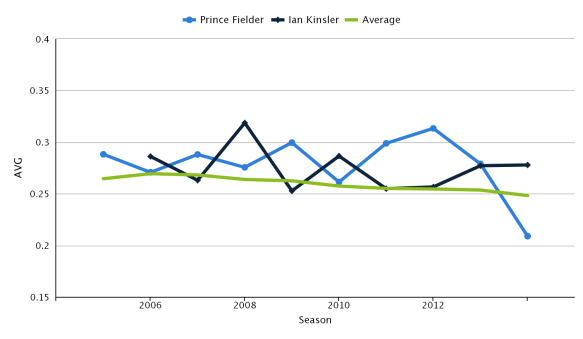
Kinsler has provided some real spark, though. Looking at the right side of this graph, you can see that, while he and Prince posted similar batting averages last season, Kinsler has kept the pace this year, but Prince has dropped off sharply with the Rangers.

chart

While Fielder has the edge in on-base percentage, probably due to his ability to draw walks (of the intentional and unintentional varieties), Kinsler’s hitting for more power (.133 ISO vs. .121 ISO) and is posting a better wOBA— a catch-all offensive metric– than Fielder (.319 vs. .277). They also have the same number of home runs (two), with Kinsler driving in nearly twice as many runs as Fielder (14 vs. 8), while stealing three bases (to Fielder’s zero, obviously).

Less than a month later, Prince’s season would be over, a completely understandable side effect of probably overdue neck surgery.

Kinsler powered right along, though, making 726 plate appearances in a career-high 161 games. His bat seemed to cool off in the second half of 2014 (.353 wOBA vs. .276), but he still managed to finish the season tied with Miguel Cabrera for the title of most valuable Tiger, as determined by fWAR (5.1 fWAR apiece), although much of that was due to Kinsler’s defense (and Cabrera’s lack thereof).

In reviewing last year’s statistics in anticipation of this season, Kinsler’s numbers jumped off the page for one main reason: his walks had disappeared. Continue reading