Up in smoke: Duck Dunn, dead at 70

On Sunday, Donald “Duck” Dunn, longtime bass player for legendary Stax Records house band Booker T. & the MG’s died in Tokyo at the age of seventy. As first reported by best friend, bandmate, and guitarist Steve Cropper, Dunn “died in his sleep . . . after finishing two shows at the Blue Note Night Club.”

Dunn grew up with Cropper in Memphis, and the two formed a band in the late 1950s before going to work for Stax, where they eventually became half of the house band, Booker T. & the MG’s, alongside Booker T. Jones (organ) and Al Jackson (drums). AllMusic lays out the essentials:

As the house band at Stax Records in Memphis, TN, Booker T. & the MG’s may have been the single greatest factor in the lasting value of that label’s soul music, not to mention Southern soul as a whole. Their tight, impeccable grooves could be heard on classic hits by Otis Redding, Wilson Pickett, Carla Thomas, Albert King, and Sam & Dave, and for that reason alone, they would deserve their subsequent induction into the Rock & Roll Hall of Fame. But in addition to their formidable skills as a house band, on their own they were one of the top instrumental outfits of the rock era, cutting classics like “Green Onions,” “Time Is Tight,” and “Hang ’em High.”

As a member of the MG’s and as a session musician, Dunn played with (hyperlinks to video evidence) Redding (also including the 1967 Monterrey Pop Festival performance), Sam & Dave, Wilson Pickett, Eric Clapton (with Phil Collins), Neil Young, and, famously, the Blues Brothers, among many others.. He, Cropper, and Jones also were part of the band backing Clapton, Young, Bob Dylan, George Harrison, Tom Petty, Roger McGuinn, G.E. Smith, and other stars on the Bob Dylan 30th Anniversary Celebration.

Also as a member of the MG’s, Dunn was inducted into the Rock and Roll Hall of Fame in 1992 and received a lifetime achievement award in 2007.

At this point, I don’t find anything on the web beyond the basic AP-style report, but I’ll supplement this post with any engaging remembrances that appear later. My only additions are: 1) Blues Brothers is my favorite movie; 2) this is some great music; 3) dial up Otis and Duck from 1967’s Monterrey Pop Festival; and 4) there would seem to be something to be said for dying (basically) doing what you love.

Close with a clean-shaven, pipeless Dunn and his fellow MG’s performing their biggest hit, “Green Onions”:

Jam the Bountygate Shuffle

We do a lot here with sports and music, so an opportunity to combine the two is pretty irresistible. Such an opportunity comes today in the form of a positive externality of the NFL’s crackdown on the New Orleans Saints’ bounty program, which we’ve been covering here on a derivative level. Back in March, the league suspended Saints head coach Sean Payton for a year because of the bounties. As a Deadspin reader reports, Payton seems to be handling his time off just fine.

At least nominally, Grace Potter and the Nocturnals have been on my radar since college, when they started getting some pub and a friend got into them, but I never listened to them, and I figured my friend’s allegiance to Grace Potter was based mostly on them both being female Vermontsters. When I saw today’s Jam for the first time, though, I realized my assumptions about Potter’s sound were inaccurate, and she, Warren Haynes, and Sean Payton are welcome to rock ZZ Top anytime:

To what we’re listening: Root Glen’s Winter EP

Whether it’s emails from East Anglia or that leftover, freezer-burned Yankee pot roast that once warmed my chilled, cabin-feverish soul and has yet to depart the refrigerator, I just can’t trust the seasons anymore. (Blame my preference for pre-Enlightenment alchemedic metallurgy over 21st century “science” or the fact that it was 40 degrees two days ago and today it was 80 and hailing with the sun out.) One thing in which I’ve learned I can trust, though, is the continued development of the band Root Glen. That trust is based on being more than seventy-five percent of the way through the New Jersey-based band’s formative year of quarterly, seasonally themed releases. In fact, that year’s almost up, as the group’s spring offering is due out shortly. I don’t even care that this review is so late, because it could snow tomorrow in Topeka, and you need to be mentally ready for that.

The sparse, dry, wintry sounds of “Throw it in the Bay” appropriately open Winter, and the tune is an excellent way to start this EP. The sound immediately transports the listener to that dark, snowbound cabin depicted in the cover art. The verse rocks out in a fashion reminiscent of the darker turn heard on the band’s Fall release with a few appropriate variations: 1) rather than straight-ahead rock, there’s a slight jam feel around the fringes creating more of a slowly looping feel, something that both reminds the listener of the band’s loose, early sound and, here, suggests a nice feeling of ongoing despair; 2) the production value continues to improve, and on this song, it serves to mute the sound– much like a heavy snow would– as much as tighten it; 3) guitarist Ross Griswold’s lead line threads a long approach through the song that both compliments the feel described as variation (1) and 4) provides some developing continuity for those appropriately frequent times when the thicker parts back out into sparseness.

The second cut, “Lost in the Night” opens like Everlast’s “What it’s Like” and features an up-front exchange between David Moroney on vocals and Eric Blank’s kit cymbals. Griswold tastefully varies the electronics on his instrument to create some subtle soundscapes underneath these two, and Andres Gonzales gets a feature toward the end after rooting this tune with his occasionally and deftly muted bass. And just as the first song gave way to a more prominent role for Moroney and Blank in the second, it’s Gonzales’ more pronounced bass that leads the way into “Removed.” The reggae feel hinted at with some of the jam sensibilities present in the first song appears in this third song, placing the listener on a calmer, higher plateau after rising through the first two pieces. Gonzales’ slightly slappy bass eventually gives way to an airy interlude that visually recalls standing on a mountain as clouds rush by in a time-lapse video.

This lilt continues into “Out of Frame,” which will be the first number likely to draw the casual listener to the EP credits to find out who’s playing that saxophone (Marty Eigen), but it’s the distant, unison vocals that especially recall Talking Heads’ Remain in Light. (While looking at the credits, the listener will discover that five additional individuals helped Root Glen on three of Winter‘s five songs in various ways, including everything from songwriting to vocals and instrumentation.) At last, “Caradhras” is a fitting tag for Winter, a seven and a half minute piece of modern progressive (post-progressive? post-post-progressive?) rock that contains a nice hook and a very slight bit of tension-and-release work while staying within the introspective confines of the EP.

With Winter, Root Glen shows listeners yet another of their faces, this one perhaps the most mature yet, reminding us very clearly of a season this year did not bring us. As before, you can stream or purchase Winter at http://rootglen.bandcamp.com/album/root-glen-winter. Catch up on the latest band news at RootGlen.com.

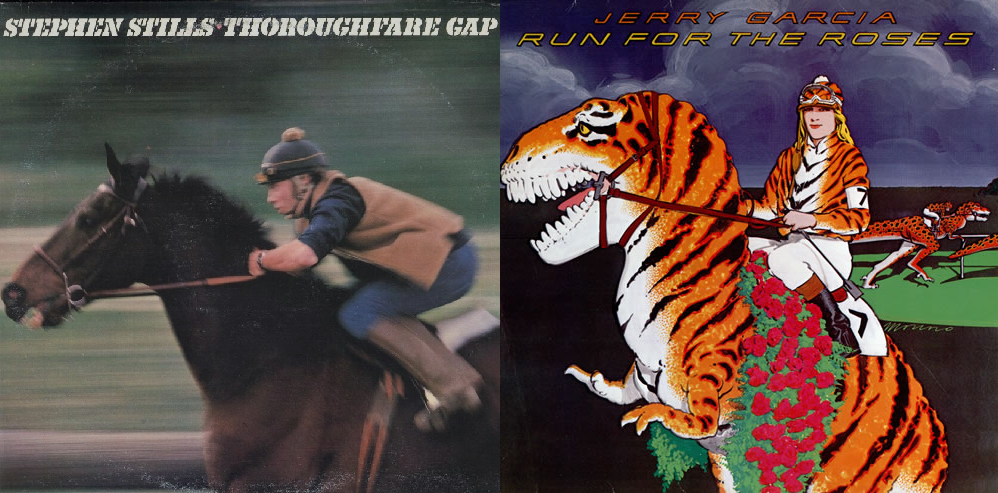
To what we’re (sort of) listening during the Derby: Stephen Stills and Jerry Garcia

Plenty of people have made good listening suggestions for Derby day (HT: @amention, who also gave us yesterday’s timely jam), but two of the musical selections I most associate with horse racing are strikingly mediocre offerings by two top-tier musicians.

First up is Stephen Stills’ Thoroughfare Gap, a 1978 release that is the lowest-rated of all Stills’ albums on AllMusic. Usually thorough (sorry), AMG’s review is a mere two sentences long: “A rather poor attempt of Stephen Stills’ to adapt to the disco/dance craze. Includes lame covers of Buddy Holly (‘Not Fade Away’) and Gregg Allman (‘Midnight Rider’) along with the semi-hit title track.” Click here for a live take of that title track in which the Texan sounds alternatively tired and British, although his acoustic guitar is expectedly dexterous.

Jerry Garcia’s 1982 Run For The Roses received a few more lines in its AllMusic review, but it really isn’t any more glowing, beginning by noting that it’s the last release for the Jerry Garcia Band and “sadly, it is also Garcia’s most lightweight effort as a bandleader,” and including adjectives like “marginal,” “impotently executed,” “underachieving,” and, with respect to the cover art (pictured above, right), “disconcerting.” Like Thoroughfare Gap, the title track is the best-regarded selection on Run For The Roses. Here‘s a lazy live version from an undated JGB performance.

What’s playing in the background of your Derby party?

Backwards down the springtime line: A reader-suggested Friday Jam

Reader, commenter, and master of the Monday Link Parade and Heli Free Sawatch domains Andy sends in this week’s Jam, and I went for it without hesitation, save the time it took to swap out the static video for this live-action version, which sacrifices nothing from the studio version, particularly as regards Charlie’s more energetic playing and Mick Taylor’s work on lead axe. Had the latter not left the Stones, one wonders who might have bourne Clapton’s nickname today.

The Strange, Tense Power of Talking Heads’ ‘Fear of Music’ (via The Atlantic)

When Fear of Music was released, the group was on the verge of outgrowing local New York success and moving toward the arena-filling, ten piece musical funkanauts they would be circa 1984’s concert doc Stop Making Sense. The success of their cover of Al Green’s “Take Me to the River” and appearances on Saturday Night Live and American Bandstand had gained the group a wider audience, yet made them wary of selling out. This gave rise to a set of contradictions that would manifest even on Fear of Music‘s jacket: all black with raised worm-like shapes reminiscent of tire tread or, in Lethem’s view, a steel door that evokes both a “chilly authority” and “desire to be stroked.”

[Author Jonathan Lethem’s] slow approach [to the album] yields big, as it reveals a record composed not of disparate songs, like, say, a short-story collection, but a “concept album” in the most abstract yet perhaps truest sense. Fear of Music tells no narrative, but weaves together its bleak motifs in such a way that a resonance chamber forms, the pop music equivalent of the postmodern, fractured books of Italo Calvino. Parts that at first seem only distantly related start to feel of a piece the further one goes and the closer one looks. The majority of the song titles act as a table of contents of sort—”Mind,” “Paper,” “Cities,” “Air,” “Heaven,” “Animals,” “Electric Guitar,” “Drugs”—all riffing on themes of restlessness, dissolution, and instability. Crackpots, conspiracy theorists, criminals, and druggies emerge as characters, and a bleak landscape forms. Make no mistakes, it’s the apocalypse. … Read More

(via The Atlantic)

Friday Jam: He was Levon, and He was a Good Man.

The news came out of Woodstock on Tuesday, from his wife and daughter, that Levon Helm was in the final stages of his battle with cancer. When I first read it, I had to close the door to my office for a few minutes. I couldn’t quite figure out why it shook me up so. It’s not like I ever met the guy. I saw him perform live only once. But he’s unique among my musical icons, if you can call them that, insofar as I feel like we’d relate to one another. That we’d have something to talk about, that he wouldn’t be too uppity to say a few words, and that it wouldn’t just be polite conversation. That a man who grew up in a town called Turkey Scratch would be all that you’d expect – easy going enough to sit down and have a beer with you and tell stories for hours, no matter who you were. By all accounts, he was. I’d conned myself into thinking we’d been old friends.
 ——-
At that moment when you realize that The Band sings The Weight and Up On Cripple Creek, it occurs to you that you’ve been a fan a lot longer than you’ve known. But my first experience with The Band, the moment that I had a realization that the band I was loving was none other than The Band, occurred in my sophomore year of college (So late – for shame!). My roommate at the time had “discovered” them recently, and honored his discovery by playing The Night They Drove Old Dixie Down. Over and over again, at top volume, for a couple weeks. No exaggeration. I’d say he played it ad nauseum, but I can’t recall it even getting old.
 
And it didn’t get old when, each year, AD would call us together at Thanksgiving to celebrate and fellowship in a law school classroom, of all places, to watch the Last Waltz. Ironically, Levon hated that movie. But for me, and probably a lot of other folks, it’s the first glimpse you have of this man, and the spectacle of him crooning as he bangs the hell out of those drums.
 
When I finally saw him play live, at the Ramble at the Ryman in 2010, I was two weeks away from graduating law school. It was one of those late April days – sunny, not too cool, not too hot, air heavy with the fragrance of blooms and electric with life – that is the truest blessing of a southern Spring. A group of us grabbed dinner and headed downtown to worship. A perfect storm of circumstances that set it up to be a magical night, no matter which guests he brought on stage. The voice wasn’t what it had been before his surgeries, but it was still beautiful. As AD said to me on Tuesday afternoon, even afterwards, he never lost his inflection, that sound that makes it so immediately clear who is singing up there. But the voice sometimes faltered, so singing duties shifted throughout the evening. Still, he was grinning from ear to ear the entire night. Truly, I can’t recall a moment when he wasn’t singing or grinning. Or as this reviewer put it, looking like a proverbial pig in the shit. They closed the night with a cover of I Shall Be Released, and then I walked out and down onto Broadway with a crowd full of people who were quiet with the recognition that the night had been a special one, even by Nashville standards. For me, it still makes The List.
 
He left us yesterday, so we’ll honor him with today’s jam. We picked The Night They Drove Old Dixie Down, but if you are satisfied with one song right now, you’re a better  man than me. To that end, here’s a great spotify playlist from Rolling Stone to keep you listening for a while longer.
 
Ramble on, old friend.
 

Silent Film Series: Virgil “Fire” Trucks (Detroit, MI 1956)

I’m sort of cheating with the second featured film in ALDLAND’s Silent Film Series, because a) it already is a silent film and b) its selection largely has to do with the music indirectly associated with it. Still, I’m guessing most artists would be willing to cheat a little if it meant avoiding a sophomore slump, so I don’t feel bad at all.

And this short (7:23) movie really is kind of beautiful. It’s amateur footage shot on 8 millimeter film by members of the Capurso family depicting an outing to see the Yankees play the Tigers on a sunny summer afternoon at old Tigers Stadium on August 4, 1956. It opens with scenes of downtown Detroit as the family heads to the ballpark, where the Tigers would win a game that featured home runs by both Mickey Mantle and Al Kaline.

Of greater interest to me is the Tigers’ pitcher that day, Virgil “Fire” Trucks. He’s the great uncle of guitarist Derek Trucks and was no slouch on the mound. From a Peter Gammons profile piece:

Virgil Oliver Trucks was born on April 26, 1917. He won 177 Major League games from 1941 until he retired in 1958. Ted Williams once said he might have been “the hardest throwing right-hander I ever faced.”

He is one of four pitchers who threw two no-nos in a single season and he finished fifth in the American league MVP race in 1953 for the White Sox (he started that season with the Browns). And back when the Tigers won the 1945 World Series, Detroit’s great staff was called “TNT” — Dizzy Trout, (MVP) Hal Newhouser and Trucks were three of the best in the game.

Go back to the beginning. Andalusia of the Alabama-Florida League. 1938. Including the playoffs[, he] struck out 448 batters.

448. That, Sweet Melissa, is the most strikeouts ever recorded in an organized professional baseball season.

And for the full season, he was 25-6, with a 1.25 ERA and two no-hitters.

After a strong 1939 split between Alexandria and Beaumont, in 1940 he pitched for Beaumont in the Texas League and threw another no-hitter, in 1941 threw another no-no for Buffalo in the International League and by the time he made his debut on Sept. 27, 1941, he had four Minor League no-hitters on his resume.

Somewhere along the way, they tried to figure out how hard he threw. “They found an old Army gun,” says Trucks. “It read 105 miles an hour.”

Gammons’ piece is full of stories about Virgil, including how he helped the Tigers win the World Series after taking two years off to join the war effort, how he nearly became the only pitcher ever to throw three no-hitters in one season, how he’d add two more World Series rings to his total, and how he decided, after meeting with Derek– who keeps one of Virgil’s baseball cards on his Gibson– and learning that his great nephew is considered one of the best guitarists who ever lived, that maybe he ought to start listening to the Allman Brothers Band (the 95-year-old former pitcher’s nephew, Butch Trucks, was a founding member of that band, with which Derek now plays).

The younger member of the Capurso family who uploaded this added some generic classical music from the London Metropolitan Orchestra, but I maintain that it’s best experienced silently, the original audio being lost to technology, and the music of Virgil’s descendants yet to be born.

(HT: @DerekAndSusan) 

_______________________________________________________

Previously
Silent Film Series: Baron Davis (Oakland, CA 2007)

Related
Album review: Tedeschi Trucks Band – Revelator

Whip to Grave: Levon Helm, the Real Voice of America (via Esquire)

This was healing music, but it was in no way peaceful. Levon’s voice made sure of that. It was tough and sound and brooked no easy answers. (When, an album later, he voiced the story of Virgil Kane, a grunt in the Confederate army, he managed to push the story beyond politics. You swear by the mud below your feet and you make a pact with the land that nothing can break.) It was a Southern voice, certainly, but there was in it that universal sense that we are all in this great experiment together, that we hold a number of truths to be self-evident and the ones that Mr. Jefferson listed were only the very beginning of them. That there is a commonwealth that binds us, through the worst of what we can do to each other, and the worst of what we can make of our promise. For all the wild rhetoric and the political posturing, and for all the horror that extended from My Lai to the floor of the kitchen of the Ambassador Hotel and back again, that we all had an America to come back to, no matter how long we were away, no matter even if we were half-past dead. Because that America was the America of the tall tale, the underground history, the renegade, buccaneer country that belongs to all of us. Levon Helm told those stories. He gave that history a voice that we could all hear over the din of the times.

He was the true Voice of America, as far as I’m concerned. … Read More

(via Esquire)

______________________________________________

I’ve praised and criticized Charles Pierce here before. I’ve never criticized his ability to write, though, and he posted the excellent textual snapshot excerpted above this morning, as Levon’s health currently and precipitously fades.