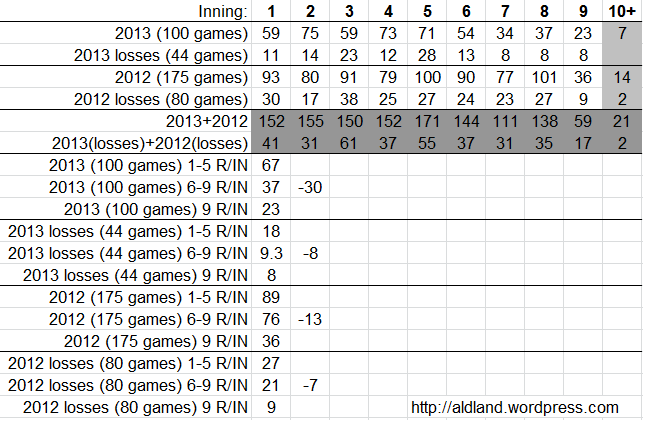
ALDLAND celebrated tax day this year by taking a dive into the numbers behind the Detroit Tigers’ offensive production. Since last season, I had developed the feeling that this should-be offensive power was having trouble scoring late in games, hamstringing their ability to mount comebacks and generally secure a win in the later innings, and I wanted to investigate to see whether that really was the case.
The evidence I gathered in April appeared to support my hypothesis. The 2013 season was just twelve games old, though, and it was difficult to ascribe too much meaning to data gathered from such a small sample set. As of today, however, Detroit has played one hundred games in the 2013 campaign, so I decided to update the numbers:
The middle of July is one of the slowest times in sports, but the MLB came through by banning Ryan Braun for the remainder of the season for violating its drug policy and provided us with more than enough fodder for a podcast. Listen as Marcus and I discuss the Braun story and related subplots, as well as our thoughts and advice on workout gear and a recap of Lefty’s big win in Scotland.
_______________________________
Download the ALDLAND podcast at our Podcasts Page or stream it right here:
As I have acknowledged in the past, I am not perfect. I realize now that I have made some mistakes. I am willing to accept the consequences of those actions. This situation has taken a toll on me and my entire family, and it has been a distraction to my teammates and the Brewers organization. I am very grateful for the support I have received from players, ownership and the fans in Milwaukee and around the country. Finally, I wish to apologize to anyone I may have disappointed — all of the baseball fans especially those in Milwaukee, the great Brewers organization and my teammates. I am glad to have this matter behind me once and for all, and I cannot wait to get back to the game I love.
Braun failed a drug test back in October 2011, but he was successful in overturning a fifty-game suspension on appeal by identifying a procedural deficiency in the testing process. During the pendency of that appeal, Braun stated:
This is all B.S. I am completely innocent.
Following its resolution in his favor in February 2012, Braun held a press conference where he issued a long statement, excerpted here:
…
[T]this is without a doubt the biggest challenge I’ve ever faced in my life, and it’s made it that much more challenging that I’ve had to deal with it publicly. But I truly view this challenge as an opportunity, just as I’ve viewed every other challenge in my life – as an opportunity. I’ve tried to respect this process, even though the confidentiality of the process was breached early on. I’ve tried to handle the entire situation with honor, with integrity, with class, with dignity and with professionalism because that’s who I am and that’s how I’ve always lived my life.
If I had done this intentionally or unintentionally, I’d be the first one to step up and say, “I did it.” By no means am I perfect, but if I’ve ever made any mistakes in my life I’ve taken responsibility for my actions. I truly believe in my heart, and I would bet my life, that this substance never entered my body at any point.
…
I’ve always stood up for what is right. Today is about everybody who’s been wrongly accused, and everybody who’s ever had to stand up for what is actually right. Today isn’t about me, it isn’t just about one player – it’s about all players. It’s about all current players, all future players and everybody who plays the game of baseball.
…
Ultimately, as I sit here today, the system worked because I am innocent, and I was able to prove my innocence. After today I look forward to returning my focus to the game of baseball, being able to get back with my teammates, allowing my life to return to some sense of normalcy and focusing on helping our team get back to the post-season.
A very special edition of the ALDLAND podcast this week as blog founder AD joins us to talk NBA free agency and the MLB all-star game. Marcus and I revisit some of our MLB picks from the start of the season and AD makes his own.
_______________________________
Download the ALDLAND podcast at our Podcasts Page or stream it right here:
On Tuesday at Yankee Stadium, George Brett will hold a news conference to talk about the most famous moment in his Hall-of-Fame career: the Pine-Tar Game.
Yet absent from that news conference will be a 47-year-old New York cop named Merritt Riley, who feels personally responsible for the pine-tar debacle.
“I really believe the Pine-Tar Game would never have happened if I hadn’t done what I did,” said Riley.
Speaking publicly for the first time ever about his role in the Pine-Tar Game—which took place 30 years ago this month—Riley said, “I remember it happening like it was yesterday.” … Read More
Involving myself in this project meant developing a more intentional approach to sports observation, fandom, criticism, and so forth. Part of this was reorienting my daily and weekly routines in order to make myself more aware of important events happening in the sporting world, and to place myself in a position to be paying attention to those spaces in which something important to that world might be about to happen. My immersion has not been total, of course. (See, for example, this site’s golf coverage.) Some aspects have required greater degrees of adjustment. Others have felt much more natural, though, and baseball probably leads that group. Living within the terrestrial boundaries of the Detroit Tigers Radio Network (and Fox Sports Detroit) during the 2012 season meant keeping up with that team on a near-daily basis was as easy as passively listening to the radio at night after work. Baseball is a sport that, for the fans, is designed to seep into the mind over time, a multi-month titration of awareness appreciable only at some distance. Writing a serial feature on that team only made sense. Having an outlet for accumulated observations and possible trends, interesting stories about the team, and personal experiences was a way to process a 162-game season, memorialize those little thoughts, observations, and experiences, and generally gain that periodic distance from the game’s day-to-day that makes caring about the next game and the next series fun.
Listening and watching that much baseball– 2013 finds me tracking two teams in particular– is a great way to learn about the game, and I wanted to carve a space outside of those individual team features to write about some of baseball’s details and strategy. I would like this to be more about aspects of the sport that are hiding in plain sight: readily observable things that, when noticed, would enhance any fan’s enjoyment, rather than complex statistical analyses, although I do have some thoughts on the unavoidable topic of sabermetrics. My thought is that each post in the series would look at one isolated issue or nugget of information that, when I happened across it, felt like something I was really glad to know as a slightly more than casual baseball fan and something other, more casual fans might appreciate knowing too.
Here’s a brief, very simple example to kick things off:
The short answer is yes, the Detroit Tigers are baseball’s unluckiest team this year.
Baseball Prospectus has a semi-interactive feature called “Adjusted Standings,” which looks just like an ordinary baseball standings grid, but it has a few extra columns. I don’t pretend to understand the number crunching that’s going on behind the scenes to determine the precise contents of those extra columns, but I do understand the gist of the concept, which is to assess the relationship between a team’s outcomes and the quality of its play. Teams that play the game well usually win games. Sometimes teams play poorly but still win. Sometimes teams play well but lose. If such an incongruity persisted over the course of many games, we reasonably could say that the reason was due to good luck or bad luck.
In the Tigers’ case, that chart shows that, for three different ways of measuring teams’ luck (look at columns D1, D2, and D3), no team has had worse luck than the Tigers this year. Continue reading →
This year’s Detroit Tigers are far from perfect, but they’re off to a good start on the strength of their starting pitching and the bats of Miguel Cabrera, Prince Fielder, Jhonny Peralta, Torii Hunter, Omar Infante, (increasingly) Victor Martinez, and (once again) Austin Jackson.
The weak link– the bullpen– has been both very obvious and very weak. Hoping for some addition by subtraction, the club sent onetime-closer Jose Valverde down to the minors, and a more focused “closer-by-committee” approach has emerged, centering around Joaquin Benoit and Drew Smyly, with an emphasis on not misusing Phil Coke.
One of the criticisms of manager Jim Leyland is that he likes to have go-to players to fill defined roles, and nowhere is this more applicable than in his handling of relief pitching. In short, Leyland wants to have one guy be his guy when it comes to closing out games in the ninth inning. His unwillingness to deviate from that approach has had exceedingly frustrating consequences when The Closer is someone less effective than the likes of a Craig Kimbrel or, say, a 2011-vintage Valverde. (This is especially true because the Tigers have trouble scoring late in games. If the bullpen blows a lead late, this team is unlikely to mount a comeback.) Even though fans would like to see Leyland be a bit more nimble with the way he utilizes his personnel, some of his attitude surely has rubbed off on them. The fans want to have someone who can be The Closer too.
My opinion is that, if the Phillies are willing to part with Papelbon without demanding much beyond the absorption of his contract, the Tigers should get him. If his steady hand can turn these cardiac kitties into some cool cats come playoff time, it’ll be worth it.
That said, it probably is worth taking a look at how Papelbon would stack up with his new teammates if he were to catch a ride to Motor City this season. Continue reading →
 Dinner is a popular event at the Abbey, and after last episode’s three-course meal, it seems it’s supper time again.

 On Tuesday at Yankee Stadium, George Brett will hold a news conference to talk about the most famous moment in his Hall-of-Fame career: the Pine-Tar Game.