Baseball Notes: New WAR Without an Act of Congress

During the 2018-19 MLB offseason, Baseball Prospectus revamped the offensive component of its main player-performance metric, WARP. For some people, this resulted in a significant alteration in the way they thought about the then-more-recent performances of some of the game’s top players, chiefly Miguel Cabrera and Mike Trout and the divisive MVP races of 2012-13 between those two.

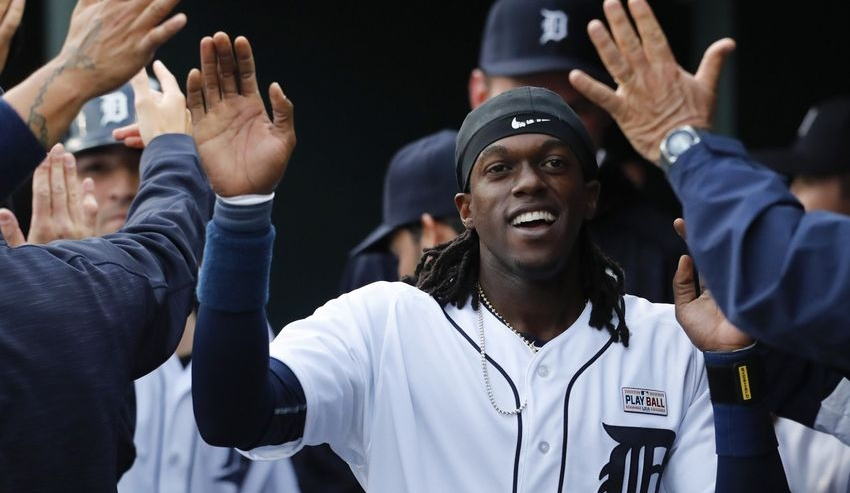
Now it’s FanGraphs’ turn to update its player-performance metric, WAR (a/k/a “fWAR”). Their tweaks don’t appear to be as methodologically fundamental as what BP did to WARP, but they did result in some slight– less than a win per season at the extremes– adjustments to players’ career fWAR numbers dating back to 2016. Among those who some people now will think are better players than they thought they were a few days ago (i.e., those whose fWAR numbers increased the most) are a batch of current and (mostly) former Detroit Tigers:

  • J.D. Martinez: +2.9
  • Tucker Barnhart: +2.0
  • Gio Urshela: +1.3
  • Austin Romine: +1.1

Avisail Garcia, meanwhile, was docked 1.4 fWAR, and Leonys Martin dropped 1.1 fWAR.

The full list of players seeing a shift of at least one win in their 2016-23 fWAR totals is here.

___________________________________________________________________

Previously
Baseball Notes: Offensive Discrimination
Baseball Notes: Current Issues Roundup
Baseball Notes: Baseball’s growth spurt, visualized

Baseball Notes: The WAR on Robbie Ray
Baseball Notes: Save Tonight
Baseball Notes: Current Issues Roundup
Baseball Notes: The In-Game Half Lives of Professional Pitchers
Baseball Notes: Rule Interpretation Unintentionally Shifts Power to Outfielders?
Baseball Notes: Lineup Protection
Baseball Notes: The Crux of the Statistical Biscuit

Baseball Notes: Looking Out for Number One
Baseball Notes: Preview

Related
Miguel Cabrera continues to shine in the DRC era
Miguel Cabrera further bolstered by sabermetric update
Trout vs. Cabrera, and Aging with DRC+ (via Baseball Prospectus)
Miguel Cabrera in the bWAR era

Everyone’s Going to be Worse: 2024 Detroit Tigers Season Preview Notes

Many have published their previews of the 2024 Detroit Tigers season. What follows are my notes from those previews, primarily the corresponding Baseball Prospectus annual chapter and its PECOTA projections, along with my own annotations and recent news updates.

Everyone’s Going to be Worse

Only the really hopeless Athletics and White Sox scored fewer runs than the Tigers in 2023. The reason the Tigers’ offensive outlook today isn’t hopeless (as any good Detroit fan will tell you too many times) is because Spencer Torkelson had a really good second half last season, and that’s going to be his new baseline for his major-league career, which really will begin this year. His 121 wRC+ and a homer every 16.2 plate appearances– his second half– sounds a lot more like a good first baseman than a 95 wRC+ and a homer every 31.3 plate appearances– his first half. Torkelson is the case study that proves Tigers fans’ optimism for 2024 is grounded in reality: all good trends will be banked as established new normals, while any bad trends have reasonable explanations and therefore safely may and should be ignored.

The cold baseball computer isn’t buying the Midwestern thaw. PECOTA projects every Tigers hitter listed in the team’s BP annual chapter to be worse in 2024 than he was in 2023. Can that sentence really be true? I don’t know whether it can but it is. Sure, some of these guys are Not Ready For Primetime Players, minors types whose prospect statuses merit their mention but, at least for this year, understandably don’t project as majors talent. But it really is bad news for all of the alleged major-league talent.

Continue reading

Are the Detroit Tigers a playoff team in 2023?

The 2023 MLB playoffs started two weeks ago without the Detroit Tigers, who’d been officially eliminated about a week beforehand and effectively eliminated long before that. Still, taking a look at the baseball being played this October, it’s difficult to escape the feeling that the Tigers had been a 2023 playoff team.

Infield/Catcher
Willy Adames*
Willi Castro
Kody Clemens
James McCann
Isaac Paredes

Outfield
Nick Castellanos
Avisail Garcia
Robbie Grossman
J.D. Martinez

Pitcher
Andrew Chafin
Chad Green*
Joe Jimenez
Michael Lorenzen
Joe Mantiply
Matt Moore
Erasmo Ramirez
Max Scherzer
Gregory Soto
Julio Teheran
Caleb Thielbar*
Justin Verlander
Justin Wilson

All of the foregoing players were rostered on 2023 MLB teams that made the playoffs and previously played for the Tigers or *one of their farm teams. Don’t let anyone tell you they can’t build a winner in Detroit. Also don’t let anyone forget that the AL East put three teams in the 2023 MLB playoffs, and those three teams posted a collective 0-7 postseason record this year.

Whose All Stars?

Image result for shane greene all star

The stars were out in Cleveland last night, but whose were they? A year ago, the 2018 MLB All-Star teams played a game for the age, one so representative of these true-outcome times that all but one of the fourteen runs scored that night came courtesy of a home run. Last night was much different. The 2019 all stars scored half as many runs as their 2018 counterparts (with just two total through five innings, sinking the under), and only two of the seven runs came off of home runs, solo shots by Charlie Blackmon and Joey Gallo. (Year-to-year strikeout totals nearly were identical.) As a whole, MLB is seeing its highest-ever percentage of runs scored attributed to home runs through this point in the current season, but its ostensible 2019 stars hit like they came from 1989.

_______________________________

Last night’s ASG likely looked fairly familiar to fans of the Detroit Tigers, however, and not just because the current version of that team only scores 36.01% of its runs with homers, third-lowest in 2019. Even though Detroit had just one representative on this year’s AL All-Star team, Shane Greene wasn’t the only familiar face among the rostered invitees in Cleveland. Justin Verlander was the AL’s starting pitcher; J.D. Martinez was the AL’s starting DH (0-2); James McCann caught Greene’s perfect seventh inning; and Max Scherzer was named to the NL squad (did not play).

The Tigers currently have the second-worst win percentage in baseball– still good enough for fourth in the AL Central!– and resume their regular season schedule Friday against the basement-dwelling Royals.

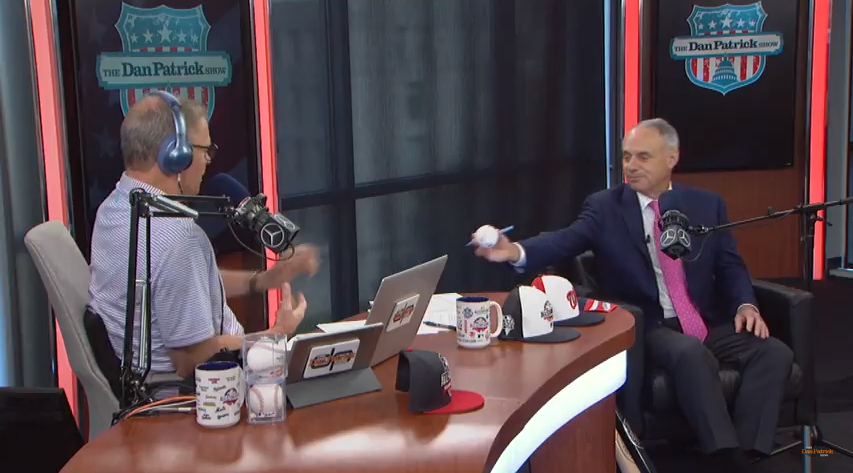
Designated Sitter, or, Manfred Ado About Nothing

manfred dp

For people who write about baseball, the All-Star break offers at least two things: (1) an intraseasonal oasis in which one can examine and address baseball topics over the span of a day or two without worrying that the otherwise constant barrage of new baseball events occurring that might, for example, mess up the performance numbers on which a writer had founded his or her baseball writing and (2) a probably countervailing force in the form of significant public interviews with the sport’s leaders addressing the sport’s Big Topics Of The Day.

Regarding the latter, Commissioner Rob Manfred kicked things off this morning with an appearance on Dan Patrick’s radio show. Here are my notes of the highlights:

manfred dp notes

People love to talk about the designated hitter and whether the National League will adopt it, and Manfred’s mention of the subject this morning predictably reignited the “conversation”:

I suspect that those on the fence or without a considered opinion on the subject may have found prodding from recent articles like this one Ben Lindbergh published last month illustrating the historically poor offensive numbers from current pitchers. What many of these conversants don’t do is think about this conversation from the DH side, however. There really is no doubt that a designated hitter is going to bat better than a pitcher, but the nature of the DH position is changing, both in terms of the players who are filling that role and their performance levels.

Regarding the union’s particular partiality to the DH, are David Ortiz-types really the players finding extra PAs as designated hitters? Take a look. Continue reading

Saving Detroit: Yo, a J.D. Martinez trade comp

cespedes-crabs-660x330

Last night, I provided my instant reaction to the trade that sent J.D. Martinez to the Diamondbacks for three modest infield prospects. In that post, I considered what many are calling a “very light” return for the slugging outfielder in the context of another star-for-prospects trade made just days ago between the two Chicago teams involving starting pitcher Jose Quintana and suggested that a lesser return for Martinez was appropriate in light of his contract status (expiring), age, injury history, and inconsistent defense. I further suggested that, with multiple transactions still to be made over the next two weeks, it is too early for a referendum on Detroit’s general manager, Al Avila.

Avila is a first-year GM, but he worked alongside previous Tigers GM Dave Dombrowski for many years and is an experienced and well-regarded talent evaluator, so the job isn’t exactly new to him. Yet, in some Tigers fan circles right now, Avila is being pilloried as an unqualified, incapable rookie, while Dombrowski has never been remembered more fondly.

As I wrote last night, even if this trade becomes a blemish on Avila’s resume (the more thorough analyses of the prospects involved in the trade out this morning paint a more detailed picture but don’t really contradict the experts’ immediate reactions), it’s much too soon to declare him unfit for his current position. In addition to the Quintana trade discussed last night, though, there is another trade we can look to as a rough comparison between Avila and Dombrowski: the 2015 Yoenis Cespedes trade.

With the non-waiver trade deadline rapidly approach, on July 31, 2015 Dombrowski traded Cespedes to the New York Mets for two pitching prospects: Luis Cessa and Michael Fulmer. That trade, along with two previous ones that sent David Price to Toronto (for lefty pitching prospects Daniel Norris, Matt Boyd and Jairo Labourt) and Joakim Soria to Pittsburgh (for JaCoby Jones), surprised some Tigers fans, who were not necessarily soothed when Dombrowski described what looked to some like a sudden selloff as a mere “rebooting.” Not insignificantly, these trades immediately cost Dombrowski his job.

In isolation, the Cespedes trade– from Detroit’s standpoint– looks fairly similar to yesterday’s Martinez trade. Both players were on expiring contracts and thus guaranteed only to be rentals for the receiving teams (and an unusual clause in Cespedes’ contract actually made it less likely that the Mets would be able to sign him as a free agent, though Cespedes waived that provision and did remain in Queens). In the first half of 2015 (the split most readily available to me as a rough approximation of a snapshot at the trade deadline), Cespedes had a 121 wRC+ (45th among qualified hitters) and contributed 3.3 fWAR in 366 plate appearances. In the first half of 2017, Martinez posted a 156 wRC+ (would have been eighth among qualified hitters had he played enough to qualify) and contributed 1.4 fWAR in 215 plate appearances.

Cespedes memorably caught fire at the plate upon moving to New York, but he had been a lesser hitter than Martinez was over the same stretch– both in terms of a direct comparison and relative to his in-season peers– in 2017. Without a more detailed and complex analysis of the different trade markets in the different seasons, it’s difficult to say more about the two players’ relative value in this space.

The return for Cespedes– Cessa and Fulmer– was more lauded both at the time and now, in retrospect, than the return for Martinez. Fulmer immediately was highlighted as a significant prospect, and he turned in a full-season performance the following season that earned him rookie-of-the-year honors and some Cy Young votes, and he was named to his first All-Star team this season. (Cessa never played for the Tigers, who shipped him to the Yankees that offseason as part of a package that returned Justin Wilson, the team’s current closer and valuable trade chip.)

We don’t have two years of hindsight from which to assess the future development of Dawel Lugo, Sergio Alcantara, and Jose King, but, from my review of the assessments of these players by experienced prospect writers, it’s hard to see a Fulmer-caliber player among them. It remains too early to render significant judgments about Avila’s capabilities as a front-office leader, and Lugo, Alcantara, and King may have been the best available return for Martinez on the current market. To the extent Dombrowski’s 2015 Cespedes trade is an adequate comp for Avila’s 2017 Martinez trade, though, it’s not one that– in isolation– reflects especially well on Avila.   Continue reading

Saving Detroit: Martinez trade triggers premature referendum on Avila

r74499_608x342_16-9

Shortly before tonight’s game against the Royals in Kansas City, the Detroit Tigers traded right fielder J.D. Martinez to the Arizona Diamondbacks in exchange for three infield prospects: Dawel Lugo, Sergio Alcantara, and Jose King.

As he has in every season since he joined the Tigers and reconstructed his swing, Martinez has been among the best hitters in baseball in 2017. If he had enough plate appearances to qualify, he would be the fifth best hitter in baseball by wRC+ (162) to this point in the current season. He doesn’t yet have enough plate appearances to qualify, though, because he again missed time due to injury this year, and his defensive contributions continue to oscillate between positive and negative. He’s also a rental, with free agency and a significant payday headed his direction this offseason.

That last part is the reason the Tigers had to trade Martinez this month. In the combined absence of an ability to resign him on the open market and of a currently competitive team, they had to cash out whatever value they could now. Still, most Detroit fans are reacting to this trade with extreme disappointment, and national observers are calling the Tigers’ return for Martinez “very light.”

Yes, Martinez likely is going to crush left-handed pitching in the NL West and see his power numbers soar even higher in the thin desert air, but he’s still a rental with an inky injury report. Tigers fans understandably came to love Martinez, but their apparent hopes that his always inevitable trade would return a prospect haul the likes of which the White Sox just secured from their crosstown rival in exchange for Jose Quintana are not reasonable. Since 2014, Martinez has been worth 9.2 WARP and Quintana has been worth 12.7 WARP. (Simply for context, Miguel Cabrera contributed 14.5 WARP over that period.) The new Cubs pitcher also is over a year younger than Martinez and has team-friendly years remaining on his contract. It makes sense that trading Quintana would net the White Sox a package including one of the sport’s overall top prospects. Ten weeks of Martinez simply pales in comparison.

The Tigers’ trade has generated plenty of criticism of the team’s first-year general manager, Al Avila. I am not a prospect scout, but, from the perspective of the team’s fan base, I think much of this criticism is, at a minimum, premature. Avila has many years of experience as an assistant general manager under Dave Dombrowski and is well-regarded as a talent evaluator. He is entitled to the same benefit of the doubt fans accorded Dombrowski, whose transactions were regarded with assumed confidence and assessed together, rather than individually.

Still, it is difficult not to at least be a little bit disappointed right now, when the clear weight of the initial assessments of this trade do not cast Detroit’s position in a favorable light.

For Detroit, the 2006-2016 run is over and the proverbial window is closed. The next two weeks are of critical importance to this team’s future. Maybe they stumbled out of the gate with tonight’s trade, but there are more moves to be made. Keep an eye on Justin Wilson, Alex Avila, and even Justin Verlander. Painful as it feels, this, for better and worse, is how a new age of Detroit baseball begins.

______________________________________________

Previously
Saving Detroit: Michael Fulmer has righted the ship – 6/27
Saving Detroit: Tigers in Retrograde – 6/19
Saving Detroit: Fixing Justin Upton
 – 5/31

Saving Detroit: Soft in the Middle Now – 5/30
Saving Detroit: Reliever Relief, Part 2 – 5/11
Saving Detroit: Reliever Relief – 5/8

Related
Is the next Mike Trout already in Detroit?
Man vs. Machine

Is the next Mike Trout already in Detroit?

mlbf_554824983_th_45

He’s only twenty-five years old, but Mike Trout is the best player in baseball today and one of the best ever. There’s only one of him, though, and he’s under contract with the Angels through 2020, which means that your team can’t have him anytime soon, and, unless your team is the Yankees or Dodgers, it probably can’t afford him once he hits free agency either. If you don’t and won’t ever have Trout himself, your only option is to make like the post-Jordan NBA and find the next Trout. Everybody wants to be like Mike.

The Detroit Tigers, for example, really could use a guy like Trout. They haven’t done much this offseason, and they’re in need of a center fielder. Of course, they had a decent center fielder in 2016 in Cameron Maybin, but the team “traded” him to the Angels as soon as the season was over and, surprise, the Angels didn’t send Trout, who also plays center, to the Tigers in return.

While the hole in the middle of the outfield currently remains unaddressed (the team’s very recent acquisition of Mikie Mahtook notwithstanding), another anticipated outfield move that Detroit has not yet made is trading right fielder J.D. Martinez, who will be a free agent after this coming season. Martinez has been very good since the Tigers acquired him from Houston, and, assuming he returns to form following his elbow injury last season, he will earn a payday next offseason beyond what the Tigers likely will want to offer.

Before Martinez inevitably departs the Motor City, it’s worth taking another look at what exactly the Tigers have in their young right fielder, and, bold as it may seem, asking whether he’s the next Trout.

On one hand, the answer obviously is no. Martinez, in his best season, was, by whichever WAR metric you prefer, about half as valuable as Trout was in his best. There also is the matter of age: while we’d expect The Next Trout to be younger than Trout, J.D. is four years older than Mike.

On the other hand, anyone who’s followed Martinez’s career knows that he was reborn as a hitter after he left Houston for Detroit, creating a bit of deception in his developmental track (I’m sure he doesn’t spend much time thinking about those first three MLB seasons), even if the aging clock ticks on.

Imagining, for purposes of this strained and fabricated narrative, that this “young” Martinez was coming up behind the more experienced Trout, we might also notice that the two outfielders have similar batting profiles.

This afternoon, Baseball Savant creator Darren Wilman tweeted a link to a chart comparing hitters according to their batted ball exit velocity and slugging percentage:

scatter

Right there next to each other at the top of the curve are Trout and Martinez. (Click below to see more precise indications of their positions.)

Everyone knows Trout and Martinez are power-hitting outfielders, but I still was surprised to see how close Martinez was to Trout on this graph. Martinez’s overall value suffers because he plays an easier position than Trout, and, although his defense showed marked improvement in 2015 (before the improvements evaporated in his broken-elbow season last year), plays it less well than Trout plays his. Still, if I’m Martinez’s agent, a chart showing that my client hits– in terms of exit velocity and extra bases– just like Trout is going to be on page one of the Boras Binder I’m distributing this offseason. And if I’m Tigers GM Al Avila, I’ll make sure every potential trade partner this summer catches a glimpse of it too.

Sure, some still want Detroit to make another all-in push in 2017, but the proverbial contention window is hanging as heavy and tenuously in its frame as it ever has for this crew, and it’s tough to imagine a world in which they can retain Martinez. In five years, after seeing him mash in pinstripes or Dodger blue, Tigers fans may look back and see Martinez’s delayed, Trout-esque offensive prime as one of the largest costs of their now-overleveraged roster.

Offseason starts with a bang for the Detroit Tigers

maybin-gone

When the Detroit Tigers’ season ended in Atlanta last month, the message from general manager Al Avila was both clear and clearly different than it had been a season ago, when Avila took over the job from his boss, Dave Dombrowski. Then, speaking as the mouthpiece of the team’s owner, Mike Ilitch, he said that “the foot is on the pedal, hard,” and the team continued to make the kind of win-now moves that largely have defined them for the past decade. Now, though, Avila’s taking his foot off the gas and ushering in a period of austerity that’s likely to be painful. It definitely will be different.

The changes began immediately. Yesterday was the first day of the MLB offseason, and Avila wasted no time in making two of his biggest decisions on current player options. First, he “traded” center fielder Cameron Maybin to the Angels for a low-grade relief pitching prospect in a move that essentially amounts to the Tigers declining to exercise Maybin’s option.

Shortly thereafter, the team announced that it would pick up the $6 million option on closer Francisco Rodriguez. (Had they declined K-Rod’s option, they would’ve owed him a $2 million buyout.)

If, as he has said, his new mission is “making this team leaner, younger, more efficient,” I’m not certain this was the way to do it. Given the money, his track record, and his strong performance last season, I like the decision to retain Rodriguez, even considering the general year-to-year unreliability of reliever performance.

The Maybin decision is more confusing, though. By fWAR, Maybin was the Tigers’ most valuable outfielder last year, and he only played in ninety-four games. (He also was their second-best baserunner.) He missed action due to injury, but not really the kind of injury that should make teams worry. He mostly just kept getting beaned on the hands. That’s just bad luck. He’s only twenty-nine. Over the past two seasons with Atlanta and then Detroit, he finally seemed to be approaching the potential he demonstrated eleven years ago that caused the Tigers to spend the tenth overall draft pick on him in 2005. (He also was the team leader in the Instagram handle category.)

Now he’s gone again, leaving behind holes in center field and the top of the batting order. Jeff Sullivan, writing up this transaction largely from the Angels’ perspective, points a finger to JaCoby Jones as the likely replacement Avila is targeting. Jones showed memorable flashes as a late-season call-up this year, but, like many prospects, he’s still young and raw and inconsistent. The other obvious fill-in is Tyler Collins, who has the relative advantage of being a left-handed hitter but the disadvantage of being at an age and experience level where “raw” is not a baseball adjective that incorporates an element of hope.

All of this happened on offseason day number one. There will be more activity involving the Tigers this offseason, and, typically, it is wise to wait to render final judgment on a particular decision until it can be viewed within the full constellation of the team’s moves. Under austerity, though, there should be little hope for or expectation of near-term improvement through an infusion of external resources; doing better must mean doing better with what you already have. There isn’t going to be a Justin Upton trade this year (which, while we’re at it, probably will be the last year J.D. Martinez wears a Detroit uniform). What stings about the Maybin trade– besides the obvious departure of talent and the intangibles of a fun guy who seemed to be having a lot of fun himself– is that it is a move that will make the team worse in 2017, and the Tigers haven’t made too many moves like that in a good while.

Catching Fire: Night of a thousand feet of home runs

If not winning, the Detroit Tigers certainly have been doing a lot of home-run hitting over the last week or so, and, after some extra-inning disappointments during that stretch, they finally put it all together last night for an overtime win last night in a home series opener against the Seattle Mariners. That game featured three Tigers homers, each of which gave the team the lead. Especially exciting for Detroit was that two of them came off the bat of Justin Upton, who finally appears to be heating up for his new team after suffering one of the worst offensive stretches of his career.

jupwrc20gmavg

Upton’s first of the night was a dead-center bomb in the seventh that gave the Tigers a 7-6 lead, and his second, which clinched the game in walk-off fashion in the twelfth, landed beyond the bullpen in left. There likely is no one happier about this apparent return to power than Upton himself, and, especially with J.D. Martinez out with an elbow injury, it couldn’t be more timely for the team.

Upton’s homers last night inspired celebration, but Miguel Cabrera’s, which gave the Tigers a 2-0 lead in the first inning, inspired awe. I’ve never seen a Comerica Park home run hit where Cabrera hit his last night. No one has.

Have a look:   Continue reading