College Football Playoff Semifinal viewing and listening options

My latest post for TechGraphs outlines your options for watching and listening to the “New Year’s Six” bowls– the Peach, Orange, Cotton, Fiesta, Rose, and Sugar Bowls– taking place today and tomorrow. The Peach Bowl kicks off momentarily, with the two playoff semifinal games following this evening.

Go Green!

The full post is available here.

Regarding the folly of believing the Falcons are good

falco

To a very casual observer, a mid-December post on the 6-7 Atlanta Falcons would cry out for a Dickensian introduction, but it simply has not been a tale of two halves for these dirtier-than-anticipated birds.

Some, like MMQB’s Andy Benoit, really wanted to believe in that Victorian-era trope, though. Three weeks ago, Atlanta, which started the season 5-0, had lost four of five games, slipping to a 6-4 record. Falcons fans were beginning to lose hope, but Benoit told them not to panic, because “a closer look reveals a different story.” Benoit’s message was compelling in its simplicity:

On film, the 1-4, Stage 2 Falcons haven’t looked significantly different from the Stage 1 Falcons who started 5-0. And, OK, maybe the Stage 1 Falcons were not quite as good as their record indicated, but those five wins are a more accurate portrayal of the 2015 Falcons than the club’s four losses. The biggest difference between Stage 1 and 2 has been the dreaded turnover.

[T]he Falcons have beaten themselves with random fumbles and a few interceptions, of which only one was a truly bad offensive play. Ryan, cerebral as he is, has always had a slight tendency to take the bait and make a foolish throw or two into disguised or tight coverages. But interceptions have never been a major bugaboo. So unless you believe this will change in the final six games of Ryan’s eighth NFL season, there’s little reason to believe turnovers will continue to plague Atlanta.

Most likely, Atlanta’s fate hinges on how well its offense functions.

Combine the Stage 1 Falcons with the Stage 2 Falcons and what you’ll likely get is a Stage 3 Falcons club that finishes 10-6 and is a dangerous Wild-Card foe.

The seductive simplicity of Benoit’s thesis really is too good to be true. It seems easy to pick on him three weeks later, when Atlanta dropped all three games in that period and has an active six-game losing streak, but his reasoning would’ve been flawed regardless. Even if it’s true that turnovers– both fumbles and interceptions– fall within the realm of luck, and even if it also is true that the Falcons’ then-recent losses were due to turnovers, Benoit ignores the possibility that the team’s early successes also were due to luck. Instead, he simply assumes, without offering any evidence to that effect, that the team was playing closest to its true-talent level when it opened up 5-0, rather than when it went 1-4 (now 1-7, the same record with which the Detroit Lions opened the season). Couldn’t good luck have played just as much a part of Atlanta’s 5-0 opening as bad luck did in their subsequent losses? Of course, but in his overly rosy evaluation of the early season Falcons, Benoit apparently didn’t consider that.

At 6-7, Atlanta isn’t mathematically eliminated from playoff contention, but, with another game against the Panthers remaining and the Seahawks surging, they’re very likely done for the year.

In erasing their 5-0 start, the Falcons’ poor play in the last few weeks likely is a closer approximation of their true talent level than their results in the first five weeks. Indeed, as these charts illustrate, they’ve been historically bad from Week Six onward.

For postseason purposes, Atlanta no longer controls its own destiny (scenarios), but, at a minimum, it will need to beat its three remaining opponents– Jacksonville, Carolina, and New Orleans– to have a shot. According to FiveThirtyEight, the Falcons have a two-percent chance of making the playoffs, and their projected win probability this week against the Jaguars is fifty percent. Not great, Bob.

Aftershocks: What is Matthew Stafford’s future with the reorganizing Lions?

marthaOne week after Detroit Lions head coach Jim Caldwell elevated Jim Bob Cooter to offensive coordinator, dispatching former OC Joe Lombardi in the process, team owner Martha Ford brought the real thunder yesterday, terminating general manager Martin Mayhew and president Tom Lewand. Other front-office employees may have been fired as well, but available reports have been unclear on further details.

This is precisely the move the Lions needed to make, and while it probably should have happened years ago, Martha Ford has signaled that, under her watch, her family no longer is willing to accept losing and will take an active approach to building a winner. The biggest question now is how the team will go about hiring its new GM, and the experts already are suggesting possible successors.

A more concerning question arose amidst the breaking Mayhew/Lewand news, however, when a reporter covering that story stated that Matthew Stafford’s future with the Lions after the current season “is very much in doubt.” That reporter attempted to elaborate later in the day with remarks that seemed to lack internal logic, claiming, on one hand, that Stafford wasn’t smart enough to understand Lombardi’s offense, while observing, on the other, that he would be one of the top free-agent quarterbacks ever if Detroit released him. Is Stafford good or bad, Mr. Rapoport? Stafford’s teammates have aggressively bitten back against this new narrative, but the initial report gives credence to some recent rumblings about the quarterback’s future in Detroit. Would the Lions really trade or release Stafford? Should they?

This at least appears to be the dawning of a new era for the Lions, so it’s too early to know what options actually will be on the table for the team’s new GM. It is clear, though, that trading or releasing Stafford should not be one of them.    Continue reading

The Ghost of Grantland Past

grantland

ESPN reports:

Effective immediately we are suspending the publication of Grantland.  After careful consideration, we have decided to direct our time and energy going forward to projects that we believe will have a broader and more significant impact across our enterprise.

Grantland distinguished itself with quality writing, smart ideas, original thinking and fun.  We are grateful to those who made it so.  Bill Simmons was passionately committed to the site and proved to be an outstanding editor with a real eye for talent.  Thanks to all the other writers, editors and staff who worked very hard to create content with an identifiable sensibility and consistent intelligence and quality. We also extend our thanks to Chris Connelly who stepped in to help us maintain the site these past five months as he returns to his prior role.

Despite this change, the legacy of smart long-form sports story-telling and innovative short form video content will continue, finding a home on many of our other ESPN platforms.

Certainly not the Halloween surprise anyone who has enjoyed the talented collection of writing, podcasting, and video production that site has produced since it launched in 2011 wanted to see.

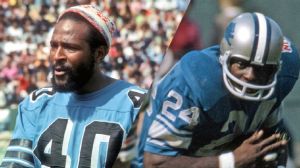
How Marvin Gaye’s NFL tryout changed his career (via The Undefeated)

marvinlionLem Barney had just finished a round of golf at Detroit’s Palmer Park Golf Course in the summer of 1968. Palmer, one of four prominent courses in the area, attracted many of the city’s black celebrities, including Joe Louis, Smokey Robinson and The Temptations.

Barney had heard Marvin Gaye, one of his favorite artists, lived nearby. With time to kill before heading back to training camp for afternoon practice, he figured why not? Gaye sang the score to Barney’s high school and college years at Jackson State University. The second year defensive back introduced himself to Palmer’s clubhouse employees, who quickly obliged with his request for Gaye’s address.

Barney easily found Marvin’s house, less than a mile-and-a-half from the course. When the legendary Motown crooner and avid sports fan opened the door, he instantly recognized Barney, inviting him in for breakfast.

For nearly two hours, the athlete and the singer chatted like long-time friends, bonded by mutual passions: sports and music. … Read More

(Via The Undefeated)

Window Shopping: Step Back From the Window, or, Thank You Very Much, Mr. Rebooto

The July 31 non-waiver trade deadline was an especially active period for the Detroit Tigers franchise, which made big moves both with player and front-office personnel.

Detroit traded three of the best players on its 2015 roster in the days and minutes prior to the trade deadline. The team’s biggest move, and arguably the biggest of one of the most active trade-deadline periods ever, was their decision to trade number-one starter David Price to the Toronto Blue Jays. They also sent closer Joakim Soria to Pittsburgh, and, in the final moments before the deadline, Yoenis Cespedes to the Mets.

The basic logic behind each of these moves is that, even prior to these trades, each of these players was, for all practical purposes, not going to be a member of the Detroit Tigers in 2016. That’s because each is in the final year of his current contract, meaning that each becomes a free agent at the end of this season. The Tigers would have no special ability to keep Price, Cespedes, or Soria in Detroit after the end of the 2015 season, and, given their individual successes, each is likely to fetch contract offers on the free market too rich even for Mike Ilitch’s blood. Rather than keep Price, Cespedes, and Soria for August and September on a team that’s unlikely to even make the playoffs, only to watch them walk away in the winter, the Tigers, with an eye on the post-2015 future, decided to cash in some of the value of these assets by trading them now. In doing so, Detroit converted these three expiring assets into six prospects, including five pitchers and one infielder.

Baseball analysts widely praised these transactions as beneficial to the Tigers, who, general manager Dave Dombrowski announced were “rebooting,” selling with the goal of remaining competitive in the near term, rather than undergoing a full rebuilding. The top return for Detroit was Daniel Norris, a now-former Blue Jay who lives in a van and shaves his beard with an ax. They also received Matt Boyd from Toronto, a younger starter who, in his recent Tigers’ debut, beat Johnny Cueto and the Royals.

Of course, the only real question for Detroit was not whom to trade but whether to trade. As July 31 approached, that question divided fans and, it later would be revealed, members of the team’s front office and ownership. As for the former group, most fans recognized the Tigers’ slim playoff odds and supported selling, although a minority that included this writer held out hope that the team could make one more postseason push before initiating a rebuild. Ultimately, Dombrowski’s “rebooting” seemed to satisfy both camps: Detroit would get close-to-ready prospects in exchange for their expiring assets. No long rebuilding process– a full surrender– was in store, just a quick retooling.

Two additional notes in the context of these trades: 1) one week before the trade deadline, Toronto, the biggest buyers, and Detroit, the biggest sellers, sat four and five games out of the last American League wild card position, respectively, and 2) while it isn’t at all likely that Price, Soria, or Cespedes will return to Detroit in the offseason, the effect of an unusual clause in Cespedes’ contract is that the Tigers actually increased whatever chance they have of resigning Cespedes by trading him.

_________________________________________

As the Tigers and their fans were settling into life without Price, Soria, and Cespedes, and enjoying their first trial run with Norris, who had a strong start on Sunday in Baltimore, unbeknownst to them, even more action was afoot behind the scenes.    Continue reading

Window Shopping: Pigs in the Pen

It’s July, which means it’s time for MLB teams to sort out their trade-deadline strategy. While fans distract themselves with All-Star festivities, general managers are preparing to execute player transactions in attempts to load up for a playoff run or, in acceptance of their near-term fates as noncontenders, build for the future.

In this context, the Detroit Tigers find themselves in a bit of a bind. After a very strong start, they’ve slid back to a .500 record and have been entrenched in the middle of the AL Central, never too far out of first place, but never really within striking distance. Would a first-place finish from this position be unprecedented? Hardly. Can they claim a fifth-consecutive division title without making a significant trade this summer? Almost certainly not. The Tigers’ record is not a product of underperforming their potential; instead, it likely is a reasonably accurate reflection of this team’s collective ability to date, warts, lower-body injuries, and all.

There is no question that the Tigers should be buyers this month, however thin their wallet may be with currency in the form of desirable prospects. I can’t say with any certainty whom Detroit should acquire this month– starting pitchers Johnny Cueto and Cole Hamels are the most valuable targets on the market, but the sellers’ prices may be too rich for the blood of the Tigers’ farm system– but I do agree with the prevailing preference for bolstering the pitching rotation. Shane Greene‘s floor proved too low to allow the team to continue to wait to see how high his ceiling might go, Alfredo Simon’s regressed to the very average levels we should have expected out of him as a starter, and, with appearances in just four games in 2015, Justin Verlander’s projected resurgence isn’t happening. The return of game-calling extraordinaire Alex Avila to his precarious post behind the plate can’t fix that many holes, and neither, I suspect, can J.D. Martinez‘s unsustainable home-run rate. Detroit needs to find another starter.

The trade-deadline attention on the pitching rotation represents a shift of attention away from their bullpen, the conventionally identified leading source of all of the Tigers’ problems. Continue reading

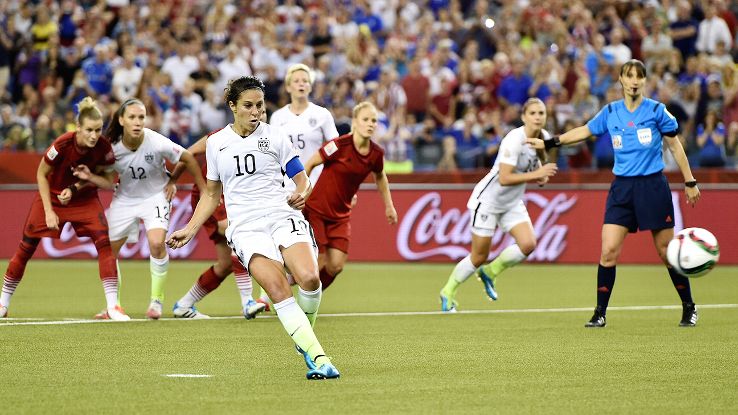
US defeats Germany to advance to World Cup finals

Last night in Montreal, the United States defeated Germany 2-0 to advance to the finals of the 2015 World Cup, which will take place on Sunday and pit the Americans against either England or Japan. Behind goalie Hope Solo and a staunch defensive back line, the team is riding a 513-minute shutout streak, and last night’s win makes the United States the first country to reach four Women’s World Cup finals.

I enjoyed watching the (second half of the) game last night, and I realized I probably enjoy watching the women’s team better than the men’s national team (the only other soccer-watching I do).

Pros:

  • The women seem tougher than their male counterparts. Result? Less flopping. Get that garbage outta here.
  • The USWNT is more successful against its competition than the USMNT. Result? More winning. Americans love a winner, and I’m no exception.

Con:

  • Smaller fan base, for whatever reason. Result? Less exciting viewing atmosphere. Watching every U.S. Men’s World Cup game last year was a broadly public, electrically focused experience. Here’s hoping folks come out to support the women this weekend.

In light of the fact that the number of soccer games I’ve watched in the last two years is in the single digits, further comment would overburden my limited experience with the sport. Instead, I’ll just be keeping an eye on Japan and England’s match tonight and rooting for an American victory on Sunday.