Urban renewal: Once Meyered in the Swamp, a Buckeye nut returns to his roots

I met Urban Meyer once, about a month after we won our first title with him at the helm. Through a series of very fortunate events, I actually got to have an uninterrupted conversation with the guy for about 20 minutes. In that time, it became obvious that February 2007 Urban Meyer only cared about two things: winning football games, and spending time with his family. And it was clear that, notwithstanding all the success on the first front, he was pretty upset about everything he was missing out on at home.

Which is why, 2 (and then again 3) years later, when he claimed he was leaving, at least in part, on account of his family, I believed it. I really think that was a big deal to him, and I think he has, by and large, taken great advantage of the time off to see his kids. But he loves coaching football, so seeing his inevitable return come a little quicker than I expected is understandable.

Given all that, I’m having trouble being mad at him. Sure, he said some ridiculous things about how he couldn’t step away and then end up coaching somewhere else in a year or two; how wrong that’d be. I’m sure he felt that way at the time, and I appreciated the sentiment. But he obviously can’t come back to UF now, and tOSU is his alleged dream job, so I don’t begrudge him moving on. If he raids our coaching staff, as has been rumored, that’s another story. But until we see that confirmed, best of luck buddy.

My feelings about the way UF handled the Urban Meyer situation over the past two years are a little different. I understand that he had a ton of leverage when we negotiated with him, but our AD, Jeremy Foley, basically let Urbz walk all over him. As I understand it, he had a $500,000.00 buy out, on a deal that paid him millions of dollars over a very long period of time. Even worse, a month after his second, longer-term retirement, we still paid him a $1MM bonus that he was to earn if he was still the coach as of January 1, 2011. So we essentially gave him a cool million to take a year off while he waited on what is reportedly a 7 year, $40MM contract. Money aside, the guy also got to keep an office on campus, and was a continued presence in Gainesville. It made for a challenging transition, and probably didn’t make Will Muschamp’s job any easier (though I’m not going to begin making excuses for this season).

As for how this hire plays out for tOSU, it’s tough to predict. Call us bitter Gator fans, but from discussions with fellow UF grads over the past week, the consensus seems to be that the Buckeyes might not be getting their money’s worth. The Urban Meyer that won national championships had great assistant coaches he could rely on. Even then, he was a workaholic. If he’s truly found a work-life balance, I think we’ll see a more even win-loss balance as well. I’ve heard more in depth analysis about why he’ll have trouble succeeding, but I’m not an Xs and Os guy, and I can’t begin to give a good explanation. Surely they will improve on this year’s record, but questions of how many years before he can win a national championship are a little premature. In terms of recruiting, I’d assume tOSU starts getting more national recruits than they have in the past, but I’m praying that kids from the state of Florida still think of Ohio in the same way I do: Cold, gray, ugly, and irrelevant for decades.

Running past interference

I like Grantland’s Vegas correspondent, Bill Barnwell, and it seems he had himself a pensive weekend, maybe because he lost all his money? Who knows, but he posted today his suggestions for reforming the NFL’s pass interference rule that are thoughtful and almost academic in their substance and presentation. Aside from the practical workability concerns he identifies, I think his solution– creation of minor, major, and flagrant pass interference penalties– is a good one. The details are available here.

I have long complained about pass interference calls in football too, but not for the same reasons as Barnwell. I’ve often said that 75% of pass interference calls shouldn’t be made, and while I’m no good at numbers, the point is that it’s called too much. Barnwell agrees for a derivative or secondary reason: the game-atlering nature of the sanction. I think so for a primary reason, however: the very act being punished isn’t worthy of punishment as often as it is punished, irrespective of what that punishment is.

I get that football doesn’t work if the DBs get to just tackle the receivers on every play, and I get that this is especially true today, when passing has come to dominate the pro game to the extent it now does (ESPN declared 2011 the Year of the Quarterback, so it must be true), but this is still a contact sport, and passes are still live balls, and getting a jersey tugged or an arm touched is part of the game. Watching every receiver who just missed a catch pop up and flail for a flag he more often than not gets shouldn’t have to be, though. I know we don’t really live in the world of tear-away uniforms anymore, but the jersey pull is the dumbest of all, right? “Yep…right there…grabbed the back of his jersey….”  Whether that and other similar physical interactions cost the defense five yards or fifteen yards isn’t my concern, and I don’t propose any formal rule change. Rather, the league should just tell the officials to back off on their pass interference calls. 

Barnwell, ever the Vegas man these days, writes a lot about risk and reward in his proposal for sanction modifications. Because the types of interactions the pass interference penalty punishes aren’t those that are large player safety threats, a similar analysis could apply to my proposal for treatment of the underlying act in that this is a low risk, high reward area for the league to permit back into the game some of the physicality it’s taking out in other areas.

Busy Monday

It was a busy weekend, really, and mostly because it was twice as long as most ordinary weekends. Plenty of football, including another Lions Thanksgiving day defeat at the hands of the Packers, injuries, and Ndamukong Suh (more on him later), a dominant performance by LSU over then-number 3 Arkansas that left Razorbacks head coach Bobby Petrino less than happy with the Tigers’ Les Miles (Clay Travis (who else?) has the video here), Michigan State rolling over Northwestern in a classic trap game, Michigan beating Ohio State for the first time since 2003 (more on that exciting game later), and Vanderbilt destroying Wake Forest to finish the regular season with a bowl-eligible 6-6 record, tripling their win total from last year and besting their win total of the last two seasons combined. In an era when a new coach routinely gets three or four years to “get his guys in” before he has to show success, Vanderbilt’s James Franklin turned a 2-10 team into a 6-6 team in one year, playing in the toughest conference in America, and he’s mad because they were a couple plays away from being 9-3. The Commodores’ loss to UT still stings, but the Vols’ defeat at the hands of lifeless Kentucky will keep the Big Orange out of a bowl this year, and that definitely is a silver lining for Vandy fans.

In Sunday NFL action, I have to mention Tim Tebow, who continued his improbable winning ways, and the Indianapolis Colts, who continued their extremely probable losing ways.

Two pieces of basketball news sure to be disappointing to large segments of the population: first, throwback UNLV took down top-ranked UNC in decisive fashion at the Las Vegas Invitational on Saturday, and the NBA is back, games to start piously on Christmas Day (link to the entirety of Grantland.com pending) (UPDATE: here it is.). (More seriously, the situation in Syracuse seems to have entered a new phase.)

In hockey, the Red Wings took down the pesky Predators and the Capitals fired their coach 22 games into the season.

Oh, and despite their loss in Ann Arbor, Buckeye hearts are aflutter with news of the hiring of Urban Meyer as OSU’s next head football coach. (More on that later, too.)

Multi-sport Monday

Another tough weekend for many of the teams followed with particularity here. Results were mixed, and it gets complicated now that college basketball is in full swing, but it’s somewhat remarkable how losses hurt more than wins feel good.

In the win column, MSU avenged last year’s embarrassing loss with a solid win at Iowa, and Vanderbilt demolished Kentucky at home. Clemson bounced back with a narrow win against Wake Forest, while other notable top 25 teams took their first losses of the season. Oregon was all over Stanford in Palo Alto, and Boise State fell at home to TCU on a missed last-second field goal, which sounds familiar. That leaves LSU and Oklahoma State atop the BCS rankings at 10-0. Houston, also 10-0, comes in at eleventh.

This morning, the eponymous hosts of ESPN Radio’s morning show, Mike & Mike, were discussing Kirk Herbstreit’s assessment of the final few games of the season, which, to Herbstreit, set up much like a playoff this year. The would-be national championship contenders, LSU and Oklahoma State, each face difficult tests over this final stretch. The former still must face Arkansas and probably Georgia in the SEC championship game, while the latter has to play Iowa State in Ames before taking on rival Oklahoma at home. Waiting in the wings should either team lose are Alabama and Oregon. Greenberg pointed out that the only thing Alabama and Oregon have in common this year is a loss to LSU (the Tigers beat Alabama last week in Tuscaloosa, and they beat Oregon on a neutral field to start the season), and both Mikes then roundly rejected as undesirable any scenarios in which these two teams would leap over a one-loss LSU team to play for the national championship, exclaiming that this is why college football needs a playoff system.

The problem is that that sort of result is exactly what happens in a playoff system. In the NFL, it doesn’t matter when you lose, or how badly you lose, and to the extent it matters to whom you lose, predetermined, objective organizational and tie-breaking rules determine the consequences. For many reasons, the analogy isn’t perfect, but those wishing for a college football playoff must abandon certain mentalities of the current system, including the way we think about losses. If we take Herbstreit’s conceptual approach to these last few games of the season and consider them “like a playoff,” then we shouldn’t reject an outcome the way the Mikes did today. In a playoff system, once you’re in the playoffs, what happened before doesn’t matter (seeding and byes and such aside). Once you meet the qualifications to get into the playoffs, all that matters is that you “survive and advance,” to use Tom Izzo’s words. And the NCAA basketball tournament provides a ready analogy. Although they made it interesting early and didn’t give up late, Michigan State fell to UNC by a decent margin in a majestically set game on Friday night. If UNC also beats Duke this season, but MSU and Duke ended up facing each other in the tournament finals, no one would have a complaint about the legitimacy of that pairing. Similarly, if these last few college football games are seen as “the playoffs,” we shouldn’t care exactly how LSU, Alabama, and Oregon got to this point; rather, all that matters is what they do now and going forward.

On the topic of not caring, Vandy basketball embarrassed themselves at home in a 71-58 loss to Cleveland State, and the Lions looked abysmal in a 37-13 loss at Soldier Field that wasn’t even that close.

Joe Paterno to retire at season’s end

ESPN reports:

Penn State football coach Joe Paterno has decided to retire at the end of the season, according to a person familiar with the decision.

Paterno will announce his retirement later Wednesday. The Associated Press reported on Paterno’s pending retirement, which has been confirmed by ESPN sources.

Sources have told ESPN that Paterno is planning to coach the 12th-ranked Nittany Lions in Saturday’s home game — their last home game of this season — against No. 19 Nebraska.

For many, this is not soon enough, and it is at least a little difficult to understand why Paterno will be in the stadium this weekend. The burden would appear to be on Penn State to justify why he should be coaching this weekend, rather than on others to say that he should not. Given that most people who’ve watched a Penn State game in the last two or three years probably think that Paterno doesn’t do much during the games anyway, some sort of paid administrative leave for a week seems like a measured, reasonable approach. The program already is in turmoil over the underlying incident regardless, and a decision like that buys the school and the coach some time to get their acts together, something they’ve largely failed to do to this point.

In examining legacies, it strikes me that it must be very difficult for a longtime, successful coach to step away on his own terms. Paterno’s coaching peer, former Florida State coach Bobby Bowden, was forced out by his school before he was ready to leave, and Bowden was knocked out of his fairly tight race with Paterno for most career wins as a head coach due to NCAA violations that forced FSU to vacate wins. While the wrongdoing alleged to have occurred in Happy Valley is different in kind from the NCAA violations in Tallahassee, it is worth noting those similarities that do exist between the departures of these two coaches.

The de facto national championship preview: The players

Yesterday’s de facto national championship preview focused on the coaches. Today’s looks at the players.

Alabama and LSU players were in the news before the season even started, which, given each team’s potential for success isn’t surprising by itself. That both teams’ players were in the preseason news for off-field reasons is notable, though. It may seem like an age ago, but Alabama was one of the places hit very hard by the tornadoes that devastated parts of the lower Midwest and Southeast earlier this year. Tuscaloosa was a direct hit. A month later, Sports Illustrated ran a cover story by Lars Anderson that is one of the most powerful sports pieces I’ve read. Facing personal losses themselves, the Tide football players nevertheless had to stand tall in a community and a state that looked to them– as they always had in good times– for support in bad times. Terror, Tragedy And Hope in Tuscaloosa.

LSU players made their way into the preseason, non-sports news in a manner less worthy of an emotional SI cover and an earnest letter home. Keep reading…

The television channel that launched 1,000 conference realignments

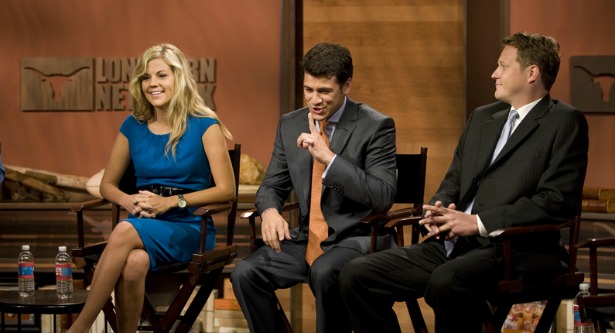
So much has happened in the world of college athletic conference realignment that ALDLAND’s coverage of the fluid, polycentric topic has all but fallen off, and it’s easy to forget what started all of this. Yes, last year, TCU had planned to jump to the Big East next year in order to secure that faltering conference‘s automatic BCS bid, and yes, Conference USA, the Big East, and the ACC had adjusted their jocks in recent years resulting in inconsequential shifts between Boston College, Miami, Louisville, and Cincinnati, and the Big Ten and Pacific 10 each had made minor additions, but it was Texas A & M’s move that represented the first falling domino on this American Fall that saw the Aggies loosed from the oppressive, yet apparently failing, bonds of the Big XII, the tumbling of the Big East‘s old basketball regime, TCU’s reversal of course, and about a billion other related stories. And the hand that pushed that first domino belonged to ESPN’s Longhorn Network.

As Deadspin reports, however, the catalytic network is fairly impotent when it comes to actual television broadcasting as, after launching two months ago, LHN still isn’t on anybody’s tv set:

It was two months ago today that we ran a sky-is-falling story on ESPN’s Longhorn Network going live without having lined up cable companies to actually broadcast the channel. We thought that was just last-minute posturing and ESPN’s muscle would get the deals done before long. But here we are, halfway through the season, and it’s still a channel without a home.

Awful Announcing has a good breakdown of the problems, which start with the one major cable provider in the fold not having much of a presence in Texas itself[:]

“The most glaring issue is outside of the Texas fan-base, there just isn’t a lot of interest in the channel and in fact the mere existence of the network has more than likely hurt the brand of Texas nationally more than it’s helped it. The idea that an entire network can be propped up by two shitty football games has cable providers holding the line knowing the implications of giving in.

“Also working against LHN is the fact that ESPN is their distribution partner. You’d think that this would only help adoption of the channel but my take is that ESPN has bullied the entire industry for quite awhile. This is really the only time where operators actually have leverage and can potentially keep it as an ace up their sleeve for future negotiations on other ESPN/Disney talks.”

This situation can’t continue indefinitely. The Big Ten Network suffered through the same growing pains, with most cable companies only agreeing to carry it in its second year of existence, but that was amid public demand. With no one clamoring for the Longhorn Network in their home, it’s still likely that by next year the network’s footprint will be national: but not at the price ESPN wants to charge to carry it.

From the beginning, it felt like the Worldwide Leader had bit off a bigger bite of Texas rawhide than it could chew, but LHN is starting to look like a Tejas-sized broadcast failure that no one will notice because no one’s ever seen it and ESPN won’t report on it.

Sportsnight in the D: ALCS & MNF

For the first time in ten years, Monday Night Football was in Detroit, and following a 24-13 victory over Chicago, the Lions are 5-0 for the first time since 1956. The home crowd affected the game, helping to cause the Bears’ nine false-start penalties, and officials only had to stop play once for a foreign object thrown onto the field, which I think is pretty good, all things considered. ESPN’s decision to replace now-banished Hank Jr.‘s traditional open with a Detroit-themed segment narrated by legend Barry Sanders was a nice touch too. All of this helped distract Motown sports fans from the painful, extra-inning demise of their baseball team that concluded moments before kickoff. Even if the Tigers were healthy, I’m not sure Texas still isn’t the better team, and the Tigers certainly aren’t healthy. Down 0-2, they return to Detroit for the third and fourth games of the series. Right now, coming home is about the only thing cutting in their favor in this series. If Calvin Johnson can swing a bat, now would be the time for him to speak up.

TCU to join Big XII

ESPN Dallas/Fort Worth reports:

TCU trustees are scheduled to meet on Monday and are expected to accept the Big 12’s invitation to join the conference, sources confirmed Sunday.

An announcement could come as early as Monday evening.

The Big 12 extended TCU an invitation on Thursday and said it would begin discussions with the university immediately. TCU chancellor Victor Boschini Jr. issued a statement on Thursday about the situation.

“These discussions with the Big 12 have huge implications for TCU,” the statement said. “It will allow us to return to old rivalries, something our fans and others have been advocating for many years. As always, we must consider what’s best for TCU and our student-athletes in this ever-changing landscape of collegiate athletics. We look forward to continuing these discussions with the Big 12.”

A move to the Big 12 allows TCU to rekindle some of the rivalries it had for so long in the Southwest Conference, which disbanded in 1996.

TCU, the defending Rose Bowl champion, agreed earlier this year to leave the Mountain West Conference for the Big East, which has an automatic BCS berth.

A source told ESPNDallas.com last week that TCU would have to pay a $5 million exit fee to leave the Big East, but would be able to join the Big 12 in time for the 2012-13 athletic year.

What? You thought the Big XII was collapsing? Over and done with? Maybe. But the Big East is going down first, as reported here a month ago. Texas Christian’s decision to get itself into a BCS conference at all costs made sense two years ago, but now, the Big East is done, and TCU’s football team isn’t as good. (That’s a perspective that shows how fast this landscape really is changing, even if it appears incremental on a day-to-day basis.) The Big XII, fearing it’s next to dissolve, had to take TCU to keep something resembling a critical mass and, conveniently, replace one departing Texas team with another. And of course, TCU still thinks it belongs in a BCS conference. Million-dollar musical chairs.

Jim Leyland’s ALDS Game 5 lineup

When a reader told me he’d seen Tigers’ manager Jim Leyland wearing a suit on TBS last night, I knew something was awry. Earlier in the day, ESPN Insider, Vanderbilt graduate, and Vermonster Buster Olney reported that Justin Verlander would not start Game 5 against the Yankees in New York, and that Don Kelly would start at third, with Magglio Ordonez in right field.

I’ve only ever seen Leyland in a baseball uniform, includng hat, or some other Belichickian attire like a windbreaker pullover or hooded sweatshirt, so to see him dressed as pictured above somewhat shocks my brain.

Less shocking, but still surprising, were Leyland’s starting lineup choices. That Verlander would not start was expected. In the playoffs, you have to be able to count on your number two starter in a must-win game, and Doug Fister is more than competent to handle that task. I’m still scratching my head over the Kelly/Ordonez decision, though, and I’m trying to figure out which came first. Both mostly play right field. Ordonez has been an offensive power in the past, but he generally has cooled off in the last year or two. Kelly usually is described as a defensive replacement, meaning that he does not hit especially well, although he has been making good contact in this series.

Leyland had been working a similar pairing at third base with the recently acquired Wilson Betemit and longtime Tiger Brandon Inge. Like the Kelly/Ordonez pairing, one (Betemit) is the better hitter and the other (Inge) the defensive replacement. Also like Kelly/Ordonez, Betemit’s bat has cooled off in this series, while Inge’s has heated up.

In a vacuum, Leyland’s decision to start Kelly and Ordonez is not necessarily strange, but when examined together with the consequence of that decision– both Betemit and Inge on the bench– I have a hard time understanding it. Which is why I, unlike Leyland, wear a suit most of the time and don’t manage a baseball team. Still, I hope the Tigers aren’t getting away from what got them to this point.