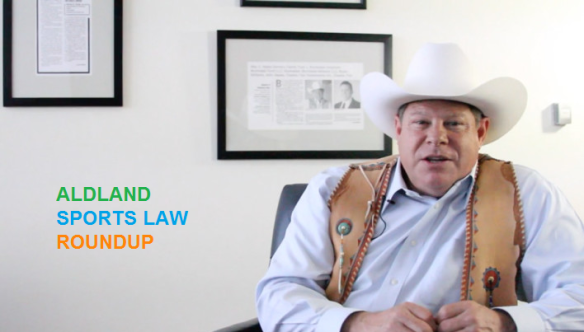
I used to write the sports technology roundup at TechGraphs, an internet website that died, and now I am writing the sports law roundup at ALDLAND, an internet website.
Here are the top sports-related legal stories from the past week:
- Baseball stadium netting: On Wednesday, the trial court dismissed a lawsuit seeking increased fan-safety measures in baseball stadiums, including expanded safety netting behind dugouts and along the foul lines, based on a lack of standing. I previously wrote about this case over at TechGraphs (see here, here, and here), generally discussing the ways in which it– despite the legal weaknesses in the plaintiffs’ position– already was effecting change. Although those legal weaknesses proved to be the downfall of this suit, the court’s ruling was not without its admonitions to Major League Baseball. For example, an early footnote contains this observation: “Why Major League Baseball, knowing of the risk [foul balls pose] to children in particular, does little to highlight this risk to parents remains a mystery.” The order also expressly suggests the possibility that future litigation along these lines may be more availing in other states, where the “Baseball Rule,” which makes it very difficult for fans to recover against baseball teams and leagues, has fallen under attack: “Thus, it is conceivable that, under the right set of circumstances, a plaintiff could obtain the type of relief that plaintiffs seek here. Given the changing nature of both the baseball game experience and the injuries at issue, which are far different from those in 1914, what is a ‘reasonable expectation’ on an ‘ordinary occasion’ is not a static concept.“
- Football painkillers: Attorneys for retired NFL players in a lawsuit against the league alleging that team doctors dispensed painkillers “‘as if they were candy’ regardless of long-term effects” are seeking permission to depose team owners Jerry Jones and Jim Irsay. Outside of football, Irsay, who inherited ownership of the Indianapolis Colts from his father, is known for collecting famous guitars– including Jerry Garcia’s Tiger, Les Paul’s Black Beauty, and Prince’s Yellow Cloud— and having a history of abusing painkillers. The plaintiffs also have amended their complaint to add a RICO claim, which, among other things, introduces the potential for tripling their financial recovery in the lawsuit.
- NCAA transfer rules: Johnnie Vassar, a former Northwestern basketball player, filed a putative class-action lawsuit against the NCAA, alleging that the rule forcing transferring students to sit out of their sport for their first year at their new school violates antitrust laws. Vassar claims that he attempted to transfer from Northwestern but was unable to do so, because all of his target schools only would accept him if he could play immediately. In recent years, Northwestern has emerged as a cradle of anti-NCAA legal activity.
- Triathlon death: A wrongful death claim brought in connection with the drowning death of a competitor in the 2010 Philadelphia Triathlon cannot proceed, a Pennsylvania appellate court ruled, concluding that the triathlete knowingly and voluntarily assumed the risk of participating in the event when, in the course of registering for it, he executed a detailed liability waiver.
- Cuban baseball-player smuggling: In a federal criminal case against a sports agent accused of conspiracy to smuggle Cuban baseball players into the United States, the government has listed numerous professional players, including Yoenis Cespedes and Jose Abreu, as trial witnesses. For more on this general subject, ESPN The Magazine’s feature on Yasiel Puig is a must-read.
- Boxing fraud: The defendants– Floyd Mayweather, Manny Pacquiao, HBO, Top Rank, and others– in twenty-six lawsuits alleging that they improperly concealed Pacquiao’s shoulder injury leading up to the fighters’ 2015 bout in order to boost pay-per-view sales admitted that the plaintiffs– fans and bars– had standing to pursue their claims, even as the defendants denied that those claims had any merit.
- Gambling: West Virginia, Arizona, Louisiana, Mississippi and Wisconsin are asking the United States Supreme Court to review a Third Circuit decision rejecting New Jersey’s attempt to open up sports gambling in its state. The five states, together, filed an amicus brief in support of New Jersey’s cert petition (formal request that the Supreme Court allow them to appeal the Third Circuit’s ruling), arguing that the manner in which Congress has regulated sports gambling is unconstitutional and threatens the balance of power between the federal and state governments. In an unrelated story, daily fantasy leaders FanDuel and DraftKings announced a merger agreement this morning.
- Secondary football ticket market: Under pressure from state regulators, the NFL agreed to end its league-wide imposition of a price floor on game tickets sold on the secondary market that had prevented the resale of tickets at prices below face value. The agreement does not apply to tickets for the Super Bowl and Pro Bowl, nor does it prevent teams from acting “unilaterally” to enforce price floors, meaning that the practice could continue.
- Campus police records: The Indiana Supreme Court affirmed a trial court’s dismissal of ESPN’s lawsuit seeking the University of Notre Dame Police Department’s incident reports involving student athletes, deciding that the ND Police Department is not a “public agency” and thus cannot be compelled to produce the requested materials under the state’s open records law.
Sports court is in recess.
 Why would she marry him?


