“The Ballad of Kerry Collins”

Ethan Trex wrote that “if Tom Waits ever writes a sad song about an exhausted journeyman quarterback, it will almost certainly be called ‘The Ballad of Kerry Collins.’”
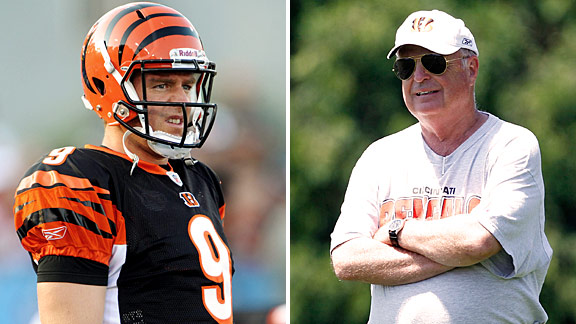
Bubbling up in the bloggochatter since the announcement this week that the former Titans, Raiders, Giants, and Panthers quarterback was going to join the Indianapolis Colts have been comparisons between Collins and former Packers, Jets, and Vikings quarterback Brett Favre, and that’s unfortunate for everyone.

I first noticed it when a reader pointed me to Jim Wyatt’s post on the Titans Insider blog, and I saw it again in Trex’s post on The Triangle, quoted above. Wyatt hit the theme heavily, opening his post with,

Quarterback Kerry Collins insisted back in July he wouldn’t pull a Brett Favre. “No, no,” he said. “I’m done.”

Yet on Wednesday he pulled a Favre, coming out of retirement and agreeing to terms with the Colts. Collins said in July he was retiring after 16 NFL seasons, including the last five with the Titans. A call from the Colts, who are dealing with lingering injury issues with quarterback Peyton Manning, changed his mind.

Trex started out with a Favre theme as well, although, to his credit, he didn’t attempt to coin a phrase when he lamented:

Great, now we’re going to have to put up with the Great Kerry Collins Un-Retirement Watch every August until the end of time. We finally get Brett Favre’s career put in the ground, and you job us like this, Kerry?

Admittedly, Collins shares some things in common with Favre, like persistent, gray, stubbly facial hair. But we shouldn’t be so quick to apply the “pulling a Favre” label every time a player unretires. What’s important to remember about Favre is how he went about his “retiring” and “unretiring,” if it even can be called that. He never really shut the door at the end of a season. He kept himself in the spotlight through strategic PR moves. In short, he milked it. And he did it multiple times.

If we have to talk about “pulling a Favre” every time a player comes out of retirement, we unfairly cast a negative light on something that need not be negative at all, and we diminish the magnitude of the terribleness that was the actual Favre’s retirement process. To even approach Favre status, Collins is going to have to do this a few more times and make a bigger stink about it. Until then, he’ll just be the next guy to try to “pull a Testaverde.”

Text messaging competitions: Non-sports vs. no sports

August is known as a slow sports month, which means it probably isn’t the best time to start a new sports website, but here we are. An NFL labor dispute provided a compressed preseason that offered some contrast to that part of the baseball season right before most people wake up and start watching again (which means it’s exactly when the Tigers will go on a tear (and as soon as I write that, for them to blow it in the 10th against the D-Rays)) and that part of the NASCAR season where drivers are still screwing around, oblivious to the fact that the lack of urgency probably will cost them a spot in the playoffs.

Revelations about the Longhorn Network grew into the second annual Texas A&M-SEC flirtation that again has fizzled, and the news of brazen NCAA violations at UMiami are simultaneously so flagrant and unsurprising that there’s not much to add to Charles Robinson’s initial report. And so we cover year-old mascot news.

On the sports blogging front, famous ex-benchwarmer and blogger of the people Mark Titus of Club Trillion apparently now is writing for Grantland, to no tidings whatsoever. I can’t decide what to think about this. Everywhere but on this site, Grantland has been taking it on the chin pretty badly, and even I’m beginning to find The Triangle’s daily sports update by Shane Ryan unreadable. Titus has been the anti-establishment candidate for as long as he’s been a public figure, and probably longer, so it’s tough to see him alongside the purported literary elite that populate Grantland, even if that site’s natural audience surely must be welcoming his voice.

While that relationship, to the extent it is one, remains in its embryonic stages, a new site lurks on the horizon. The Classical, a conceptual rival to (at least the idea of) Grantland, is slated to get rolling possibly by the end of this year.

Sports bloggers probably fall into two camps: the big time, corporate types viewed as influential but out of touch, and the small time, snarky, critical types viewed as operating on the rumor level as much as the cutting edge. Whether internet sports writers are generally clueless reactionaries or hypercritical gossipmongers, they managed to pull it together for uniformly positive and heartfelt responses to the news that Lady Vols’ basketball coach Pat Summitt was diagnosed with early onset dementia. (See here, here, and here, among many other examples.)

All this to say that, today, I traded the slow sports news for the non sports news when I saw a commercial during the TV dead zone that is 6:30-7:30 pm Eastern for a text messaging contest on Wednesday night. I haven’t been able to locate the details on this particular contest online, but apparently these things happen from time to time.

Texting is not a sport, and neither is gambling, but for someone who likes writing about sports (and, really, writing about writing about sports), gambling on sports has a certain, vague attraction, even if I don’t gamble myself, and so I took in Bill Barnwell’s second dispatch from Vegas for Grantland. Of course, I’d trust Barnwell’s betting advice as much as I’d trust that of former vice presidential candidate Wayne Allyn Root or Danny Sheridan. Barnwell does provide some background information on gambling terminology and strategy, though, and that’s nice even if it isn’t always accurate. What I do enjoy from him are the parts of his submissions that talk about the history of Las Vegas, and about trying to find a way to live there and maintain sanity and financial solvency. Having spent just twenty-six (consecutive) hours in Vegas, I have just enough personal experience to enjoy following Barnwell on his desert adventure. We’ll see how long my jealousy lasts.

Finally, Wednesday saw the fruits of a story I’ve been trying to cultivate since the early days of The Triangle and Google+, which is to say, July. It was then that the unappreciated legacy of Kerry Collins, associated more with memories of problems with alcohol and, per the New York Times’ “Black People” section, misplaced racial epithets, than gridiron greatness, came to my attention:

Collins retired this week, which, considering that I happened to graduate from the same college at around the same time, and considering that he once (rightfully) mocked me in a pizza parlor after I got wildly intoxicated on sambuca, seals both of our journeys from misbegotten youth into adulthood. And while we’re here, I would like to note that Collins has more passing yards than Jim Kelly, Donovan McNabb, Phil Simms, Steve Young, Y.A. Tittle, Johnny Unitas, and Troy Aikman. If he had won the 2000 Super Bowl with the Giants, and then made the Super Bowl with the 2008 Titans, he would be a borderline Hall of Famer. As it is, he has to be considered as the most underrated decent-to-very-good quarterback of the past 15 years.

The author makes a fairly remarkable point here, even excusing his sambuca-driven intoxication, and it’s one that Chris Johnson, Collins’ former teammate in Tennessee, mentioned in my fake interview with him the other weekend. Bill Polian, president of the Indianapolis Colts apparently got the memo too, because he pulled Collins out of retirement as insurance for an ailing Peyton Manning. And there’s the ALDLAND news/non-news cycle. Good keeping up, all.

“To Them That’s Gone: A Film for the Fallen” Enters Final Fundraising Push (via QuestionsPresented)

"To Them That's Gone: A Film for the Fallen" Enters Final Fundraising Push In the summer of 2008, Jon Bellona and a crew of runners set out on a transcontinental run– the Run for the Fallen– from Fort Irwin, CA to Arlington National Cemetery in Virginia, one mile for each member of the American military killed in Operation Iraqi Freedom. The group had a powerfully uncomplicated mission statement: Run for the Fallen is a collective of runners whose mission is clear and simple: To run one mile for every American service … Read More

via QuestionsPresented

The final chapter of the Ole Miss mascot search

The sports media’s football coverage in August has focused almost exclusively on the NFL to the exclusion of the fast-approaching college season. This is a small attempt to balance that coverage by taking a concluding look at a story that started to gain steam during the 2010 college football season.

On Saturday, September 3rd, the Ole Miss football team will take the field in Oxford with something they haven’t had since 2003: a mascot. The school’s teams will continue to be known as the Rebels, but after officially retiring Colonel Reb in ’03, the Rebel Black Bear now will represent Ole Miss squads on the field.

While Mississippi’s black bear population recently has been on the rise, particularly in the Delta region, the selection of the Rebel Black Bear was something of a second-best option, at least for a vocal subset of Ole Miss students and others watching off campus. This pre-selection video highlights the one-time top contender:

As the video suggested, copyright law of some variety formally took Admiral Ackbar out of the running, he surely would have made one of the most interesting and creative mascots in college football. Geekery aside, it also would have been a great marketing opportunity for George Lucas & co.

By dumping Col. Reb, Ole Miss distanced themselves from some of the school’s decidedly Confederate trappings, a motive that also drove revisions related to their fight song, “From Dixie With Love.” Students traditionally had concluded the song by chanting “the South will rise again.” Instead, “the Ole Miss student government passed a resolution suggesting the chant be replaced by the phrase, ‘To hell with LSU.'”

The Weekend Interview: Roger Goodell

Roger Goodell has been the commissioner of the National Football League since August of 2006. During those five years, Goodell has sought to leave his mark on the game in a number of ways, first among them being his attempt to control and improve the image of the league through tough punishments for player misbehavior on and off the field. Other notable goals include increasing the global reach of the game– London, Mexico City, and Toronto all have hosted games– and expanding the regular season to from sixteen to eighteen games, something he failed to achieve during the summer’s labor disputes.

Goodell has been a controversial figure with players almost since the beginning of his tenure, and the summer’s labor disputes carried the natural consequence of ill will from fans. His most recent decision regarding supplemental draft hopeful Terrelle Pryor has drawn heavy criticism from players, fans, and media observers. Yet the game has done anything but flounder under his watch. For this imagined interview, I caught up with Goodell in the Mile High City, which he was visiting in advance of tonight’s Bills-Broncos game.  Keep reading…

Horrible Bosses: Bengals’ Mike Brown (via ESPN.com)

Yes, Palmer has four years left on his nine-year, $118 million deal. You signed the contract, you say. Live up to it. In fact, that’s what Brown has said. “He gave his word. … He’s going to walk away from his commitment. We aren’t going to reward him for doing it.”

But Brown is a hypocrite. He has cut hundreds of players before their contract was up and given them nothing. Why should Palmer live up to a deal that works only one way? If Palmer should suddenly go blind, would Brown still give him the money? Are you kidding? Brown is cheaper than your local Goodwill. … Read More

via ESPN.com

Why is Roger Goodell carrying water for the NCAA?

After delaying the supplemental draft to hear ovations from disgraced former Ohio State University quarterback Terrelle Pryor, NFL Commissioner Roger Goodell decided, contrary to the apparent application of NFL rules, that Pryor would be allowed to enter that draft, and, contrary to ready explanation, that Pryor would be suspended for the first five games of the regular season.

That Goodell would allow Pryor into the supplemental draft was not a surprise. Despite a likely inability to make the requisite showing of “changed circumstances,” Pryor was too (in)famous to be left out, and some teams had whispered an interest in him.

What is surprising, though, is the condition Goodell imposed on Pryor’s eligibility: a five game suspension. Indeed, Pryor cannot even practice with the team that drafts him–assuming a team drafts him– until Week 6 of the regular season. Pryor’s high-profile agent, Drew Rosenhaus, appeared to accept the terms of admission graciously: “We accept that voluntarily. It’s a small price to pay for him to have a chance to pursue his dream of playing in the NFL.” Pryor’s attorney was less gracious: “Terrelle is going to [the] NFL because the NCAA mandated that he feed their families but he couldn’t feed his own.”

The five-week suspension just so happens to exactly mirror the suspension Pryor would have faced had he returned to play at Ohio State, assuming he would face no further sanctioning. It’s unlikely that this is a coincidence, since it is a disproportionately heavy punishment when compared with other NFL game suspensions.

The obvious and unanswered question about the conditions of Pryor’s eligibility is, “why?” Goodell’s reputation, as established early and often through his treatment of players like Pacman Jones and Michael Vick, is as a tough, paternalistic disciplinarian. Players who violate league policy or the law can expect to be punished by the NFL under Goodell’s watch.

What was completely unexpected, however, was that Goodell would act to enforce violations of NCAA policy. Pryor has violated no laws, and no policies of the NFL. Why, then, is Goodell punishing him?

The only answer can be that Goodell is punishing Pryor for violating NCAA policies, something that 1) is absolutely beyond his authority, and 2) sets an untenable and inappropriate standard as applied to events in the recent past and the potential near future.

For example, what of Seattle Seahawks head coach Pete Carroll, who fled Los Angeles as his USC program went down in NCAA-sanction flames (to say nothing of Reggie Bush)? What if the new NCAA investigation of the University of Miami finds that current NFL players who played there violated NCAA rules? What if the NCAA’s ongoing investigation of Auburn turns up infractions by Cam Newton, the Carolina Panthers’ new starting quarterback?

Does this new aspect of the Goodell Doctrine, the Pryor Precedent, mean that all NCAA rule breakers who go to the NFL now can expect to face punishment from the professional league as well? And why wasn’t Pryor himself entitled to notice of this new punishment policy?

Finally, it is notable just how transparent a departure the suspension was from anything resembling the norm. After hearing the news of Pryor’s conditional eligibility at lunch yesterday and going to post a 140-character version of this post on Twitter, I found the feed full of links to similar reactions. Even for those on board with Goodell’s “new sheriff in town” approach before this week, I imagine this is a departure too attenuated to justify. What, after all, was Goodell’s motive here?