Monday Monday

Dan Wheldon, a two-time Daytona 500 champion and one-time overall IndyCar champion, died yesterday in a 15-car, 230 mph crash in the early laps of a race at Las Vegas Motor Speedway. He had agreed to start the race from the back of the pack as part of a $5 million contest that would award half the prize to him and half to a fan if he won the race. He was 33 years old.

In the world of college football, ALDLAND’s rivalry games both were exciting, as Michigan State held off late pushes by Michigan to make it four straight over the Wolverines, and Georgia avoided three game-winning opportunities for Vanderbilt, escaping Nashville with a five-point win. (More on the latter game later.) Elsewhere in the top 25, Clemson came from behind to beat Maryland 56-45, and Virginia upset Georgia Tech. And the first set of BCS rankings are out: 1) LSU; 2) Alabama; 3) Oklahoma; 4) Oklahoma State; 5) Boise State.

On Sunday, one streak ended (the 49ers handed the Lions their first loss), while another continues (the Colts fell to 0-6).

The Word Series matchup is set as of last night, and it will start in St. Louis, where the late-surging Cardinals host the Texas Rangers, who finished off the ailing Tigers in a blowout on Saturday night. Although I was hoping for a different ALCS outcome, I knew Detroit likely was outmatched after watching the first game of the series, and when the injuries to starters continued to mount, it seemed only a matter of time before the Tigers ran out of gas, which they did in spectacular fashion on Saturday. Still, they made competitive a series I did not think would be, and they pushed Texas to extra innings in many of the games and otherwise played them close. It leaves to the imagination and the off season what that team could have accomplished had it been healthier.

Sportsnight in the D: ALCS & MNF

For the first time in ten years, Monday Night Football was in Detroit, and following a 24-13 victory over Chicago, the Lions are 5-0 for the first time since 1956. The home crowd affected the game, helping to cause the Bears’ nine false-start penalties, and officials only had to stop play once for a foreign object thrown onto the field, which I think is pretty good, all things considered. ESPN’s decision to replace now-banished Hank Jr.‘s traditional open with a Detroit-themed segment narrated by legend Barry Sanders was a nice touch too. All of this helped distract Motown sports fans from the painful, extra-inning demise of their baseball team that concluded moments before kickoff. Even if the Tigers were healthy, I’m not sure Texas still isn’t the better team, and the Tigers certainly aren’t healthy. Down 0-2, they return to Detroit for the third and fourth games of the series. Right now, coming home is about the only thing cutting in their favor in this series. If Calvin Johnson can swing a bat, now would be the time for him to speak up.

TCU to join Big XII

ESPN Dallas/Fort Worth reports:

TCU trustees are scheduled to meet on Monday and are expected to accept the Big 12’s invitation to join the conference, sources confirmed Sunday.

An announcement could come as early as Monday evening.

The Big 12 extended TCU an invitation on Thursday and said it would begin discussions with the university immediately. TCU chancellor Victor Boschini Jr. issued a statement on Thursday about the situation.

“These discussions with the Big 12 have huge implications for TCU,” the statement said. “It will allow us to return to old rivalries, something our fans and others have been advocating for many years. As always, we must consider what’s best for TCU and our student-athletes in this ever-changing landscape of collegiate athletics. We look forward to continuing these discussions with the Big 12.”

A move to the Big 12 allows TCU to rekindle some of the rivalries it had for so long in the Southwest Conference, which disbanded in 1996.

TCU, the defending Rose Bowl champion, agreed earlier this year to leave the Mountain West Conference for the Big East, which has an automatic BCS berth.

A source told ESPNDallas.com last week that TCU would have to pay a $5 million exit fee to leave the Big East, but would be able to join the Big 12 in time for the 2012-13 athletic year.

What? You thought the Big XII was collapsing? Over and done with? Maybe. But the Big East is going down first, as reported here a month ago. Texas Christian’s decision to get itself into a BCS conference at all costs made sense two years ago, but now, the Big East is done, and TCU’s football team isn’t as good. (That’s a perspective that shows how fast this landscape really is changing, even if it appears incremental on a day-to-day basis.) The Big XII, fearing it’s next to dissolve, had to take TCU to keep something resembling a critical mass and, conveniently, replace one departing Texas team with another. And of course, TCU still thinks it belongs in a BCS conference. Million-dollar musical chairs.

Report on college athletic director pay

USA Today reports:

Following the lead of the $5 million football coach, athletics directors may be next to hit the college sports salary jackpot.

ADs average about $450,000 at the NCAA’s top-tier schools, according to a USA TODAY analysis, rivaling the pay of many university presidents. But at least five ADs make more than $1 million, and since August 2010, at least 10 public schools have given their AD’s pay raises of $75,000 or more.

USA Today’s cover story on the topic is here. The paper also provided a breakdown of the top 120 schools’ ADs. The top ten, ranked in descending order by total pay:

School Athletics Director Conf. University pay Other pay Total pay Max Bonus
             
Vanderbilt David Williams SEC $2,560,505 $0 $2,560,505 $0
Florida Jeremy Foley SEC $1,545,250 $0 $1,545,250 $50,000
Louisville Tom Jurich Big East $1,422,204 $5,500 $1,427,704 $344,000
Texas DeLoss Dodds Big 12 $1,093,391 $2,365 $1,095,756 $125,000
Ohio State Gene Smith Big Ten $1,074,546 $0 $1,074,546 $250,000
Wisconsin Barry Alvarez Big Ten $1,000,000 $40,800 $1,040,800 $0
Oklahoma Joe Castiglione Big 12 $975,000 $0 $975,000 $510,000
Notre Dame Jack Swarbrick Indep. $932,232 $0 $932,232 $0
Duke Kevin White ACC $908,659 $0 $908,659 $0
Tennessee Dave Hart Jr. SEC $750,000 $0 $750,000 $0

(HT: @AndrewBrink)

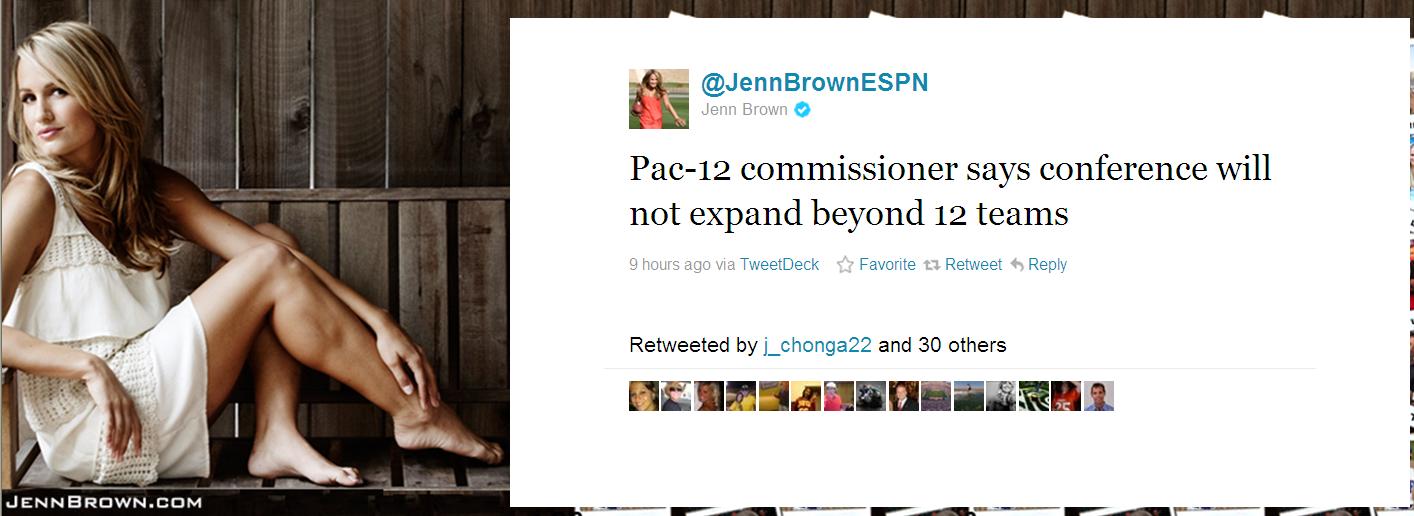
The Pacific Twelve will not expand, cannot explain why, and will regret and later reverse this decision

As beautifully reported last night, the recently-expanded Pacific Twelve Conference declared it will expand no more. While commodawg recently wrote that I have made some “preposterous suggestions” on this site (a not wholly inaccurate suggestion itself), I am going to register a prediction on this issue. First, though, I have to thank commodawg for discussing and linking to the only sampling of the written word ever to speak of the major Western conference as the “Pacific 12.” That’s on par with “Philip Jackson,” and the only place to go from there is “Pacific Twelve,” so here we are.

Before this year, the Pacific Twelve was the Pac 10. The conference added consistent football juggernauts Colorado and Utah to make a non-baker’s dozen. In reality, the Buffs and Utes are anything but (no matter what Senator Hatch says), which is what makes yesterday’s statement confusing. The flailing Big XII’s national powerhouses, Texas (to my surprise) and Oklahoma, were making comparatively overt, public ovations to the Pacific Twelve, and it was the acts and statements of these schools that triggered the no-expansion announcement. Why they would not want these two programs, though, is beyond me.

I haven’t engaged in the rumor-mongering that’s been flooding the webwaves these past weeks and months, but it’s hard to disagree with the view that we’re going to end up with four sixteen-school superconferences. Once the SEC, Big Ten, and whatever survives out of the ACC and Big East each amass sixteen members, the Pacific Twelve will wish really bad that they’d become the Pacific 14 in 2011 by adding Texas and Oklahoma. In fact, they could have led the way by also taking Texas Tech and Oklahoma State, schools thought to be politically tied to their in-state counterparts, to become the first sixteen-school major conference. Their non-expansionist foreign-conference policy might make Ron Paul happy on some micro level, but in the next round of major conference realignment, the Pacific Twelve will 1) join in the expansion; 2) wish they already had as members these two major programs because there aren’t any better options and those are two excellent options anyway; and 3) solicit their membership if Texas and Oklahoma aren’t already gone to another conference.

Concert report: Lyle Lovett and his Large Band

Last week, I was fortunate enough to be able to attend a sold-out performance by Lyle Lovett and his Large Band at the same venue where I saw Bruce Hornsby, Béla Fleck, the Noisemakers, and the Flecktones earlier this month.

Lovett and his crew put on an excellent show from start to finish, and despite taking no set break and shifting personnel over the course of the night, Lovett himself was on the stage for the all but one song, during which he let his female backup singer take control of the band. Lovett’s Large Band is comprised of Lovett on lead vocals and acoustic guitar, four backup singers (one female, three male), four other guitar players (one pedal steel, two electrics, and one more acoustic), fiddle, mandolin (who was the second acoustic guitarist), cello, percussion, piano, and a prolific, veteran bass player. (HT: @jwg31 for a long-distance ID of Leyland Sklar. More photos here.)

I’ve seen this group before, in the same spot, a few years ago, and I had an enjoyable time then despite not knowing any of the singer-songwriter’s tunes. In the interim period, I’d picked up only a sparse smattering of his recorded sounds (primarily pilfered from my paternal unit), so I was especially pleased at the number of songs I recognized during this performance.

If Lovett is two things, he is a storyteller and a Texan, and the former in particular was on display this night. He deftly adjusted his personnel throughout the performance, beginning offstage while he let his full band work out for the crowd (an approach well-used by the best, like him and B.B. King), eventually stripping the band down to bass, guitar, mandolin, fiddle, and one microphone for Texas-style bluegrass, and slowly building the band back up again, featuring different alignments and arrangements along the way.

Lovett interacted with his bandmates and the crowd with ease and tumbleweed-dry wit. He took care to introduce and shine the spotlight on his cohorts, and he conversed from the stage with a child he recognized in the audience from prior appearances at this venue (they’ve played it three consecutive summers).

I enjoyed this performance even more than the last one. Lovett showed why he is one of the best singer-songwriter-big(large)-bandleaders and, despite being “one ugly dude” (in the words of my father’s friend shortly before the show), a consummate and intimate showman. He also tricked a bunch of upper-Midwesterners into liking country music for a night, and for that alone he and his band earned the audience’s applause, of which there was plenty.

Click here for more photos of the night.

Friday Friday Friday Friday Friday

It’s the end of the week again, and this Friday finds ALDLAND having avoided (I think) a week-two sophomore slump. Friday-themed jams seem like a good idea as long as I can keep thinking of them. Suggestions are welcome.

After last week’s inaugural jam, the selection for this week was the next logical choice. I wanted to offer a live cut instead of a generic slideshow of grainy stills, and, as it turned out, there was only one real option readily available. The band apparently went through its Amish phase in 1980, but don’t worry if you don’t recognize the group since you’ll get a pretty good clue around the 1:35 mark.

Eagerly Anticipating the LSU/A&M Rivalry

Huzzah for inaugural posts. Given the frequency of AD’s posting thus far, I’m a bit intimidated by the prospect of making any sort of regular contribution to ALDLAND. I sat out the first week so that I might get a feel for the Bard of Battle Rapid’s voice and the character of the blog. Unfortunately, from what I’ve seen so far, it would seem that my forte – sweeping, overwrought pieces that capture the zeitgeist and bring readers to a greater knowledge of self and a higher plane of being – will be completely out of place among fake interviews of hockey players.  Further, my commentary on sports usually doesn’t progress beyond cursing from the sidelines or the occasional essay on why Lane Kiffin is an idiot. If you really want my opinion on sports – and by sports, I mean college football – just go read Spencer Hall at Everyday Should Be Saturday. If I could write, or knew anything about sports, I suspect that’s what I would say. At any rate, for now, any contributions I make to ALDLAND will likely be focused on music.

That said, this Texas A & M rumor means I’ll be commenting on sports sooner than I expected. I’ll admit I was a little surprised to read that A & M  was looking at the SEC again. Not that the idea is inconceivable, but the timing caught me off guard. We went through all this last year, with Texas flirting with the PAC10+ (What would they have called that, by the way? Is Texas Pacific Group up for grabs now that the PE shop is officially TPG?) It seemed clear at the time that A & M was pretty content to stick around so long as the Longhorns continued to anchor the conference.

It also suggests that A & M got a look at the details of the Longhorn Network deal about the same time we did. That’s been covered extensively, and I won’t try to add my own thoughts (because, frankly, I haven’t read the thing. I haven’t even read the coverage at Midnight Yell that AD linked). But my understanding is that it certainly doesn’t provide any long term security for the Aggies.

As an SEC man, I’m all for A & M joining the conference. Their strategy, though, suggests that there isn’t strong leadership inside the administration in College Station. I don’t know how strong their bargaining position with Slive and Co. was last year, but it certainly had to be better than right now. If they are in talks this time around, it means they are desperate for an exit, so I’d expect to see the SEC get them on good terms (whatever that means).

As for Big 12 Commissioner Dan Beebe’s comment that moving away from your geographic base and tradition rivals can “create a lot of problems”, I understand he has to say that kind of stuff, but get real man. You can see why A & M doesn’t want to stuck in the University of Texas with a dash of Oklahoma conference. If UT decides to go their own way someday (And don’t say they won’t. As literally every Texan will tell you, it’s the only state that can secede from the union), the whole house of cards falls. Granted, a move by A & M might help accelerate the collapse.

The last question is a matter of balance in the SEC. If Slive puts the Aggies in the West, who do we steal for the East? My pick during this whole debate last year was Va. Tech, and I still think it’s the best move in terms of increasing market share (as well as getting another high quality program). That said, with all that’s happened in the past few months, I bet we could get Ohio State for ten cents on the dollar right now. It’s not a cultural fit by any means, but having a crippled OSU in the East for the Gators to beat up on would make me a happy man. One can dream.

Pulling back the curtain on the University of Texas – ESPN relationship

Bloggers at The Midnight Yell, a Texas A&M site, have made public the contract between the University of Texas and ESPN for The Longhorn Network. One of their friends obtained the document through a successful open records request.

The full report highlights a number of notable terms of the agreement. To me, the most interesting provision is the one granting Texas editorial control:

In the event that UT reasonably determines that any on-air talent does not reflect the quality and reputation desired by UT for the Network based upon inappropriate statements made or actions taken by such talent and so notifies ESPN, ESPN will cause such talent to be promptly replaced (and will in any event no longer allow them on air following such notice).

There isn’t much to add to that, except to say that I don’t know whether clauses like this are common or becoming common with the rise of these sorts of networks (which now exist, to varying extents, in the Big Ten, SEC, and Pac 12), but, common or not, they have to raise questions about the integrity of the host network.

If you’re interested in the money involved, Texas’ ability to leave the ten-team Big 12, or any other aspect of the relationship, read The Midnight Yell’s thorough coverage.