Georgia doesn’t have an English bulldawg’s chance in Michael Vick’s backyard against LSU in the SEC championship, but I finally tracked down a digitized version of a jam I’ve enjoyed on vinyl for some years, so I offer it here as an anticipatory or preventative salve for commodawg and all readers pulling for the underdawgs tomorrow:
Tag Archives: sec
Moonshine hangover: What happened at the end of Vandy/UT last night?
I found the ending to Vanderbilt’s overtime loss to Tennessee last night confusing, and not for the reason you might suspect; it really was confusing. The Vols won the overtime coin toss and elected to go on defense first. On that first possession, a Jordan Rodgers pass was caught, the receiver fumbled the ball, and a Tennessee defender scooped it up (note that it may have been a strip or an interception– the whole thing is a muddled mass of murkey malarkey) and ran it back for a touchdown, thereby ending the game. An official had whistled the play dead, however, because he believed the Vol defender’s knee was down when he recovered the fumble. Although Tennessee only would have needed to kick a field goal to win, Vandy was not given the opportunity to defend that kick attempt. The Commodores had blocked one earlier (negated by penalty), and their defense had been responsible for most of their points on the night. Despite ESPNU’s consistently undesirable camera angles throughout the broadcast, television replays unequivocally demonstrated that the defender’s knee never touched the ground, which makes this all the more confusing, because those TV replays also unequivocally demonstrated that the play nevertheless had been whistled dead. There was an official review of the play, and the head official stated the scope of the review as whether the play had been whistled dead, not whether the defender’s knee was down. Anybody watching knew that Vandy won the former review, but lost the latter. Except that they didn’t.
VSL‘s Bobby O’Shea did some good work on this late into the night last night. He first reported on the immediate reaction of the former head of officiating for the NFL, Mike Pereria:
The referee said there was “no signal” and “no whistle” and hence, the replay assistant allowed the touchdown. Here’s the problem…. There was a whistle and there was a signal. What you really have here is an inadvertant whistle and unfortunately, it appears … that the official who blew the whistle and pointed to the ground did not step up and admit his mistake. It’s clear on video.
About and hour later, he reported a statement from the SEC’s Coordinator of Officials, Steve Shaw:
On the last play of the Vanderbilt-Tennessee game, in overtime, the Tennessee defender intercepted the pass, his knee did not touch the ground and he returned the interception for a touchdown. During the play, the head linesman incorrectly ruled that the Tennessee player’s knee was down when he intercepted the pass by blowing his whistle and giving the dead ball signal. The play was reviewed as if there was no whistle on the field and as a result, overturned the incorrect ruling. By rule, if there was a whistle blown, the play is not reviewable.
But, no harm, no foul? O’Shea lodges many criticisms of the handling of this outcome, all of them valid, but if the right thing happened, does Vanderbilt really have a leg to stand on here? I think so, because, as someone else pointed out, whistles blowing a play dead affect the players playing on the field in the moment. I didn’t stick around long enough to see enough replays to know whether Vandy defenders let up and otherwise could have caught the UT defender who recovered the ball, but that isn’t the sort of secondary judgment call replay officials should be making, and it’s why the on-field official likely correctly stated the scope of review as whether whistles blew the play dead. If the play had been blown dead, even if erroneously, we don’t get to imagine what would have happened had that erroneous whistle not been blown, even if that’s what it looks like we got here. That’s why the rule, as Shaw stated, is that a play is not reviewable if the whistle was blown, as it plainly was in this case.
The de facto national championship preview: The players

Yesterday’s de facto national championship preview focused on the coaches. Today’s looks at the players.
Alabama and LSU players were in the news before the season even started, which, given each team’s potential for success isn’t surprising by itself. That both teams’ players were in the preseason news for off-field reasons is notable, though. It may seem like an age ago, but Alabama was one of the places hit very hard by the tornadoes that devastated parts of the lower Midwest and Southeast earlier this year. Tuscaloosa was a direct hit. A month later, Sports Illustrated ran a cover story by Lars Anderson that is one of the most powerful sports pieces I’ve read. Facing personal losses themselves, the Tide football players nevertheless had to stand tall in a community and a state that looked to them– as they always had in good times– for support in bad times. Terror, Tragedy And Hope in Tuscaloosa.
LSU players made their way into the preseason, non-sports news in a manner less worthy of an emotional SI cover and an earnest letter home. Keep reading…
The de facto national championship preview: The coaches
In college football, players come and go, and it’s the coaches who are more likely to become the lasting face of a particular team. Adding to this is the common college football notion of coaching “systems.” Coaching in the NFL is more about coordinators and their “schemes”– the Wide Nine really isn’t a defensive “system,” and the Wildcat really isn’t an offensive one, though it may be offensive to some– although coaches have developed systems at that level, including Bill Walsh’s West Coast offense and Tony Dungy’s Tampa 2. Systems certainly are in play at the high school level, but they frequently are crazy and not at all viable even at the college level. Think Wing-T, A-11, and, of course, the Wishbone.
The major college level is the Goldilocks of coaching systems, however, and along with this comes coaching personalities and attitudes that can influence the on-field performance of the impressionable, yet quite capable yoots.
This installment of our ongoing coverage of LSU vs. Alabama, the de facto national championship, therefore focuses on the two coaches …Keep reading…
The de facto national championship
One of college football’s biggest challenges, from an institutional perspective, has been its ability to crown a consensus national champion at year’s end. The first memory I have of controversy in this regard was the 1997 split championship between Michigan and Nebraska that precipitated the implementation of the BCS in 1998. (I don’t know if that decision actually precipitated the BCS, because that system may have been in the works already, but it felt that way at the time.) The BCS did not bring peace and happiness across the land, however, and the criticism that started then– I recall writing an editorial on the arbitrariness of BCS outcomes as sports editor of a newspaper in the early 2000s– has only grown in scope and volume, even reaching the halls of the U.S. Senate and the Department of Justice, and the favors it grants upon certain athletic conferences certainly has been part of the fuel for the conference realignment conflagration that burns to this day.
By some magic mix of scheduling, on-field performance, coaching, recruiting, and everything else that goes into making one particular football game happen the way it happens and mean what it means, though, we have been gifted a national championship game this year that really is as free from controversy as one could imagine, a matchup of two undefeated teams, either of which could be ranked #1, playing in the toughest division of the toughest conference in the country, and largely dominating their opponents to this point. On Saturday night in Tuscaloosa, #1 LSU will meet #2 Alabama for what many see as the de facto national championship. The BCS’ noncomical Rube Goldberg machine may churn out a pairing at season’s end that will garner national consensus, but this Saturday’s game is a guarantee; it provides certainty and assurance, things the BCS largely has failed to give teams and fans since its inception.
In anticipation of this game, plan on daily coverage this week* from ALDLAND to get you ready for it.
* Disclosure: This is likely to severely decrease our unplanned coverage of the Breeders’ Cup. In our stead, I recommend the sports page of the Louisville Courier-Journal.
In South Carolina, there are many tall pines
And there used to be three men known as Marcus Lattimore, Steve Spurrier, and Stephen Garcia. 
Within the last week or so, though, all that has changed. First, quarterback Garcia, who’d shown flashes of brilliance on and off the field, but not nearly as much of the former as the latter, got himself kicked of the team for failing a drug test.
In their first game without Garcia, young backup Connor Shaw helped lead the team to a gutty two-point victory over Mississippi State last Saturday, but the Gamecocks lost Heisman-caliber running back Lattimore to a season-ending knee injury. For many, this team was the favorite to win a weak SEC East, but without Lattimore, it’s tough to see much success left for SC this season.
And that brings us to the OBC. In seven years in Columbia, Spurrier has a 50-34 record, which stands in marked contrast to his overall NCAA coaching record (186-73-2), to say nothing of his record at Florida (122-27-1). Known as a quarterback specialist (due in no small part to winning a Heisman Trophy himself as a Gator QB), he’s struggled to develop quarterback talent for SC, where he’s given his starters (and some reporters) very short leashes.
But the Ol’ Ball Coach, bowling his headset like a dilapidated yo-yo seemingly with even greater frequency of late, definitely has looked ol'(d). A coach only is as good as his players. With an inexperienced quarterback and without his star running back, things very suddenly are looking very bleak in Columbia.
Nashville recap: Georgia escapes, 33-28
I made it into town on Friday night in time for a ceremonial pregame dinner at Music City’s finest anti-internet fried chicken establishment and a chance meeting with Taylor Hicks, and I was up the next morning to watch the early games (11:00 am Central) at Nashville’s newest sports bar. After victories by our party’s favored teams, Michigan State and South Carolina, we made our way to our usual tailgate spot, the sunny, low-70s weather being perfect for the activity.
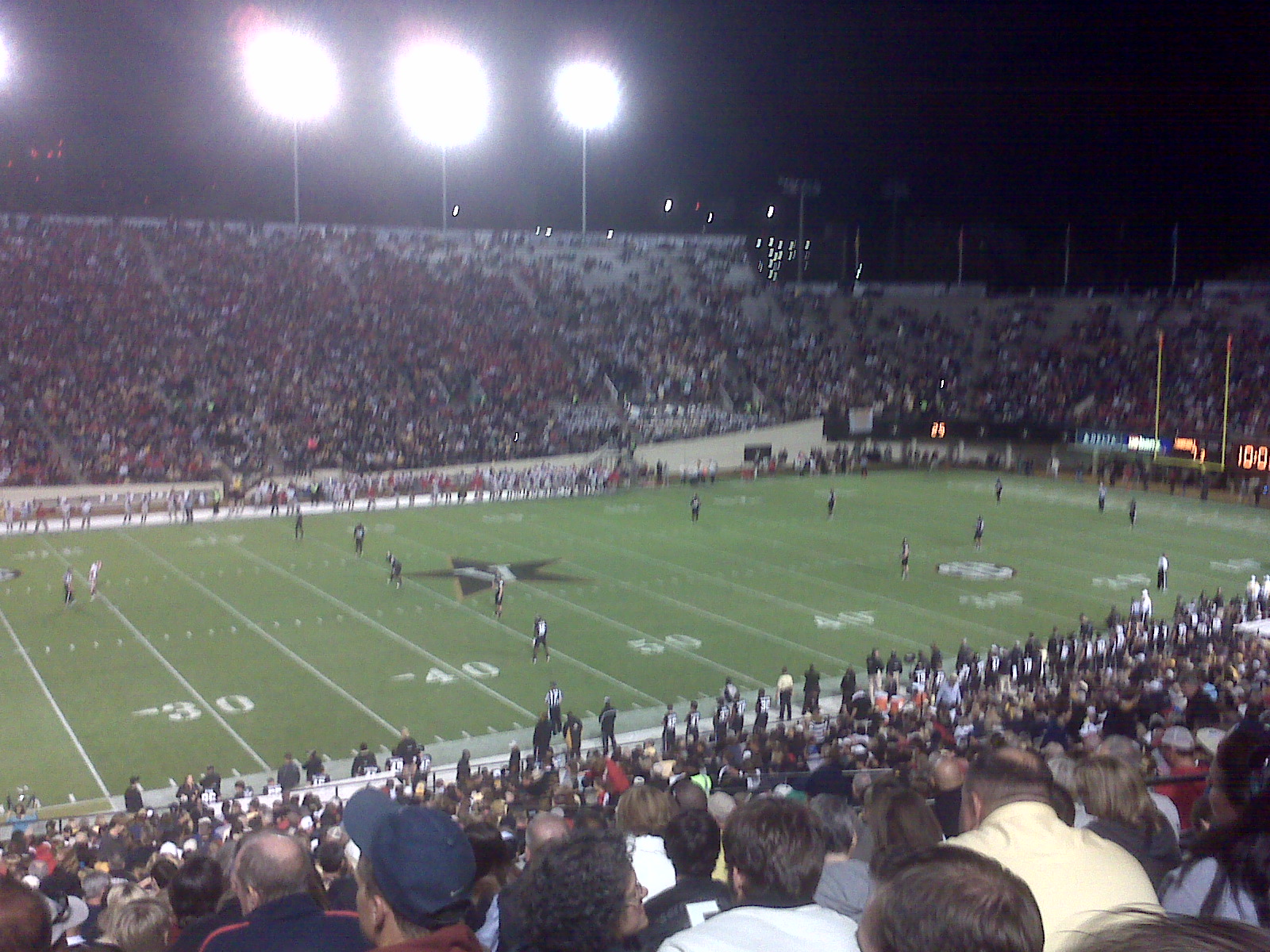
Like most of Vanderbilt’s conference foes, Georgia is on the winning side of a lopsided record that stretches back to 1893. Saturday’s game followed suit, omitting the adjectives. Georgia won, but not handily (much to commodawg’s chagrin), as Vanderbilt missed three game-winning opportunities in the final seconds. Milking a five-point lead, the Dawgs tried to run out the clock, but defense and Vandy’s use of its two remaining timeouts forced a Georgia punt that Vanderbilt blocked. With nothing between them and the endzone but a loose ball, the Vanderbilt defenders were unable to scoop it up and run it in, falling on the bouncing ball instead. With eight seconds left in the game, QB Jordan Rodgers took two strikes at the endzone from about twenty-five yards out, but the Commodores were unable to convert.
Our seats were good for watching the game, but they didn’t allow us to gain any particular insights on the postgame scuffle between Vanderbilt head coach James Franklin and a Georgia assistant coach or the alleged dirty play on Georgia’s part that may have instigated it. Keep reading…
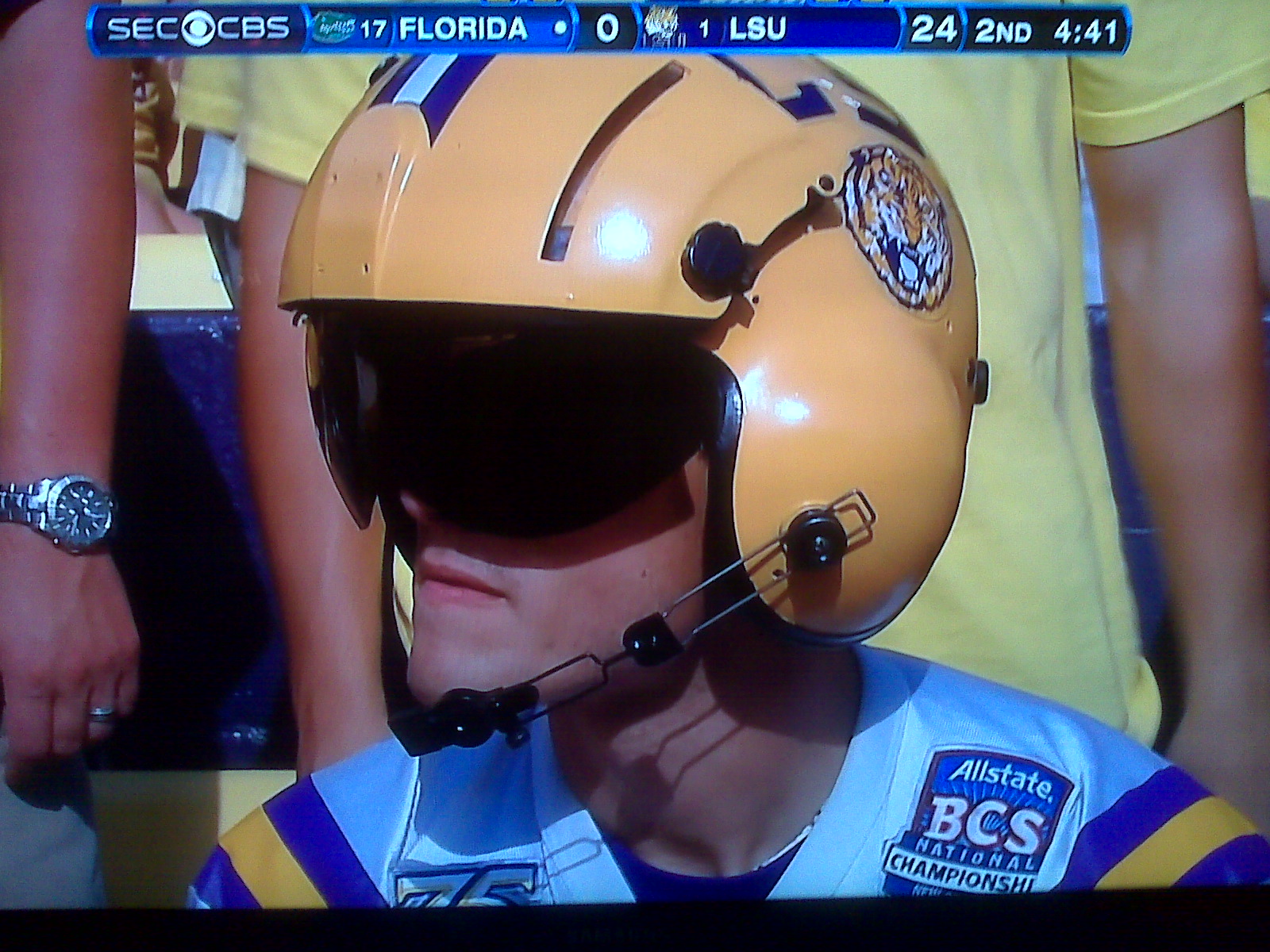
Florida vs. LSU: Requesting permission for flyby
Ultimate Underdog (via Sports Illustrated)
For Vanderbilt, playing in the nation’s toughest conference is a losing proposition. But the only team in the SEC that everyone can love is 2–0, thanks to a new coach who has turned a blind eye to the past.
For fans, Saban is like a fiftysomething Justin Bieber. It does not seem to bother anybody that he is a reluctant guest of honor. “I think you all know that this is one of my favorite days of the year,” Saban tells reporters sarcastically.
Appearing before the media alongside Saban and the three Tide players, almost for bookkeeping purposes, are the representatives for the Vanderbilt Commodores. They have a new coach, 39-year-old James Franklin, but the same old story. They have finished with a losing record in 27 of the last 28 years. They have not had a winning conference mark since 1982.
Even at a gathering of its conference brothers, Vanderbilt football is an orphan. Forget luring fans to Media Days. Vanderbilt barely draws any media to Media Days. Of the 1,050 credentialed reporters, fewer than 10 are there to cover Vanderbilt.
And yet: This appears to be Franklin’s favorite day of the year. He says, “I believe whoever I meet, they’re a Vanderbilt fan. And if they’re not, by the time we get done talking, they are.” He looks out at a ballroom of skeptical media members and sees opportunity in every seat. … Read More
(via Sports Illustrated)
(HT: @rmccost)
S-E-C! S-E-C! S-E-C!: That inescapable chant and the “new” southern pride (via Grantland)
When I first heard the chant, I was sitting in the Rose Bowl with a Mangino-sized scowl on my face. My Texas Longhorns had gotten their legs (and arms) broken by Alabama. Crimson Tide fans — thousands of them in white button-downs and khaki pants — were hugging each other and laying their cheers on us: “We’re gonna beat the hell out of you!” That’s when I heard the chant. “S-E-C! S-E-C! S-E-C!” … Read More
via Grantland