What do the College World Series, the U.S Open golf tournament, marijuana, and Derek Jeter have in common? All of them appear in my latest post at TechGraphs, a roundup of the week’s top sports technology stories.
The full post is available here.
What do the College World Series, the U.S Open golf tournament, marijuana, and Derek Jeter have in common? All of them appear in my latest post at TechGraphs, a roundup of the week’s top sports technology stories.
The full post is available here.
Back in February, before the 2015 MLB season started, I wrote that the projected-to-be-terrible Philadelphia Phillies should just give up and put themselves out to pasture. They did not immediately heed my advice. Nearly four months later, the team found itself with a 22-44 record, the worst in all of baseball. Cue the terminal sequence: Continue reading
According to press reports, front-office personnel of the St. Louis Cardinals used a guessed password to gain access to a private database of player information held by the Houston Astros. Over at ESPN, legal analyst Lester Munson makes the startling claim that this may not be a crime . . . . This is just wrong. … Read More
(via The Volokh Conspiracy)

In my latest post at Banished to the Pen, I attempt to visualize in graphic fashion the effectiveness of all thirty Major League Baseball teams at converting baserunners into runs and, having done so, speculate only a little bit wildly about the reasons why two of those thirty teams– the Detroit Tigers and San Francisco Giants– are not scoring as many runs as they probably should be given their large number of opportunities to do so (i.e., baserunners).
The full post is available here.

Last night might have been the second-best night in Vanderbilt baseball history, surpassed only by the evening nearly one year ago when they won their first national championship. On the fourth birthday of Grantland.com, a sporting internet website named for VU’s second baseball coach, the Commodores completed their super regional sweep of Illinois and secured a spot in the 2015 College World Series.
Soon after the game ended, three Vandy starters– Dansby Swanson, Carson Fulmer, and Walker Buehler– were selected in the first round of the MLB amateur draft, with Swanson as the first overall pick.

As they make their way to Omaha, here’s hoping this team has a few more good nights left in the tank.
________________________________________________________________
Previously
Vanderbilt wins the College World Series

The Detroit Tigers shot out to a hot start in 2015, but things have not been too good for Detroit since then. They’ve won just five of their last thirteen series. The team’s active six-game losing streak is its longest in four seasons.
The title of this year’s serial Tigers feature at this site, Window Shopping, comes from the common theme of Detroit season previews that, with respect to a World Series championship, the team was trying to keep open its “window of opportunity,” assuming that proverbial window had not already slammed shut under the weight of expensive long-term contracts, aging players, and perceived defensive burdens.
After the last month and a half, though, it is as if these window shoppers, gazing upon the Commissioner’s Trophy in a fancy Harrod’s storefront display (did we fight the Revolution for nothing??), reached into their back pockets in consideration of making the eventual purchase, only to find they suddenly had no money, no credit cards, no traveler’s checks, nothing. They’ve been robbed.
The Tigers are in a tailspin, and it isn’t exactly anyone else’s fault. Their recent struggles have come in games against teams largely regarded as mediocre or worse, including the Athletics, Angels, and Brewers. What’s happening?
After starting the season with an 11-2 record, the Tigers have gone 17-24, and their performance somehow has felt even worse. By my count, since April 21, the date they entered with that 11-2 mark, Detroit has a -19 run differential. Only two other American League teams– the White Sox and Red Sox– have worse run differentials during that period, and only one AL team, Toronto (187), has allowed more runs over that span than Detroit’s 185. Of course, the Blue Jays also scored 213 runs in those games, a number that dwarfs the Tigers’ 166 and is the most in the league. On the other hand, just seven AL teams have scored fewer than 166 runs since April 21, and two of them, Kansas City and Tampa Bay, still maintained positive run differentials. (Both Sox teams, along with Seattle, Baltimore, and Oakland round out this low-scoring group.) In terms of offense and defense (the fundamental terms of competitive team sports), it’s hard to be worse than Detroit right now.
Offense fueled the Tigers’ strong start, and its disappearance has triggered their decline. They averaged 5.38 runs per game through April 20. Since then, though, they’ve scored just 4.05 runs per game, a drop of more than a run and a third. Omit a blowout 13-1 win against the Twins on May 14, and that per-game scoring average falls to 3.83. No bueno. Continue reading
As I write this, his elbow likely is spontaneously combusting, but it’s beginning to look like the Detroit Tigers finally have a reliable closer. Joakim Soria has been both busy and successful this season, appearing in twenty-two of the Tigers’ forty-eight games so far, allowing just three runs and one blown save in that span. Eight of his twenty-two appearances have been on no rest, and six more were after just one day of rest. Since Joe Nathan went down with a season-ending injury, the ninth inning has belonged to Soria, and, on a couple recent occasions, part of the eighth inning as well. Soria’s success is quite welcome, and this expanded use of his closer also reflects well on manager Brad Ausmus, who was criticized for what appeared to be inartful handling of his relievers last year.
Whatever the cause of Soria’s rediscovered success this year, along with the positive contributions of his fellow relief pitchers, the Tigers suddenly find themselves with one of the best bullpens in baseball, as measured by ERA. (They were fourth-worst in 2014.) This reversal comes not a moment too soon for Detroit, where, with Victor Martinez back on the DL, the offense has evaporated like a mid-May snow melt. Thanks in no small part to Soria, though, the team was able to win two of three in Oakland while scoring just four runs in the entire series. The closer appeared on Tuesday night and Wednesday afternoon, allowing two hits, one walk, and no runs in 2.1 innings pitched to seal both victories. Below is the final pitch of yesterday’s game, which is not unpleasing to watch.

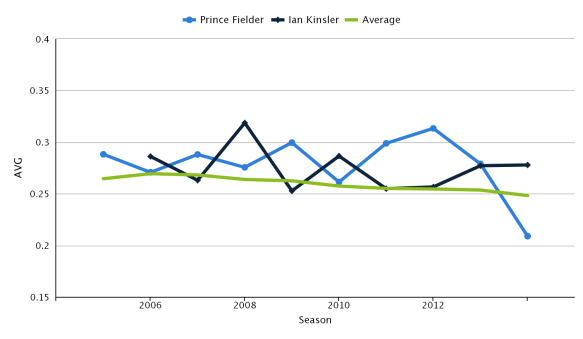
While the Detroit Tigers’ decision to trade Prince Fielder to the Texas Rangers for Ian Kinsler prior to last season initially came as a shock to Tigers fans, the positive early returns on the trade seemed to provide a calming influence. As I wrote in late April 2014,
Kinsler has provided some real spark, though. Looking at the right side of this graph, you can see that, while he and Prince posted similar batting averages last season, Kinsler has kept the pace this year, but Prince has dropped off sharply with the Rangers.
While Fielder has the edge in on-base percentage, probably due to his ability to draw walks (of the intentional and unintentional varieties), Kinsler’s hitting for more power (.133 ISO vs. .121 ISO) and is posting a better wOBA— a catch-all offensive metric– than Fielder (.319 vs. .277). They also have the same number of home runs (two), with Kinsler driving in nearly twice as many runs as Fielder (14 vs. 8), while stealing three bases (to Fielder’s zero, obviously).
Less than a month later, Prince’s season would be over, a completely understandable side effect of probably overdue neck surgery.
Kinsler powered right along, though, making 726 plate appearances in a career-high 161 games. His bat seemed to cool off in the second half of 2014 (.353 wOBA vs. .276), but he still managed to finish the season tied with Miguel Cabrera for the title of most valuable Tiger, as determined by fWAR (5.1 fWAR apiece), although much of that was due to Kinsler’s defense (and Cabrera’s lack thereof).
In reviewing last year’s statistics in anticipation of this season, Kinsler’s numbers jumped off the page for one main reason: his walks had disappeared. Continue reading

Ain’t no change in the weather,
ain‘t no changes in me.
And I ain’t hiding from nobody,
nobody’s hiding from me.
Detroit Tigers fans weren’t sure what to expect out of their new starting pitcher when Shane Greene arrived from New York this past offseason. As I noted in this Tigers season preview, the scouting report on Greene was, to be kind to his prospects, guarded: “an average pitcher — in Triple-A” with a major-league “path for . . . success [that is] very rarely traveled.” He had done moderately well in his fourteen-start rookie campaign, which included two wins– the first an eight-inning shutout– over the Tigers, and the primary question for him entering 2015 was whether he could replicate his success in limited outings across a full season’s worth of starts. After one month of baseball, the answer to that question, like most others at this point in the season, remains outstanding.

At one month old, the MLB season now has accrued a sufficient sample size of free time to permit me to compile the opening post of this site’s regular Detroit Tigers series for 2015, Window Shopping. Last year, I came out of the gate a bit too hot, burned out, and had to take the month of June off. This year finds your resident Tiger tracker more balanced and measured in his approach. This year’s Detroit Baseball Tigers have a more balanced look too. Continue reading