
Not many Tigers fans were excited when the team named Ron Gardenhire as its new manager this past offseason, but Gardenhire’s decision to add former Chicago Cubs pitching coach Chris Bosio to his staff seemed promising. After all, Bosio brought a championship pedigree by virtue of his five-year tenure with Theo Epstein’s Cubs. With Justin Verlander gone from Detroit, the Tigers pitching staff looked especially young and vulnerable. Bosio’s recent track record lent hope to the idea that he could be a secret weapon on the bench and, in particular, help mold an inconsistent rotation into a stronger, more developed group. In spring training, Bosio also showed a willingness to clash publicly with Gardenhire, which suggested an independence and division of developmental responsibility not necessarily out of place on a rebuilding team.
One of Bosio’s announced modifications he wanted his new charges, especially Jordan Zimmermann, to make, was to work faster on the mound. So far, they appear to have taken his advice. Fourteen pitchers have shortened their inter-pitch times by more than two seconds as compared to 2017, and three of them are Tigers starters:
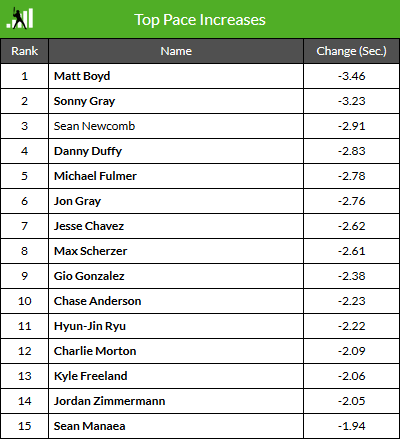
Zimmermann, Michael Fulmer, and Matt Boyd have upped their respective paces substantially this season over last season. I think that alone is a good sign, because it demonstrates both a willingness and ability to make changes in approach designed (or believed, at least) to improve outcomes. That’s the bigger question, though. Zimmermann, Fulmer, and Boyd are working faster, but are they doing better?
To try to answer that question, I propose a DRA-based comparison, which should allow us to see, on a rate basis, whether these three Tigers starters also have been pitching better in 2018 than they did during their slower days in 2017.

Of the three, Zimmermann had the smallest pace increase but the largest improvement according to DRA. Boyd, who’s shown the biggest pace increase of any pitcher, also has been better, while Fulmer has been a bit worse.
Without more digging, I don’t know that there are any broad statements to make about the consequences of speeding up on the mound. Importantly, we don’t know how the 2018 versions of these players would perform had they continued to work at their slower paces; the results might be exactly the same. The above does provide some circumstantial evidence that increasing pace can help some players, however, and it also suggests that Bosio was right to target Zimmermann as a guy who could benefit from operating at a faster pace.
______________________
The Tigers don’t have any of the top fifty players of 2018, as ranked by fWAR, on their roster. Third baseman Jeimer Candelario used to be on that list, but he now sits sixty-fifth (1.3 fWAR) after missing time with wrist tendinitis. He could return to the team later this week.
______________________________________________
Previously
WTF: Welcome Back Kozma – 5/9
Related
2018 Detroit Tigers Season Preview
Highlights from MLB Network’s visit to Detroit Tigers spring training


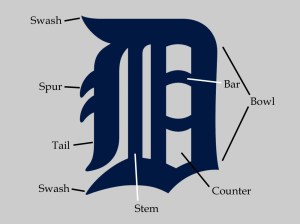 In late January, the Detroit Tigers announced an alteration to their iconic home uniforms that, depending on your level of uniform awareness, was either a seismic change or a minor detail but unlikely to be anything in between. The Tigers’ Old English “D” is the second-oldest mark in baseball, trailing only the Athletics’ “A,” which can be traced back to 1866. However, for most of their history, the D on the Tigers’ caps has differed, at times slightly, at others quite drastically, from the D on their jerseys. This offseason, the Tigers decided to put an end to that discrepancy by replacing the D on their jerseys with the one on their caps.


