Catching Fire: Heading for the exit velocity

vacation-walley-matte-today-150527_25aa56597af71bd8b926763d3272e7cd-today-inline-large

Thanks to MLB Advanced Media’s new Statcast technology, fans can learn more than ever about the activity taking place on the field (and off it) during a baseball game. One such aspect into which Statcast offers insight is exit velocity, which refers to the speed with which a batted ball leaves a hitter’s bat. These velocities can communicate something meaningful about batter success. (Very generally, and possibly very obviously, higher exit velocity is better.)

Statcast came on-line last season, but there were significant flaws in its batted-ball data gathering in 2015. The shortcomings in the 2015 data will affect any analysis that relies on Statcast information from that season, and while Statcast seems to be doing a better job of gathering a more complete set of batted-ball data this year, some imperfections remain. Fortunately, it appears that those imperfections– apparently due in part to differences in hardware installations at each park– can be accounted for. Baseball Prospectus now publishes something called adjusted exit velocity, which aims to control for various influences on Statcast-measured exit velocity that are outside batters’ control. (None of those adjustments can recapture the data the system failed to collect in 2015, of course.)

Early in the season, I went to the Statcast well to compare home runs by Anthony Gose and Giancarlo Stanton. The purpose of this post is not to undermine lazy media narratives but to present a simple comparison between various Detroit Tigers’ adjusted exit velocities in 2015 and so far in 2016.

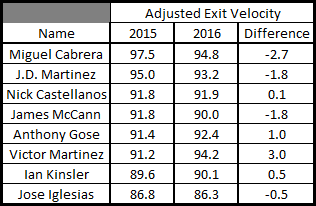
Keeping in mind the imperfections in the source data, here are the 2015 and to-date 2016 adjusted exit velocities (in miles per hour) of the Tigers’ primary hitters who played for the team in both seasons:
adjev15-16det

While recalling that we still are dealing with small sample sizes for 2016, particularly for James McCann, who’s spent much of the young season injured, and Anthony Gose, who now is down in the minors, I’d guess that the differences in adjusted exit velocity roughly comport with how well fans think each hitter is performing this year: Miguel Cabrera hasn’t heated up yet; J.D. Martinez has been struggling since moving to the second spot in the lineup after a hot start batting deeper in the order; Nick Castellanos has been breaking out; Victor Martinez is healthy again and showing it; Ian Kinsler seems to be in fine form yet again (credit those Jack White-designed bats?); and Jose Iglesias is continuing to rely on weak contact.

Cabrera was second overall in adjusted exit velocity last season, so his drop-off seems like a possible source of concern. Sluggers like Cabrera can take a while to warm up, though, so it’s not unreasonable to think that his adjusted exit velocity will climb as the current season progresses. (Cf. Giancarlo Stanton, 2015’s adjusted exit velocity champ, who, so far in 2016, is down 9.4 MPH.)

The elder Martinez has the largest change of any of the highlighted batters in either direction, but his 2015 doesn’t offer much of a baseline because he was playing through obvious injury. It therefore is reasonable to assume that some portion of that +3.0 MPH of adjusted exit velocity is due to a return to health.

Not only do these changes in adjusted exit velocity correlate with anecdotal observations of these players this season, but they also– loosely but consistently across this sample– track changes in raw power (measured as isolated power, or ISO):   Continue reading
Highlights from MLB Network’s visit to Detroit Tigers spring training

avilamaddog2

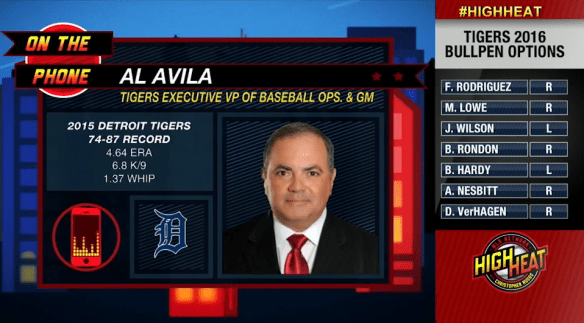
As it has done in the past, MLB Network’s “30 Clubs in 30 Days” feature spends a day with each major-league team during spring training. They spent St. Patrick’s Day with the Detroit Tigers in Lakeland, Florida. Here are the highlights:   Continue reading

2016 Detroit Tigers still in search of man out standing in (left) field

After a disappointing 2015 season, which included some odd maneuvering at the trade deadline, the Detroit Tigers entered the offseason with a significant to-do list. They’ve already made acquisitions designed to address needs in the bullpen and starting pitching rotation, but, with three months until opening day, the team still has one major hole to fill.   Continue reading

Window Shopping: Pigs in the Pen

It’s July, which means it’s time for MLB teams to sort out their trade-deadline strategy. While fans distract themselves with All-Star festivities, general managers are preparing to execute player transactions in attempts to load up for a playoff run or, in acceptance of their near-term fates as noncontenders, build for the future.

In this context, the Detroit Tigers find themselves in a bit of a bind. After a very strong start, they’ve slid back to a .500 record and have been entrenched in the middle of the AL Central, never too far out of first place, but never really within striking distance. Would a first-place finish from this position be unprecedented? Hardly. Can they claim a fifth-consecutive division title without making a significant trade this summer? Almost certainly not. The Tigers’ record is not a product of underperforming their potential; instead, it likely is a reasonably accurate reflection of this team’s collective ability to date, warts, lower-body injuries, and all.

There is no question that the Tigers should be buyers this month, however thin their wallet may be with currency in the form of desirable prospects. I can’t say with any certainty whom Detroit should acquire this month– starting pitchers Johnny Cueto and Cole Hamels are the most valuable targets on the market, but the sellers’ prices may be too rich for the blood of the Tigers’ farm system– but I do agree with the prevailing preference for bolstering the pitching rotation. Shane Greene‘s floor proved too low to allow the team to continue to wait to see how high his ceiling might go, Alfredo Simon’s regressed to the very average levels we should have expected out of him as a starter, and, with appearances in just four games in 2015, Justin Verlander’s projected resurgence isn’t happening. The return of game-calling extraordinaire Alex Avila to his precarious post behind the plate can’t fix that many holes, and neither, I suspect, can J.D. Martinez‘s unsustainable home-run rate. Detroit needs to find another starter.

The trade-deadline attention on the pitching rotation represents a shift of attention away from their bullpen, the conventionally identified leading source of all of the Tigers’ problems. Continue reading

Window Shopping: Ian Kinsler’s Walking, Not Running

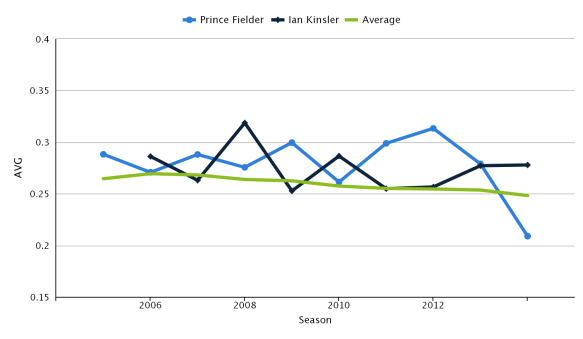
While the Detroit Tigers’ decision to trade Prince Fielder to the Texas Rangers for Ian Kinsler prior to last season initially came as a shock to Tigers fans, the positive early returns on the trade seemed to provide a calming influence. As I wrote in late April 2014,

Kinsler has provided some real spark, though. Looking at the right side of this graph, you can see that, while he and Prince posted similar batting averages last season, Kinsler has kept the pace this year, but Prince has dropped off sharply with the Rangers.

chart

While Fielder has the edge in on-base percentage, probably due to his ability to draw walks (of the intentional and unintentional varieties), Kinsler’s hitting for more power (.133 ISO vs. .121 ISO) and is posting a better wOBA— a catch-all offensive metric– than Fielder (.319 vs. .277). They also have the same number of home runs (two), with Kinsler driving in nearly twice as many runs as Fielder (14 vs. 8), while stealing three bases (to Fielder’s zero, obviously).

Less than a month later, Prince’s season would be over, a completely understandable side effect of probably overdue neck surgery.

Kinsler powered right along, though, making 726 plate appearances in a career-high 161 games. His bat seemed to cool off in the second half of 2014 (.353 wOBA vs. .276), but he still managed to finish the season tied with Miguel Cabrera for the title of most valuable Tiger, as determined by fWAR (5.1 fWAR apiece), although much of that was due to Kinsler’s defense (and Cabrera’s lack thereof).

In reviewing last year’s statistics in anticipation of this season, Kinsler’s numbers jumped off the page for one main reason: his walks had disappeared. Continue reading

Window Shopping: Tigers Roaring Out of the Gate

At one month old, the MLB season now has accrued a sufficient sample size of free time to permit me to compile the opening post of this site’s regular Detroit Tigers series for 2015, Window Shopping. Last year, I came out of the gate a bit too hot, burned out, and had to take the month of June off. This year finds your resident Tiger tracker more balanced and measured in his approach. This year’s Detroit Baseball Tigers have a more balanced look too.   Continue reading

Shane Greene Outduels A.J. Burnett as Tigers Hurdle Pirates to Avenge Only Loss

hurdle

After the Pittsburgh Pirates handed the Detroit Tigers their only loss of the 2015 season on Monday afternoon, Detroit sought and found revenge against Pittsburgh Tuesday night. The Tigers’ first seven games were marked by nearly unbridled offense (+32 run differential, second only to Kansas City and, excluding third-best Oakland (+28), not close to anyone else), but they looked to their defense for a bounceback win in game eight. Starting pitcher Shane Greene, making his second start for the Tigers after his acquisition from the Yankees during the offsesason, was excellent. In particular, Greene was highly efficient, averaging just over ten pitches per inning for eight innings of three-hit, no-walk, shutout baseball. Not-insubstantial credit for his performance is due to key defensive plays by Jose Iglesias, Ian Kinsler, and J.D. Martinez. (Greene, who was making his first-ever plate appearances as a major leaguer, was generally ineffective with his brand-new Louisville Sluggers, but no one should care because this from his mother was adorable.)

Pittsburgh starter A.J. Burnett also had a strong outing, but he could not keep the Tigers at bay forever. The visitors broke through with one run in the seventh and, thanks to some heads-up baserunning by Iglesias, an insurance run in the ninth. Joakim Soria retired the Pirates side in the bottom of the ninth to seal the win.

____________________________________________________

A minor subplot during this pitchers’ duel was the seemingly vertically compressed strike zone of home-plate umpire David Rackley, who had little interest in labeling anything up in the zone a strike. I was watching the Pittsburgh broadcast via MLB Network, but even I had to agree with the Pirate faithful that Rackley was robbing Burnett, who was throwing plenty down and away, when he even tried to go up in the zone. Pittsburgh manager Clint Hurdle certainly thought so, and after Rackley sided with the batter on a second or third Burnett pitch that really appeared to be in the zone, Hurdle started hollering at Rackley from the dugout, and Rackley tossed him as Jim Leyland watched from the front row.

Taking a fresh look at last night’s pitches this morning, it appears that my eyes did not deceive me, and Hurdle et al. were justified in their complaining:

burnettpitchplotI’ve circled in blue what I believe to be the Burnett pitch that immediately preceded the Hurdle ejection. Looked like a strike last night, and it looks like one today too. In Rackley’s limited defense, he wasn’t really calling any high strikes, but that defense isn’t much of a defense at all in the broader scheme of things. Consistency is important, but an umpire’s imposition of his own personal, deviant strike zone really isn’t.

_______________________________________________________________

Our 2015 Tigers series, Window Shopping, will begin in earnest very soon. Consider this post a prequel, and until I can get the engine revved up, I encourage you to enjoy this 2015 Tigers season preview to which I contributed in significant part.