First, an aside on data collection. I previously gathered and organized these inning-by-inning run totals by hand because I didn’t realize Baseball Reference actually tracks that information. In order to maintain the same error potential, and because B-R doesn’t separate the runs/inning between wins and losses, I’ve updated (a simplified version of) my chart as I did before.
I’m kicking off the summer concert season with a big bang deep down in Alabama this weekend. Among many others, favorites Winwood and Space Capone will be there. As for today’s featured Jam, it requires no introduction thanks to the strong captioning work contained therein:
They say that the first Super Bowl preview show begins shortly after the prior Super Bowl finishes, and with the crowning of Kentucky as the 2012 national champs late last night, today is the perfect time to post the first preview of the 2013 Final Four. There’s already much to discuss, and we can be sure that the 2013 Final Four will look much different from the one we saw over the last few days.
For one thing, most of the top players from the 2012 tournament– including Kentucky’s Anthony Davis and Michael Kidd-Gilchrist, Kansas’ Thomas Robinson, Ohio State’s Jared Sullinger, Michigan State’s Draymond Green, and Vanderbilt’s Jeffrey Taylor– will be gone to the NBA.
Another reason the 2013 Final Four will look different is that it will be played in Eastern Europe.
In one of the great moments of stealth marketing, the NCAA subtly announced during last night’s championship game that next year’s Final Four would take place in Alanta, Lithuania, a town of 464.
This is a sensible choice for basketball and non-basketball reasons, and it’s a great way to expand the NCAA’s brand abroad.
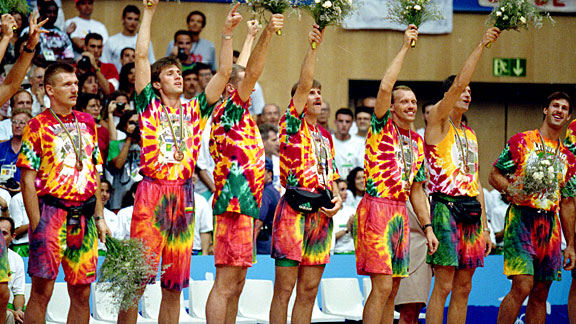
Lithuania has a strong, proud, and hip basketball tradition most notably marked by its 1992 Olympic team, known as “The Other Dream Team.” Led by Arvydas Sabonis, the Lithuanian squad represented their burgeoning democracy and their sponsors– Grateful Dead Productions– well, taking home the Bronze Medal by defeating Russia, their former overlords, in the Barcelona games.
After surviving a Napoleonic invasion and two World Wars, Alanta has displayed a ruggedness that deservedly caught the eye of the NCAA and shows that it is more than capable of hosting next year’s Final Four.
SALT LAKE CITY — Canadian freestyle skier Sarah Burke succumbed to injuries Thursday morning that she sustained in a fall Jan. 10 while training in the superpipe at Park City Mountain Resort.
University of Utah officials confirmed in a statement that Burke, 29, passed away at 9:22 a.m. surrounded by her family. As a result of the fall, she suffered a ruptured vertebral artery, one of the four major arteries supplying blood to the brain. The rupture of this artery led to severe bleeding. Emergency personnel performed CPR at the site of the accident, during which time she remained without a pulse or spontaneous breathing, the statement said.
She remained in a coma and on life support from the time she arrived at the hospital. Doctors conducted numerous neurological examinations and tests and revealed that Burke had sustained severe, irreversible damage to her brain due to lack of oxygen and blood after the cardiac arrest, the statement said. In accordance with her wishes, her family donated her organs “to save the lives of others.”
…
With her death, the world loses a world-class athlete, a tireless advocate for women’s athletics and a kind and generous soul.
Burke fought fiercely for the sport’s inclusion into the Winter Olympics. Last spring her efforts were recognized when the IOC announced ski superpipe would be included in the 2014 Winter Games in Sochi, Russia. Burke said it was the fulfillment of a life-long dream.
“In many ways, Sarah defines the sport,” Judge said. “She was one of the first people to get into the pipe and bring skis to the pipe. She’s always been very dedicated in trying to define her sport, and it’s never been about just winning. It’s been about pushing the limits. She’s always been more concerned about making herself the best, rather than comparing herself to other people.”
…
“I was often the only girl at the comps and competed against the boys for the first few years,” shes writes on the website. “I got my first sponsor when I was 17 (years) old. I had skipped training for Junior Nationals in Whistler and went off skiing in the park. Before I knew it I was traveling and competing all over the world. Ten years later I am still doing what I love and riding for the best companies out there. I have taken countless crashes and broken many bones but I love skiing more and more every year and plan to do it as long as I am enjoying it.”
…
“I plan to stick around for the 2014 Olympics so don’t be thinkin’ I am going anywhere!” she wrote. “I am really looking forward (to) skiing pow with my friends and pushing my boundaries. I would never have imagined that a girl from little ol’ Midland, Ontario, would be where I am today. So always dream big … you can make it happen.”
You can see a video of one of Burke’s X Games gold medal runs here. More related ski safety news is here.
On the day I learned of Burke’s death, I was in the process of planning my next ski adventure, and all of this had me thinking about what I like to listen to on the way to and on the mountain. Bluegrass for sure. If a heady jam is required, this is a good go-to (contextually legitimated by the appearance of a pedal-steel). I’m all for the celebration-of-life approach, but it feels like something a little more somber may be the order of this day:
(Will you look at that? It’s our boy Bruce. I really did not intend that. The venue also reminded me that I needed to amend my bio here.)
Many times, I associate a song or a group with a particular season. Few bands have a repertoire as extensive as the Dead’s, though, so it probably isn’t surprising that they have solid winter and summer catalogues. In terms of substance and presentation, the above clip clearly draws from both.
Tragic accidents like this are a reminder that athletic pursuits are not a diversion or mere hobby for everyone. In an age in which social reform focuses on the salvation of the minds of our undereducated and underprivileged children, it may be worth remembering that mind and body are connected, and that, for worse or for better, the fate of one is directly tied to the fate of the other.
When British singer Amy Winehouse died late last month of as-yet-unknown causes, media sources were surprisingly quick to note the significance of her age at death, twenty-seven years old, the same age at which a number of the most famous Western musicians died. The following is a briefly annotated list of the members of the so-called “27 Club,” with a couple notable mentions for those who nearly qualified.
(Unsurprisingly, the cause of death of many of these individuals is not entirely clear, so I’ll include the official cause of death, along with any other rumored causes, as available.) Keep reading…



 ALDLAND