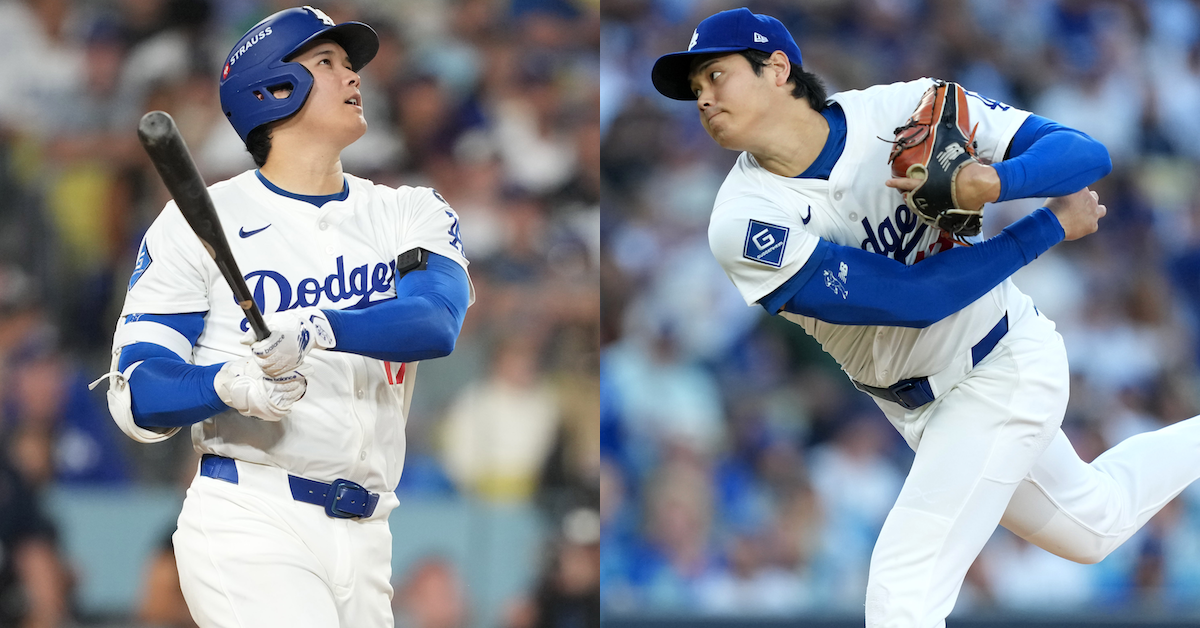
Let’s be more direct: Ohtani just had the greatest individual game in postseason history. On the mound, he threw six scoreless innings, allowing two hits and three walks while striking out 10. He got pulled after giving up two straight baserunners to start the seventh, which kind of mucked up his line, which is ironic, because that’s what the Dodgers offense has been doing to other starting pitchers over the past two weeks.
At the plate: 3-for-3 with a walk. All of those hits were solo home runs: 116.5 mph off the bat and 446 feet in the first, 116.9 mph and 469 feet in the fourth, 113.6 mph and 427 feet to center in the seventh. That second one, man, what a tank.
This is the perfect distillation of the value proposition for Ohtani. Given that this win, 5-1 over the Brewers in NLCS Game 4, clinched the pennant for the Dodgers, either one of those performances would’ve been memorable-bordering-on-legendary for Dodger fans. Put together? Well, after that fourth-inning home run, I started asking that question from a couple paragraphs back: Was this the best game in playoff history? … Read More
To be sure, I would not blame anybody for downgrading Detroit after Tarik Skubal surrendered a grand slam during a five-run seventh inning that ignominiously crowned a Tigers loss last night to a vagrant team playing in a minor-league park. Far from the August heater the team generated to fuel their run to the 2024 postseason, however, these Tigers have struggled in the second half with the likes of the Twins, Pirates, and A’s in a manner belying a true talent level perhaps somewhere below their overall winning percentage. And Javy Baez doing that bad thing again feels like a microcosm of team-wide regression trends in action:
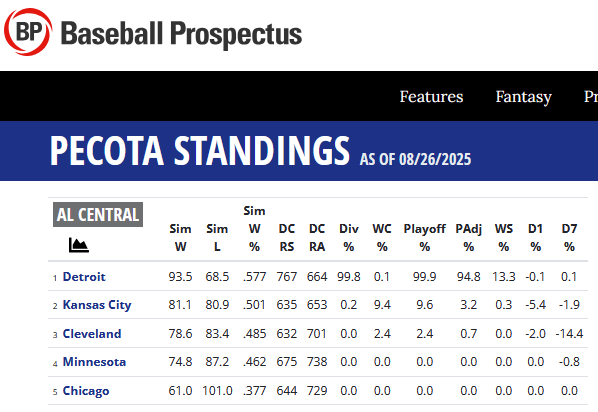
But BP’s PECOTA conceded none of that reasonable skepticism. It said this final outcome was a guaranteed certainty; no hedge, error margin, or other reservation of any kind. Presumably, it knew that Skubal could have a bad night, Baez could turn back into a pumpkin, and Jack Flaherty could continue to melt down, but it said it was not concerned. Having crossed that triple-digit threshold of certitude, it probably did not love what it saw in Sacramento last night, but one envisioned PECOTA taking that on the chin with an unwavering forward stare into a known and unavoidable future.
In short, once you go to 100%, you simply cannot go back. Again a concession from me: I will grant force majeure: If the season suddenly and prematurely ended due to a public-health catastrophe, war, or series of natural or Manfred-made disasters, then PECOTA probably gets a pass. Short of that, though? If 100% means Fool me once, shame on you. But fool me twice, baseball robot? My promise to the ALDLAND readers is that I will not be fooled again.
Entering Opening Day, Baseball Prospectus’ PECOTA announced the Tigers’ playoff odds at below twenty-percent. FanGraphs’ ZiPS, while less hateful, still came in worse than a coin flip at under forty-four-percent. Then Detroit started playing the games. And then they started winning the games. In fact, they won nineteen games before May 1 for the first time in their 124-year history, and, the next day, they became the first AL team to reach twenty wins on the season.
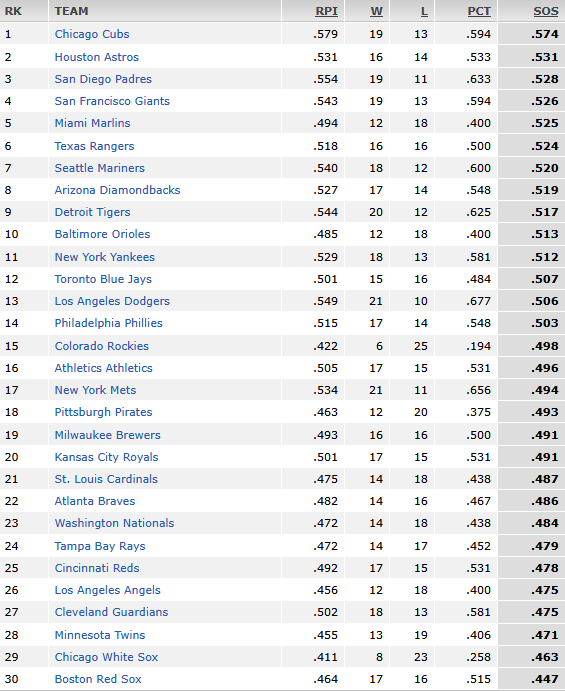
Some bitter Cleveland fans pointed out that Detroit has notched all of those wins while playing a lot of teams with sub-.500 records. That may be true. I don’t know. I do know that, according to ESPN, the Tigers overall have faced the tenth-toughest opponent schedule to date, while the rest of the AL Central has been coasting on cupcakes:
Regardless, postseason eligibility depends on standings, and standings depend only on wins, and wins are wins, and the Tigers now have twenty wins in a month’s worth of games that even PECOTA and ZiPS can’t ignore. As a result, those playoff odds have skyrocketed. BP is up from 19.9% to 61.1%, and FanGraphs is up from 43.6% to 81.1%!
There inevitably will be fluctuations, but banked wins cannot be unwon, and if relative breakouts from the on-the-ropes gang of Javy Baez, Spencer Torkelson, and Casey Mize can last, so too can this team. At least for right now, this is the fun baseball place.
Chris Sale was supposed to be an anchor for the entire Braves team, and especially its rotation. All he did last year, his first in Atlanta, was lead the team in fWAR (6.4) by nearly two wins and receive the National League Cy Young award. As with the Braves, Sale’s 2025 season is trending in the wrong direction, however.
Sale turned thirty-six on Sunday. The next day, he pitched five innings against the Los Angeles Dodgers, allowing three runs on four hits and no walks while striking out five. Not bad against a potent Dodgers offense, but his team only scored one run, so it counted as another loss.
If I’m reading this graph I generated correctly, the real trouble looming for Sale wasn’t that he fell apart in the sixth inning after holding LA scoreless and seeing just three batters over the minimum through five innings; instead, it was that he threw the slowest fastball he’s thrown since late 2023. Visually, this illustration tracks an inverse correlation between Sale’s xFIP- (lower is better) and his fastball velocity: When he’s throwing his fastball faster, his expected results tend to be better. For example, when he was locking up the Cy Young award last year, particularly in July and August, his average fastball velocity was rising and his xFIP- was plummeting. Very good. By contrast, as his average fastball velocity is dipping to start 2025, his xFIP- is climbing. Not so good.
It’s only two games, one each against two of the best teams in the National League (he also started opening day in San Diego against the Padres). But Sale is critical to Atlanta’s hopes in 2025, moreso even than last year given Spencer Strider’s injury and the departures of Max Fried and Charlie Morton, both free agents who left Atlanta to sign with AL East teams. The team needs him to be healthy and effective in carving up opposing lineups the way he once carved up his own team’s jerseys with a hunting knife.
Sale likely will be back in action this weekend as the Braves make their 2025 home debut against the Miami Marlins.
What does the future hold for the Detroit Tigers? Skubal has more influence on that than most, so his pronouncement carries great weight. Other observers are a bit more cautious than him, though. FanGraphs (ZiPS) projects an 81-81 record and a 43.6% chance of making the playoffs. Baseball Prospectus (PECOTA) is much less optimistic, chiming in at 78.5-83.5, with just a 19.9% chance of making the playoffs.
There’s quite a bit of variance between those two systems’ projections, particularly with respect to the likelihood Detroit makes it back to the postseason again this year. Considering the path the Tigers took to get there last year, catching fire in mid-August and never looking back, it’s reasonable to wonder whether that was a fluke. With due respect to Alex Cobb, Gleyber Torres, Tommy Kahnle, Jack Flaherty (welcome back!), Bailey Horn (welcome back, sort of!), Andrew Chafin (welcome back again again!), Jose Urquidy, and Manuel Margot, you can be excused for thinking the Tigers underwhelmed in the building-on-success department. There’s also a ripe case of subtraction by addition in the outfield, which is where you’ll see Javier Baez, just coincidentally absent for Detroit’s amazing August-October run last year, returning and making his debut as a real live outfielder. (In case you were wondering, yes, Baez remains under contract through 2027.)
Last year’s team went 86-76. They were 78-84 in 2023. The combination of late overachievement; middling offseason moves plus absence of history of strong in-season moves from current ownership and management; Meadows-family injuries; emerging whispers of Riley Greene fragility; and the return of Baez have me projecting an 80-82 record.
No affiliate links here, but multiple sports books currently have Detroit’s win-total line at 83.5.
The Tigers’ season opens tonight on the road against the Los Angeles Dodgers on ESPN. After three games in LA, they head north for three games in Seattle before opening at home against the Chicago White Sox on the afternoon of Friday, April 4. If nothing else, keep an eye on Skubal: he’s increased his production value each season. Repeating that feat this season would mark a very special performance.
This column returns on a Thursday evening with two notes as lovely as forgetting your problems and drinking sangria in the park.
Scott Harris and the Young Tigers are Going Streaking:
The Detroit Tigers are off today, and, based on their recent performance, only the MLB schedule-maker can stop them from winning. On August 10, Detroit was 55-63, and, according to FanGraphs, their odds of earning a playoff berth stood at 0.5%. Since then, they’ve been the best team in baseball, going 25-10 to push their record to 80-73. They just completed a series sweep of the Kansas City Royals and, amazingly, now sit just a half game out of the American League’s last wild card spot. Those playoff odds accordingly have skyrocketed to 42.3%.
Without a game, I spent the evening listening to an interview (video below) with second-year GM Scott Harris. It’s from June 25, when the team was 36-41. It of course is exciting to hear about all of the front office’s plans and aspirations when, almost three months later, they seemingly are coming to their near-term fruition. It is pretty illuminating to hear Harris speak with confidence about those plans at a time when, at least from the outside, things were not looking too hopeful, though. I also enjoyed this interview because hosts Dan Dickerson and Jason Benetti were able to draw Harris, a self-described introvert, out into the public light in a way in which he has not previously shown himself. The public hasn’t seen or heard very much from Harris since he arrived in Detroit, and what I had observed prior to today wasn’t particularly compelling or illuminating. This, by contrast, was both insightful and enjoyable.
The MLB playoff hunt officially is on in Detroit. The team has nine games left to play, three each against the Orioles, Rays, and White Sox.
Shohei Ohtani, and only Shohei Ohtani:
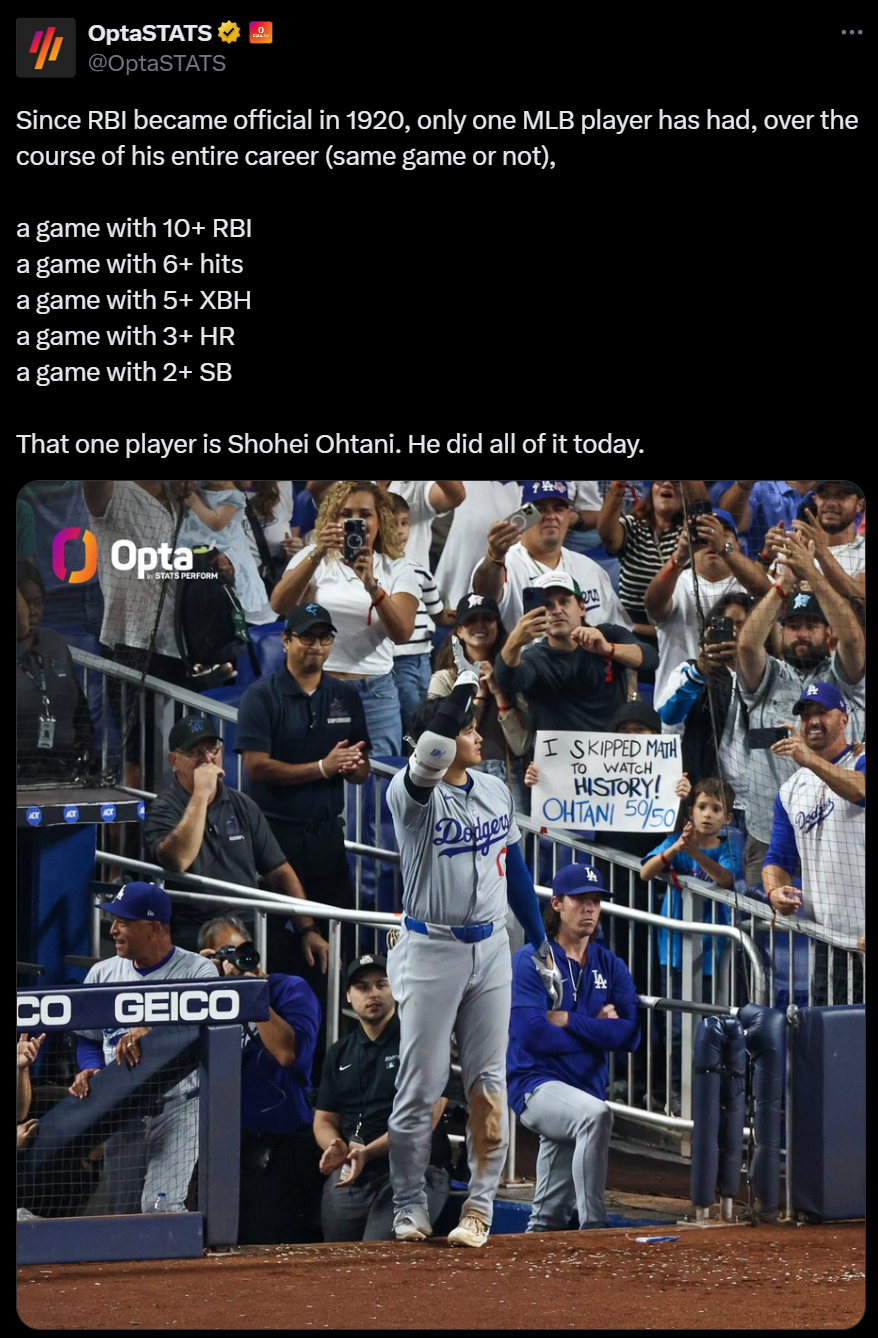
Today certainly was not an off day for the Los Angeles Dodgers. Not only did the team, in routing the Miami Marlins 20-4, clinch a playoff berth for the twelfth consecutive season, but Shohei Ohtani may have had the best single day a major-league hitter ever has had on the diamond. He went six-for-six– including three home runs and two doubles– and stole two bases.
In the process, Ohtani also became the first MLB player ever to hit fifty home runs and steal fifty bases in one season and actually stands at 51/51 with nine games remaining. We knew and hoped Ohtani would be special, but this is uncharted territory.
Wednesday was a big day in the world of baseball statistics, albeit a more complicated one than initially met the eye. Major League Baseball announced that the statistics from seven professional Negro Leagues that operated between 1920 and 1948 have been officially incorporated into its database, the culmination of a process that began in late 2020, when MLB first recognized those circuits as major leagues. As a result, several longstanding seasonal and career records have officially changed hands; most prominently, Josh Gibson is now the single-season and all-time leader in batting average, slugging percentage, and OPS, supplanting Ty Cobb and Babe Ruth in the career categories. The grassroots effort to gather and audit the Negro Leagues data that made this possible has been laudable, even heroic. But while we can never do enough to acknowledge the greatness of Gibson and his peers — along with the pain and injustice that they faced both within and outside baseball — MLB’s announcement and the dissemination of the news did strike a few sour notes, just as in 2020. … However, it is a mistake to confuse the provenance of those accomplishments as belonging to MLB, and a misrepresentation to brand them as such. As Shakeia Taylor, deputy senior content editor at the Chicago Tribune and host of the historically-focused Society for American Baseball Research podcast Ballpark Figures, succinctly put it on Twitter, “[I]t’s really as simple as referring to [Gibson] as the ‘major-league record holder’ instead of ‘MLB record holder.’ These two things are not the same.”
Again, the semantics and nuances matter. Major League Baseball (MLB) in its capitalized form refers to the corporate and legal entity created by the 2000 merger of the AL and NL, whose histories and records it subsumed, warts and all. Part of their histories is the systemic racism that excluded Black players within the aforementioned period, and so it should not simply call those records part of MLB, for however well-intentioned the gesture may be. … Within MLB’s [press] release [announcing the statistical incorporation], the supportive statements of Thorn, Lester, fellow Negro Leagues expert Phil Dixon, and Elias Sports Bureau senior historian John Labombarda are thankfully much better [than that of MLB Commissioner Rob Manfred, which elided MLB’s legacy in the creation of the Negro Leagues and the nuance of the maintenance of their statistics], with Thorn pointedly acknowledging the league’s role in creating the difficult conditions in the first place. “Shortened Negro League schedules, interspersed with revenue-raising exhibition games, were born of MLB’s exclusionary practices,” he said in the statement. “To deny the best Black players of the era their rightful place among all-time leaders would be a double penalty.” … The designation of certain bygone leagues as majors dates back to 1968, when commissioner William Eckert convened a Special Baseball Records Committee. The effort was in conjunction with publisher Macmillan’s effort to produce The Baseball Encyclopedia, which would encompass the official statistics of the major leagues. The five-man committee, which consisted of officials from the AL and NL, the commissioner’s office, the Hall of Fame, and the BBWAA — all of them white men, of course — announced in 1969 that it had determined that the AL, NL and four defunct leagues met the criteria to be considered majors[.] … The SBRC did not formally consider the Negro Leagues, with Joe Reichler, who represented the commissioner’s office, saying in 1987 that the leagues’ lack of exhaustive statistics and volume of games against local semipro teams factored into that decision. “They played against whoever they could for whatever they could get,” he told Gannett News Service. “You can’t blame them, but they never played more than 40 or 50 league games. It just wasn’t a cohesive league. There’s no way that you could say they were major league.”
The year 2020 served as a catalyst for a reconsideration of that exclusion. . . . In December of that year, MLB announced its “long overdue” decision to bestow official recognition of seven professional Negro Leagues from the 1920–1948 period as major leagues. … Read More
Now it’s FanGraphs’ turn to update its player-performance metric, WAR (a/k/a “fWAR”). Their tweaks don’t appear to be as methodologically fundamental as what BP did to WARP, but they did result in some slight– less than a win per season at the extremes– adjustments to players’ career fWAR numbers dating back to 2016. Among those who some people now will think are better players than they thought they were a few days ago (i.e., those whose fWAR numbers increased the most) are a batch of current and (mostly) former Detroit Tigers:
J.D. Martinez: +2.9
Tucker Barnhart: +2.0
Gio Urshela: +1.3
Austin Romine: +1.1
Avisail Garcia, meanwhile, was docked 1.4 fWAR, and Leonys Martin dropped 1.1 fWAR.
The full list of players seeing a shift of at least one win in their 2016-23 fWAR totals is here.
Our quizzically titled series examining the comparative stature of the 2023 Detroit Tigers continues today with a quick look at the offense. The above-referenced prompt for this focal selection is the sort of remarkable occurrence that follows a remarkable team record; in this case, the Tampa Bay Rays’ 25-6 mark to start the season. (That sixth loss, which came on Sunday to the Chicago White Sox, itself is noteworthy to Detroit fans, who surely have been recalling the 1984 Tigers’ record-setting 35-5 opening pace.) Detroit’s sub-middling 12-17 record portends lower offensive rankings for their players, and that’s exactly what we find.
As with the overall player-performance leaderboard, the results here are fairly grim. While the Rays’ roster includes six of the top twenty-five batters according to weighted runs created plus (wRC+), the Tigers don’t even have a single hitter in the current top one hundred hitters by that metric.* If you read last month’s article, you probably will guess, correctly, it’s Matt Vierling leading the way. His 112 wRC+ is good enough for 106th place on the list. Eric Haase (108 wRC+, 114th) and Kerry Carpenter (104 wRC+, 127th) are the only other Tigers who have hit at an above-average level so far in 2023, and it’s a big dropoff after Carpenter, with Riley Greene checking in at 205th place with his 78 wRC+.
Viewed as a whole, the Tigers actually are not the worst team by wRC+, with the Colorado Rockies and Kansas City Royals managing to get lower than Detroit’s 80 wRC+ team mark. Mitigating whatever silver lining of marginal upside that status might thus far provide, however, is the fact that the Tigers have scored the fewest runs of any MLB team, albeit in fewer games played than any other team.
We clearly are scraping the barrel here, so I’m going to stop now. At this moment, the Tigers are just underway against the visiting New York Mets and their new starter, Justin Verlander. Detroit is hoping for a repeat of yesterday’s modest drubbing of the Mets’ Max Scherzer, and early returns– a 2-0 lead thanks to back-to-back homers from Greene and Javier Baez– look promising.
* MLB Network, which created the Rays graphic reproduced at top, failed to disclose therein that these rankings only hold using a lower-than-expected threshold for minimum plate appearances. For comparison, limiting the list to qualified batters places just three Rays in the top twenty-five. I was able to replicate MLBN’s results by dropping the minimum plate appearances to seventy.
It is early in the 2023 MLB season. Very early. Less-than-two-weeks-in early. Not-even-ten-games-played early. Additionally, I take no pleasure in writing what you’re reading, because it is not good news, and because it now is nearly almost-astonishingly early in the 2023 MLB season.
On the other hand, if the thing I was writing was good news, I might not qualify it or hesitate to write about it or share it with the many manys of readers of this website. If the 2023 Detroit Tigers were so extremely separating themselves from the MLB pack in such a singular– but also good– fashion, you would be reading about it here, and you would want to be reading about it here. This is that, but the bad version.
By way of substantive introduction, Detroit does not have the worst record in baseball. They’re very close to having the worst record, and the reason they don’t have the worst record is at least partially circumstantial. The Tigers are tied with the Oakland A’s for the fewest wins (two apiece), but the A’s have played– and lost– one more game than has Detroit. Oakland seems to have better players than Detroit, though, at least if you grant any credence to FanGraphs wins above replacement as a reasonable general indicator of player performance. According to that metric, Kyle Muller, Ryan Noda, and Zach Jackson each have contributed more to the A’s than any player has contributed to the Tigers.
Considering the fact that, by fWAR, the Tigers’ best player so far in 2023 has been Matt Vierling, and further considering that Vierling is by that same measure the 258th-best player in baseball this season, it isn’t that surprising that another team might have multiple players who have been better than the Tigers’ best player. Nor probably is it surprising that more teams than just Oakland would, so far, have multiple players better than the Tigers’ best player. Maybe it’s mildly surprising that every other team in baseball has multiple players who rank higher than the Tigers’ best player on the fWAR leaderboard, but you probably figured that’s where this was going to end up.
Vierling, in case you never heard of him before two weeks ago, was a fifth-round pick out of Notre Dame by the Philadelphia Phillies, for which he debuted in 2021. In thirty-four games that season, he hit .346/.364/.479 and played first base and outfield. In 117 games in 2022, he hit .297/.351/.648 and played all over the field. On January 7, 2023, the Phillies sent him to Detroit along with Nick Maton and Donny Sands in exchange for Gregory Soto and Kody Clemens. Vierling played especially well in the Tigers’ two wins this season, both of which came on the road against the defending-champion Houston Astros. In those two games, he had six hits, including a home run and a double, a walk, and three RBI. In the rest of the games, he has a total of two hits (both singles) and one walk.
The Tigers are back on the road tonight in Toronto and Vierling is back in the starting lineup, hitting third. The A’s are in Baltimore with Muller scheduled as the starting pitcher and Noda hitting second.







/cdn.vox-cdn.com/uploads/chorus_image/image/72029694/1430208825.0.jpg)
 ALDLAND