
Catching Fire: Heading for the exit velocity

vacation-walley-matte-today-150527_25aa56597af71bd8b926763d3272e7cd-today-inline-large

Thanks to MLB Advanced Media’s new Statcast technology, fans can learn more than ever about the activity taking place on the field (and off it) during a baseball game. One such aspect into which Statcast offers insight is exit velocity, which refers to the speed with which a batted ball leaves a hitter’s bat. These velocities can communicate something meaningful about batter success. (Very generally, and possibly very obviously, higher exit velocity is better.)

Statcast came on-line last season, but there were significant flaws in its batted-ball data gathering in 2015. The shortcomings in the 2015 data will affect any analysis that relies on Statcast information from that season, and while Statcast seems to be doing a better job of gathering a more complete set of batted-ball data this year, some imperfections remain. Fortunately, it appears that those imperfections– apparently due in part to differences in hardware installations at each park– can be accounted for. Baseball Prospectus now publishes something called adjusted exit velocity, which aims to control for various influences on Statcast-measured exit velocity that are outside batters’ control. (None of those adjustments can recapture the data the system failed to collect in 2015, of course.)

Early in the season, I went to the Statcast well to compare home runs by Anthony Gose and Giancarlo Stanton. The purpose of this post is not to undermine lazy media narratives but to present a simple comparison between various Detroit Tigers’ adjusted exit velocities in 2015 and so far in 2016.

Keeping in mind the imperfections in the source data, here are the 2015 and to-date 2016 adjusted exit velocities (in miles per hour) of the Tigers’ primary hitters who played for the team in both seasons:
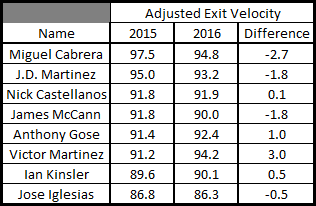
adjev15-16det

While recalling that we still are dealing with small sample sizes for 2016, particularly for James McCann, who’s spent much of the young season injured, and Anthony Gose, who now is down in the minors, I’d guess that the differences in adjusted exit velocity roughly comport with how well fans think each hitter is performing this year: Miguel Cabrera hasn’t heated up yet; J.D. Martinez has been struggling since moving to the second spot in the lineup after a hot start batting deeper in the order; Nick Castellanos has been breaking out; Victor Martinez is healthy again and showing it; Ian Kinsler seems to be in fine form yet again (credit those Jack White-designed bats?); and Jose Iglesias is continuing to rely on weak contact.

Cabrera was second overall in adjusted exit velocity last season, so his drop-off seems like a possible source of concern. Sluggers like Cabrera can take a while to warm up, though, so it’s not unreasonable to think that his adjusted exit velocity will climb as the current season progresses. (Cf. Giancarlo Stanton, 2015’s adjusted exit velocity champ, who, so far in 2016, is down 9.4 MPH.)

The elder Martinez has the largest change of any of the highlighted batters in either direction, but his 2015 doesn’t offer much of a baseline because he was playing through obvious injury. It therefore is reasonable to assume that some portion of that +3.0 MPH of adjusted exit velocity is due to a return to health.

Not only do these changes in adjusted exit velocity correlate with anecdotal observations of these players this season, but they also– loosely but consistently across this sample– track changes in raw power (measured as isolated power, or ISO):   Continue reading

Catching Fire: Who’s Number Two?

victorcatch

The 2016 MLB season is about a month old, which means that this year’s Detroit Tigers series is off to a bit of a late start. The series title is a reference both to this post, which will examine the Tigers’ catcher options, and to what the team needs to do this season in order to earn a playoff spot in a beefed-up American League Central.   Continue reading

Getting to know Jordan Zimmermann in context

talking_with_new_detroit_tigers_pitcher__0_30325097_ver1-0_640_480

I’m going to continue to link to this baseball-season countdown clock in the introductions to my baseball-related posts this month because it’s an easy way to ease into the subject matter while framing the content that follows as timely, topical, and fresh (regardless of its actual timeliness, topicality, or freshness).

The Detroit Tigers added a number of new players this past offseason in attempts to replace departures from and fix preexisting holes in each portion– offense, starting pitching, relief pitching– of their roster. Having already discussed the offense here, my focus here is on the new addition likely to have the largest effect on the pitching staff: former Washington Nationals starting pitcher Jordan Zimmermann.

As demonstrated last week in his spring training interview on MLB Network, Zimmermann has the personality of a post-Lions Silverdome hotdog, but the Tigers didn’t sign him to a five-year contract so he would challenge Miguel Cabrera in the joke-telling department. All the team is asking Zimmermann to do is replace David Price’s position in the starting rotation, which, sure, Jordan, you can borrow this book of limericks.

Zimmermann is unlikely to be mistaken for Price, but a recent comparison with another Vandy alum, Sonny Gray, can serve as an entry point to the new Tiger’s recent performance. Continue reading

The Best Baseball Research of the Past Year

Once again, the Society for American Baseball Research has chosen fifteen (non-ALDLAND) finalists for awards in the areas of contemporary and historical baseball analysis and commentary, and they are holding a public vote to determine the winners.

My latest post at Banished to the Pen highlights each finalist and includes a link to cast your vote.

As a preview, here are my summaries of my two favorite articles of the bunch:    Continue reading

2016 Detroit Tigers still in search of man out standing in (left) field

After a disappointing 2015 season, which included some odd maneuvering at the trade deadline, the Detroit Tigers entered the offseason with a significant to-do list. They’ve already made acquisitions designed to address needs in the bullpen and starting pitching rotation, but, with three months until opening day, the team still has one major hole to fill.   Continue reading

Behavioral Economics and the Rise of the Player Opt-Out (via Baseball Prospectus)

“The logic of the opt-out clauses for the club escapes me.” —Commissioner Rob Manfred

Nothing gets the baseball internet writer hot like a newly popularized contract structure. Rob Neyer has weighed in on the potential benefit to team of a player opt-out, and Dave Cameron has weighed in on how these cannot be seen as anything but additional costs. Neyer’s point is that giving a player an opt-out is often preferable to giving a player more money. Cameron’s point is that giving a player an opt-out is less preferable than not giving a player an opt-out. Both points are correct. Like most things, if we change the perspective, then we can look at anything as a positive or a negative. More simply, everything is better than a worse scenario and everything is worse than a better scenario.

So why the need for another article? Because unaddressed remains the most curious question about the player option: Why has it become so popular? Put differently, what benefit does the structure provide for each side as an alternative (in most mega-deals) to just agreeing on more money? … Read More

(via Baseball Prospectus)

The Braves are failing on their own terms

fireworks-burn-flag

It’s no mystery that I’m not crazy about the business decisions made by the Atlanta Braves’ leadership in the last few years. When I arrived in Atlanta, the Braves were a playoff team. Three years later, they’re a fourth-place team in their own division, nearly unrecognizable both in terms of record and roster. So many familiar faces are gone (only five players on Atlanta’s 2013 40-man roster remain, and the best of that bunch, Freddie Freeman, is the subject of daily trade rumors, while three of them might not belong on any major-league roster), and the team’s new, suburban stadium project, which was wrong-headed from day one, isn’t looking any better at last check.

I’m willing to concede that reasonable people can disagree about the wisdom of the Braves’ recent management decisions, though. The problem for proponents of the Braves’ plan to put a winner on the new field in 2017, all other attendant circumstances be damned, however, is that they aren’t even doing that right:

The Braves are set to move into a new, publicly funded stadium in Cobb County in 2017, and even if the rebuild goes smoothly, they seem unlikely to be in a position to win by then. There’s an unwritten rule to the art of stadium-building that says if you’re going to use the public’s money to fund shiny new digs (and you bet the Braves are), you at least have to make a good-faith effort to put a solid product on the field. The Braves are trending in the opposite direction, cutting payroll and trading off cornerstone players while construction crews are turning the $672 million SunTrust Park from blueprint to reality.

On average, a team’s payroll increased 21 percent the year it moved into a new stadium, and it jumped a staggering 57 percent during the four-year span prior to Opening Day in the new park—there’s some plain ol’ inflation mixed in there, but much of the increase is due to owners willing to shell out big contracts in exchange for the discount on a franchise-altering stadium deal.

It typically costs money to build winning baseball teams, and spend money is what teams usually do when they want to have a winning team playing its home games in their new stadium. Atlanta, by contrast, has been reducing payroll in all of its recent transactions. In other words, they aren’t doing the thing other teams do when they’re doing the thing the Braves say they’re doing.

_____________________________________________________________

Previously
New Braves stadium project continues to falter
Georgia Supreme Court Upholds Cobb’s Braves Stadium Bond Deal
Braves Break Ground on Baseball Boondoggle
The yard sale at Upton Abbey continues
From Barves to Burbs: What’s happening to baseball in Atlanta?

Window Shopping: Step Back From the Window, or, Thank You Very Much, Mr. Rebooto

The July 31 non-waiver trade deadline was an especially active period for the Detroit Tigers franchise, which made big moves both with player and front-office personnel.

Detroit traded three of the best players on its 2015 roster in the days and minutes prior to the trade deadline. The team’s biggest move, and arguably the biggest of one of the most active trade-deadline periods ever, was their decision to trade number-one starter David Price to the Toronto Blue Jays. They also sent closer Joakim Soria to Pittsburgh, and, in the final moments before the deadline, Yoenis Cespedes to the Mets.

The basic logic behind each of these moves is that, even prior to these trades, each of these players was, for all practical purposes, not going to be a member of the Detroit Tigers in 2016. That’s because each is in the final year of his current contract, meaning that each becomes a free agent at the end of this season. The Tigers would have no special ability to keep Price, Cespedes, or Soria in Detroit after the end of the 2015 season, and, given their individual successes, each is likely to fetch contract offers on the free market too rich even for Mike Ilitch’s blood. Rather than keep Price, Cespedes, and Soria for August and September on a team that’s unlikely to even make the playoffs, only to watch them walk away in the winter, the Tigers, with an eye on the post-2015 future, decided to cash in some of the value of these assets by trading them now. In doing so, Detroit converted these three expiring assets into six prospects, including five pitchers and one infielder.

Baseball analysts widely praised these transactions as beneficial to the Tigers, who, general manager Dave Dombrowski announced were “rebooting,” selling with the goal of remaining competitive in the near term, rather than undergoing a full rebuilding. The top return for Detroit was Daniel Norris, a now-former Blue Jay who lives in a van and shaves his beard with an ax. They also received Matt Boyd from Toronto, a younger starter who, in his recent Tigers’ debut, beat Johnny Cueto and the Royals.

Of course, the only real question for Detroit was not whom to trade but whether to trade. As July 31 approached, that question divided fans and, it later would be revealed, members of the team’s front office and ownership. As for the former group, most fans recognized the Tigers’ slim playoff odds and supported selling, although a minority that included this writer held out hope that the team could make one more postseason push before initiating a rebuild. Ultimately, Dombrowski’s “rebooting” seemed to satisfy both camps: Detroit would get close-to-ready prospects in exchange for their expiring assets. No long rebuilding process– a full surrender– was in store, just a quick retooling.

Two additional notes in the context of these trades: 1) one week before the trade deadline, Toronto, the biggest buyers, and Detroit, the biggest sellers, sat four and five games out of the last American League wild card position, respectively, and 2) while it isn’t at all likely that Price, Soria, or Cespedes will return to Detroit in the offseason, the effect of an unusual clause in Cespedes’ contract is that the Tigers actually increased whatever chance they have of resigning Cespedes by trading him.

_________________________________________

As the Tigers and their fans were settling into life without Price, Soria, and Cespedes, and enjoying their first trial run with Norris, who had a strong start on Sunday in Baltimore, unbeknownst to them, even more action was afoot behind the scenes.    Continue reading

Window Shopping: oY?

The notion of a “platoon split” refers to the fact that, on average, batters have more success against opposite-handed pitchers than they do against same-handed pitchers. Thus, right-handed batters generally fare better against left-handed pitching, and left-handed batters generally fare better against right-handed pitching. If you think this sounds like some Monty Hall voodoo, take a look at the numbers. It’s one of the oldest tricks in baseball.

Occasionally, however, a player will buck the trend and find himself with a reverse platoon split, meaning that he hits same-handed pitching better than opposite-handed pitching. Such appears to be the case this year for Detroit outfielder Yoenis Cespedes.

The 2015 season is shaping up to be a career-best for Cespedes. Here are his current offensive numbers:

yo2015His 3.2 fWar is good for twenty-second overall, and his 120 wRC+ (a comprehensive measure of offensive value) is third-best on his team, behind only Miguel Cabrera and the sensational J.D. Martinez. Pretty good.

What’s lurking behind those numbers, though, is something seemingly odd and definitely obviously foreshadowed by the words in this post you’ve read so far: a reverse platoon split. Cespedes bats exclusively right-handed, but, contrary to the long-prevailing trend, he has much more success against right-handed pitchers than left-handed pitchers. These are his current splits:

yo2015splitThese numbers aren’t even close. Continue reading

Window Shopping: Pigs in the Pen

It’s July, which means it’s time for MLB teams to sort out their trade-deadline strategy. While fans distract themselves with All-Star festivities, general managers are preparing to execute player transactions in attempts to load up for a playoff run or, in acceptance of their near-term fates as noncontenders, build for the future.

In this context, the Detroit Tigers find themselves in a bit of a bind. After a very strong start, they’ve slid back to a .500 record and have been entrenched in the middle of the AL Central, never too far out of first place, but never really within striking distance. Would a first-place finish from this position be unprecedented? Hardly. Can they claim a fifth-consecutive division title without making a significant trade this summer? Almost certainly not. The Tigers’ record is not a product of underperforming their potential; instead, it likely is a reasonably accurate reflection of this team’s collective ability to date, warts, lower-body injuries, and all.

There is no question that the Tigers should be buyers this month, however thin their wallet may be with currency in the form of desirable prospects. I can’t say with any certainty whom Detroit should acquire this month– starting pitchers Johnny Cueto and Cole Hamels are the most valuable targets on the market, but the sellers’ prices may be too rich for the blood of the Tigers’ farm system– but I do agree with the prevailing preference for bolstering the pitching rotation. Shane Greene‘s floor proved too low to allow the team to continue to wait to see how high his ceiling might go, Alfredo Simon’s regressed to the very average levels we should have expected out of him as a starter, and, with appearances in just four games in 2015, Justin Verlander’s projected resurgence isn’t happening. The return of game-calling extraordinaire Alex Avila to his precarious post behind the plate can’t fix that many holes, and neither, I suspect, can J.D. Martinez‘s unsustainable home-run rate. Detroit needs to find another starter.

The trade-deadline attention on the pitching rotation represents a shift of attention away from their bullpen, the conventionally identified leading source of all of the Tigers’ problems. Continue reading