The annual National Cherry Festival resumes this weekend in Traverse City and runs until the start of the 2021 MLB All-Star break begins after the following weekend. Let’s use that time to look at how the Detroit Tigers have been performing over an intraseason period selected solely to make them appear better than they have been if you do something foolish like take then entire season into account.
On May 7, the Tigers lost to the Minnesota Twins 7-3, dropping their record to 9-24, and leaving them as the only MLB team without a double-digit win total. Miguel Cabrera was running a career-worst .127/.225/.238 line, and the team had just one above-average hitter in Jeimer Candelario (115 wRC+, with his BABIP still hovering around .400).
On May 8, though, the Tigers reversed the scoreboard and beat the Twins 7-3. That started a 25-21 run, a .543 winning percentage that– holding all else constant– would bump Detroit up to third place in the AL Central (or first place in the NL East).* Sure they actually remain locked in a virtual tie for last place in the division, but let’s stick with this May 8 thing a little while longer.
Since May 8, Detroit quadrupled its tally of above-average hitters. Robbie Grossman and Eric Haase (both 107 wRC+) have come on strong and clutch. And Jonathan Schoop and breakout star Akil Baddoo are on fire. Their respective 167 wRC+ and 159 wRC+ marks would make each of them top-ten hitters if extended over the full season to date. (On the other hand, Candelario dropped 100 points of BABIP and flipped his wRC+ from 115 to 85.)
As he so often does, Miguel Cabrera deserves special mention. He’s pulled up his offensive rate numbers a good deal and continues to accumulate historic-level career achievements. He continues to close in on 3,000 hits (2,915), and at 493 homers, he now is tied with Lou Gehrig and Fred McGriff on the all-time list.
Thanks in significant part to the historic woes of the Arizona Diamondbacks, owners of an active road losing streak twenty-three games in length, the Colorado Rockies have risen out of last place in the National League West, though their 30-43 record wouldn’t place them in any better position in any other MLB division. Star outfielder Charlie Blackmon has significantly improved his personal situation, however. What in early May looked like the worst season of his career (e.g., 58 OPS+/56 wRC+) now shapes up as merely league average. Maybe DRC+ (then the outlier at 108, now roughly steady at 112) knows something after all, and the fact that Blackmon maintained an on-base streak almost as long as Arizona’s losing streak certainly helped.
Judge [David] Cannon certainly has plenty of latitude to grant a default judgment in Blackmon’s favor here. The easiest part to resolve should be a ruling on the question of a default judgment against Ramsey’s company, which, in Georgia, must be represented by a lawyer. Apparently open questions about the precise nature of the remedy or remedies Blackmon seeks (e.g., Does he just want his car back? Does he want money from Ramsey, and, if so, exactly how much?) may complicate the situation for Blackmon, however, and complications and uncertainties usually are not helpful to a party seeking entry of a default judgment.
Now, in his first edict in this case on the subject of the defendants’ default, Judge Cannon indeed seized upon that easiest portion of the issue before him, but not quite in the manner Blackmon probably wished. Acknowledging that Georgia law requires Ramsey Performance to be represented by an attorney in litigation in that state, the court’s notice nevertheless states that, in consideration of general guidance from the Supreme Court of Georgia favoring generosity in granting extensions of time during pandemic conditions, it will permit Ramsey Performance nearly another month to find a lawyer.
While this is a significant reprieve for Ramsey Performance, the relief may be short-lived. The mere participation of an attorney on the company’s behalf alone will not cure the company’s problems in this case, and that attorney still will be in the difficult position of having to convince Judge Cannon that he should excuse Ramsey Performance’s failures to respond to Blackmon’s complaint and motion for default judgment. To the extent settlement remains on the table, this may push Ramsey, who has repeatedly expressed his displeasure with the notion of having to pay for a lawyer, closer to a deal.
So pump the brakes for now, attentive public, and navigate your browser back here in a few weeks for our continuing exclusive coverage of arguably the summer’s biggest sports law story.
MLB pitchers, it seemed, took note. To many, Gerrit Cole, now the top starter in the New York Yankees rotation, has become the face of elite spin rates, and he was continuing to earn that reputation in 2021. In his first start after June 2, however, his spin rate plunged.
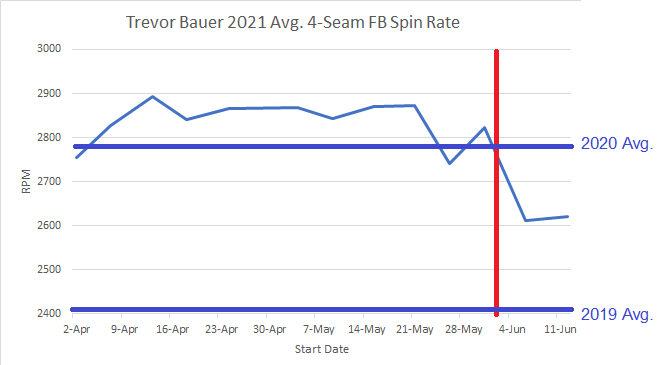
Trevor Bauer, the defending NL Cy Young winner now pitching for the Los Angeles Dodgers, forced his way into the group of spin-rate leaders last season following years of public comments criticizing pitchers who used foreign substances to increase their spin rates. Like Cole, Bauer saw his spin rate plummet after June 2.
Another leader in this category in recent seasons is Yu Darvish, now a starter for the San Diego Padres. Unlike Cole and Bauer, Darvish appeared unfazed by the June 2 announcement, at least judging by the relative consistency in his spin rates this season.
Since the June 2 announcement and enforcement of minor-league suspensions, MLB yesterday announced that it would apply the ten-game-suspension policy to major leaguers as well, with a progressive-discipline scheme for repeat offenders.
While a variety of factors can affect measured spin rates, it’s difficult to interpret the spin-rate dips from Cole and Bauer in their post-June-2 starts as anything other than an acknowledgement of the use of substances that go beyond providing the sort of control-improving grip that even batters appreciate from a safety standpoint and facilitate extreme spin rates (Spider Tack has become the brand name associated with that latter variety of substance). Cole and Bauer don’t come to this point by the same route, however. Bauer’s well-documented history of criticizing Cole and his former teammates in Houston for what Bauer strongly implied– and later seemed to demonstrate in a live-action experiment– were artificially high spin rates arguably places him in a different category than others in this conversation. On the other hand, perhaps he’s just more media-savvy. Should it make a difference if Bauer publicly changed his game to capitalize on and make a point of highlighting MLB’s underenforcement of foreign-substance rules, while Cole did, well, whatever this is?
here's gerrit cole's response when asked point blank if he has ever used spider tack, one of the sticky substances baseball is looking to crack down on pic.twitter.com/rKFOksIDoW
Nor can we draw any firm conclusions from Darvish’s spin-rate graph. Not only did Darvish’s RPMs not drop after June 2, but they continued to climb. Was he undaunted by the “imminent” threat of enforcement, and, if so, why?
All of this brings us to Casey Mize’s start last night, immediately following MLB’s declaration that it would begin enforcement of its zero-tolerance policy against major-league pitchers. In his short professional career, Mize has not been a high spin guy, nor has he been publicly associated with what he calls the “sticky.” Which is why he was so upset when an umpire forced him to change gloves during the game:
Mize was walking off the mound following the first inning of his start on Tuesday in Kansas City against the Royals, when John Tumpane stopped him for what looked like a friendly conversation.
According to Mize, Tumpane said Mize’s glove was too light-colored.
Mize said the glove, which he’s worn for every one of his big-league starts, was originally charcoal-colored, but may have faded a bit in the sun.
“He said the gray color was too light,” Mize said.
Color judgement aside, Mize was most angry because Tumpane’s order came on the same day that Major League Baseball announced a widespread crackdown on the use of sticky substances that some pitchers have used to help them grip the baseball and increase the spin rate on their pitches.
“I assume everyone thinks that I was using sticky stuff now, which I was not,” Mize said. “So I just thought the timing of it was pretty (expletive), honestly. The umpires need to get on the same page, because I’ve made 12 starts (in 2021) and everybody was fine with (the glove). Or John Tumpane just needs to have some feel and just let me pitch with the glove that the other team did not complain about. (Tumpane) brought it up himself. John’s a good umpire and a very nice guy. But I mean, just have some feel for the situation because I hate that I’m in a position now where I assume everyone thinks I was using sticky when in reality, that was not the situation at all.”
First, for visual illustration, some relevant images of Mize’s mitt:
Without more information, this seems like a questionable decision by the umpire, and, whatever his motivation, the decision did drag Mize into the broader conversation about foreign substances. So what do the spin measurements say about Mize’s pitches? Most obviously, he operates in a much lower band of RPMs than the likes of Cole, Bauer, and Darvish. That alone may be more than enough for many to exonerate him. And while Mize’s average spin rates did decline between his May 28 start and his June 3 start, the magnitude of the change was negligible relative to those Cole and Bauer exhibited. If his data suggest anything, it’s that Mize is telling the truth.
However irked Mize was after being forced into a mid-game glove change, it did not appear to alter his performance. He completed 6.2 innings, threw a season-high 103 pitches, and allowed three runs on the way to a 4-3 Tigers win in Kansas City.
To this point in the season, Mize has been the best of Detroit’s young pitchers, and he trails only Spencer Turnbull in WARP. He’s following up an interesting if inconsistent debut in 2020 with across-the-board improvements in major statistical categories. While veterans attempting to be crafty and the commissioner’s office duke it out over Spider Tack, here’s hoping Mize can avoid that fray and continue to find his footing as a leading member of Detroit’s rotation.



 ALDLAND