Why I’m not going to see Moneyball

If you’ve set eyes upon an operating television, magazine, or newspaper in the last month, you probably are aware that the big-screen adaptation of Michael Lewis’ 2003 book Moneyball is coming out tonight, and I won’t be there to see it.

More than anything, I’m surprised this movie was a) even made, and b) made as a major picture featuring a star of the notoriety of Brad Pitt. The book, a work of nonfiction, is eight years old. It describes a way of thinking that has become uncontroversial, if not widely accepted, and that, as applied in the story told in the book, did not come to lasting fruition (i.e., Oakland is bad).

The celebrated nerd motif can work as general interest film for grownups if it adds an element of widely recognized and desired glamour. For example, 21 worked because it put the nerds in Vegas. Vegas unquestionably represents glamour, allure, desire, risk, and danger to all Americans, even those who’ve never been and never want to go, for whom it’s the forbidden other. Vegas attracts your attention, even if not your urge for physical presence, and seeing it through the eyes of sheltered nerds taking on the Vegas establishment allows the audience to feel the thrills and chills of the story. You didn’t need to understand specifically how they were cheating (or whatever), you just needed to understand that they were cheating, and you were along for the ride. Kevin Spacey and a major-marketed release were justified.

Baseball can’t carry nerd protagonists the way Las Vegas can, not even Major League Baseball, and especially not a team without household-name superstars, and really especially not a team without household-name superstars doing something like juicing or gambling. The players aren’t even the focus– it’s the administrative folks, and they aren’t Jerry Jones or Al Davis. Heck, even Marge Schott would make this more compelling. It isn’t a comedy baseball movie, and it isn’t a heartfelt tale of athletic achievement. It’s Titanic without the love story: great new idea gets carried out, and, albeit less dramatically, the boat sinks. And you know all of this before setting foot inside the theater.

It isn’t that I don’t like going to the movies– I’m looking forward to a few upcoming ones in particular (The Rum Diary, the Coen brothers’ Dave Van Ronk project, and J. Edgar)– but even thinking about sitting through a screening of Moneyball makes me tired. (Although if they promised to reveal the history of the Athletics’ elephant logo, I might change my tune.)
Fall Fridays

One of the nice things about having my first real autumn in a few years is knowing that I won’t be sweating my face off at any more football games this fall. Another is a more natural turning to seasonal music, which is why I had this song in my head this morning:

A reexamination of performance enhancing drugs in sports, and Peyton Manning’s neck

Jason Whitlock, a writer for Fox Sports, formerly of the Kansas City Star, even more formerly a footballer for Ball State, and sometimes guest host of Jim Rome’s radio show, asked in his NFL column this week, “If human growth hormone or some other performance-enhancing drug would help Peyton Manning’s nerves regenerate and heal his neck, would you be against the NFL’s top player using it/them?”

Keep reading (and vote)…

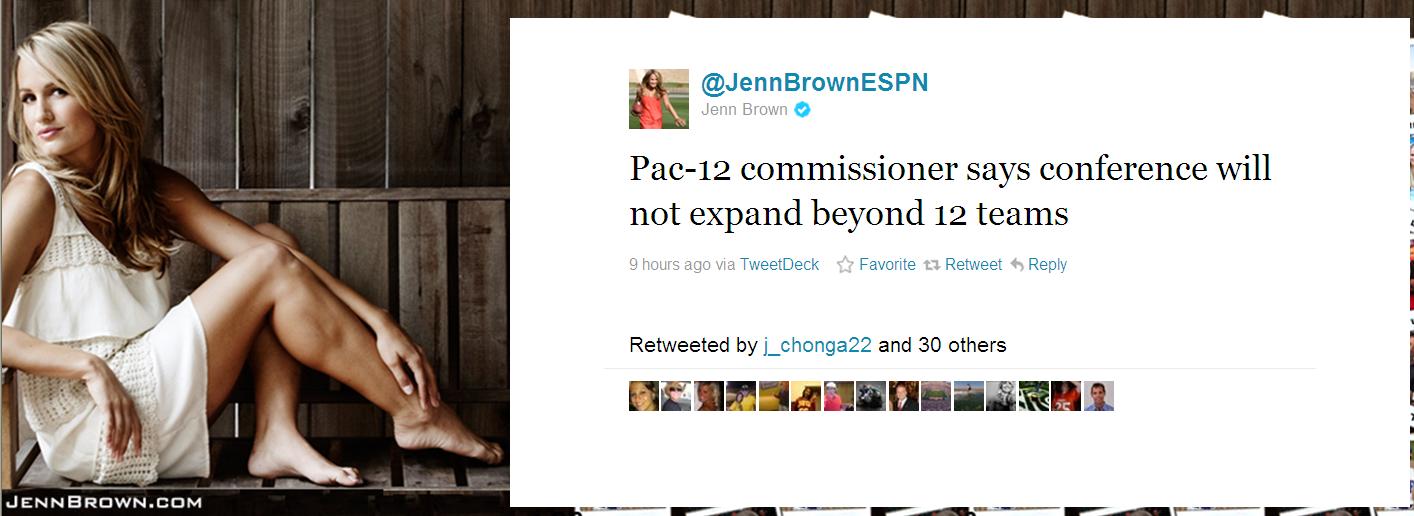
The Pacific Twelve will not expand, cannot explain why, and will regret and later reverse this decision

As beautifully reported last night, the recently-expanded Pacific Twelve Conference declared it will expand no more. While commodawg recently wrote that I have made some “preposterous suggestions” on this site (a not wholly inaccurate suggestion itself), I am going to register a prediction on this issue. First, though, I have to thank commodawg for discussing and linking to the only sampling of the written word ever to speak of the major Western conference as the “Pacific 12.” That’s on par with “Philip Jackson,” and the only place to go from there is “Pacific Twelve,” so here we are.

Before this year, the Pacific Twelve was the Pac 10. The conference added consistent football juggernauts Colorado and Utah to make a non-baker’s dozen. In reality, the Buffs and Utes are anything but (no matter what Senator Hatch says), which is what makes yesterday’s statement confusing. The flailing Big XII’s national powerhouses, Texas (to my surprise) and Oklahoma, were making comparatively overt, public ovations to the Pacific Twelve, and it was the acts and statements of these schools that triggered the no-expansion announcement. Why they would not want these two programs, though, is beyond me.

I haven’t engaged in the rumor-mongering that’s been flooding the webwaves these past weeks and months, but it’s hard to disagree with the view that we’re going to end up with four sixteen-school superconferences. Once the SEC, Big Ten, and whatever survives out of the ACC and Big East each amass sixteen members, the Pacific Twelve will wish really bad that they’d become the Pacific 14 in 2011 by adding Texas and Oklahoma. In fact, they could have led the way by also taking Texas Tech and Oklahoma State, schools thought to be politically tied to their in-state counterparts, to become the first sixteen-school major conference. Their non-expansionist foreign-conference policy might make Ron Paul happy on some micro level, but in the next round of major conference realignment, the Pacific Twelve will 1) join in the expansion; 2) wish they already had as members these two major programs because there aren’t any better options and those are two excellent options anyway; and 3) solicit their membership if Texas and Oklahoma aren’t already gone to another conference.

The Enduring Myth Of Mookie Blaylock And Pearl Jam (via Deadspin)

He was an All-Star in 1993-94; had a shaved dome and chiseled physique when fades and “smooth muscle” were still the norm; and could always be counted on for minor upheavals, via crossovers, hesitations, or bolts to the basket that left no question as to his strong on-court identity (if not necessarily his value). In this way, he may have been the perfect analogy for Pearl Jam before they even knew it. … Read More

(via Deadspin)

Transition Monday

This past weekend didn’t feel as exciting as the previous one, from a sporting perspective (still deciding if that dependent clause is necessary), but it was a busy one.

On Friday, Dave Gavitt died. On Sunday, the collegiate athletic conference Gavitt founded and ran, the Big East, also died. Some may protest that the conference is not dead yet, but the decamping of Syracuse and Pittsburgh to the ACC is the harbinger of the Big East’s now-inevitable death.

in addition to the regularly scheduled bundles of football, the weekend also saw AL Cy Young lock and legitimate MVP contender Justin Verlander earn his twenty-fourth win, as well as his twelfth straight start, with eight scoreless innings in Oakland. (As the improving Shane Ryan observed, Verlander “could become the first pitcher since Bob Welch in 1990 to win 25 games. That milestone would probably cement Verlander’s legendary status, because who can forget the great Bob Welch?”)

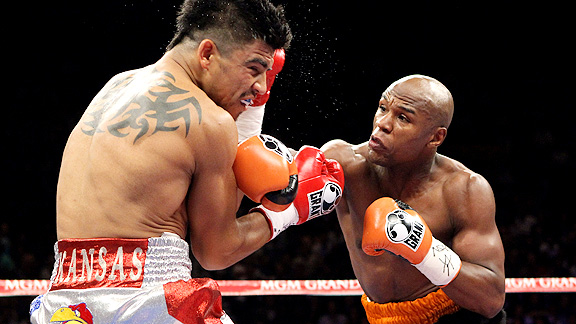
The final major happening of the weekend came in Las Vegas, where Floyd Mayweather knocked out Victor Ortiz in the fourth round. Full coverage, video, and instant analysis is available here.

As for the week ahead here, stay tuned…

No hate, just heat in Hope-Calvin rivalry (via ESPN.com)

So how did arguably America’s most evenly matched rivalry come to fruition? Like many heated contests, it boils down to religion. The sister colleges, separated by a mere 30 miles, are of different faiths: Hope is connected to the Reformed Church in America; Calvin is affiliated with the Christian Reformed Church. (The Christian Reformed Church broke off from the Reformed Church in America in 1857.)

While the rivalry began across all sports, it has grown into a national event in men’s basketball. Much of that is due to the teams’ success, particularly in the past three decades. Much more than bragging rights is on line when the teams meet. … Read More

(via ESPN.com)

Less cowbell Friday

Mississippi State lost a defensive struggle to SEC West foe LSU last night in Starkville. The visitors had a 6-3 lead at the half, and I thought the Bulldogs had the winning edge a couple times in the third quarter, but they couldn’t quite overcome LSU, which finally broke the dam in the fourth and won 19-6. Mississippi State still is a team on the rise, but I’m not sure they’re going to get a chance to improve on last year’s nine-win season until 2012.

Because I couldn’t come up with a Friday-themed Friday jam, I’ll make it up to you with two clips. I guess everybody’s got to have a thing (I guess?), and Mississippi State has made the cowbell its thing. Two clips to try to cheer up Bulldog fans and remind everyone else that something sorta good came out of Starkville once: