Window Shopping: Step Back From the Window, or, Thank You Very Much, Mr. Rebooto

The July 31 non-waiver trade deadline was an especially active period for the Detroit Tigers franchise, which made big moves both with player and front-office personnel.

Detroit traded three of the best players on its 2015 roster in the days and minutes prior to the trade deadline. The team’s biggest move, and arguably the biggest of one of the most active trade-deadline periods ever, was their decision to trade number-one starter David Price to the Toronto Blue Jays. They also sent closer Joakim Soria to Pittsburgh, and, in the final moments before the deadline, Yoenis Cespedes to the Mets.

The basic logic behind each of these moves is that, even prior to these trades, each of these players was, for all practical purposes, not going to be a member of the Detroit Tigers in 2016. That’s because each is in the final year of his current contract, meaning that each becomes a free agent at the end of this season. The Tigers would have no special ability to keep Price, Cespedes, or Soria in Detroit after the end of the 2015 season, and, given their individual successes, each is likely to fetch contract offers on the free market too rich even for Mike Ilitch’s blood. Rather than keep Price, Cespedes, and Soria for August and September on a team that’s unlikely to even make the playoffs, only to watch them walk away in the winter, the Tigers, with an eye on the post-2015 future, decided to cash in some of the value of these assets by trading them now. In doing so, Detroit converted these three expiring assets into six prospects, including five pitchers and one infielder.

Baseball analysts widely praised these transactions as beneficial to the Tigers, who, general manager Dave Dombrowski announced were “rebooting,” selling with the goal of remaining competitive in the near term, rather than undergoing a full rebuilding. The top return for Detroit was Daniel Norris, a now-former Blue Jay who lives in a van and shaves his beard with an ax. They also received Matt Boyd from Toronto, a younger starter who, in his recent Tigers’ debut, beat Johnny Cueto and the Royals.

Of course, the only real question for Detroit was not whom to trade but whether to trade. As July 31 approached, that question divided fans and, it later would be revealed, members of the team’s front office and ownership. As for the former group, most fans recognized the Tigers’ slim playoff odds and supported selling, although a minority that included this writer held out hope that the team could make one more postseason push before initiating a rebuild. Ultimately, Dombrowski’s “rebooting” seemed to satisfy both camps: Detroit would get close-to-ready prospects in exchange for their expiring assets. No long rebuilding process– a full surrender– was in store, just a quick retooling.

Two additional notes in the context of these trades: 1) one week before the trade deadline, Toronto, the biggest buyers, and Detroit, the biggest sellers, sat four and five games out of the last American League wild card position, respectively, and 2) while it isn’t at all likely that Price, Soria, or Cespedes will return to Detroit in the offseason, the effect of an unusual clause in Cespedes’ contract is that the Tigers actually increased whatever chance they have of resigning Cespedes by trading him.

_________________________________________

As the Tigers and their fans were settling into life without Price, Soria, and Cespedes, and enjoying their first trial run with Norris, who had a strong start on Sunday in Baltimore, unbeknownst to them, even more action was afoot behind the scenes.    Continue reading

Window Shopping: oY?

The notion of a “platoon split” refers to the fact that, on average, batters have more success against opposite-handed pitchers than they do against same-handed pitchers. Thus, right-handed batters generally fare better against left-handed pitching, and left-handed batters generally fare better against right-handed pitching. If you think this sounds like some Monty Hall voodoo, take a look at the numbers. It’s one of the oldest tricks in baseball.

Occasionally, however, a player will buck the trend and find himself with a reverse platoon split, meaning that he hits same-handed pitching better than opposite-handed pitching. Such appears to be the case this year for Detroit outfielder Yoenis Cespedes.

The 2015 season is shaping up to be a career-best for Cespedes. Here are his current offensive numbers:

yo2015His 3.2 fWar is good for twenty-second overall, and his 120 wRC+ (a comprehensive measure of offensive value) is third-best on his team, behind only Miguel Cabrera and the sensational J.D. Martinez. Pretty good.

What’s lurking behind those numbers, though, is something seemingly odd and definitely obviously foreshadowed by the words in this post you’ve read so far: a reverse platoon split. Cespedes bats exclusively right-handed, but, contrary to the long-prevailing trend, he has much more success against right-handed pitchers than left-handed pitchers. These are his current splits:

yo2015splitThese numbers aren’t even close. Continue reading

Detroit Tigers Midseason Status Update

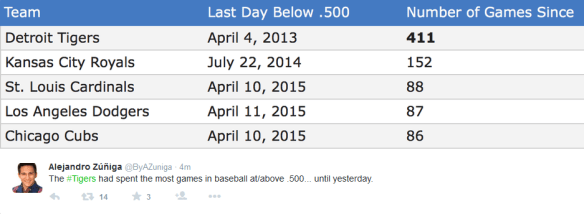
500

The anticipated events of the next two weeks will go a long way toward shaping the identity of the next phase of the Detroit Tigers organization. Will they push for a World Series run or cash out their movable assets while they’re at their highest values? This is the time to decide. My latest contribution to Banished to the Pen is a quick assessment of where the team stood at the All-Star Break that should help contextualize their options and actions as they enter the second half of the season.

The full post (scroll down for my segment) is available here.

Window Shopping: Pigs in the Pen

It’s July, which means it’s time for MLB teams to sort out their trade-deadline strategy. While fans distract themselves with All-Star festivities, general managers are preparing to execute player transactions in attempts to load up for a playoff run or, in acceptance of their near-term fates as noncontenders, build for the future.

In this context, the Detroit Tigers find themselves in a bit of a bind. After a very strong start, they’ve slid back to a .500 record and have been entrenched in the middle of the AL Central, never too far out of first place, but never really within striking distance. Would a first-place finish from this position be unprecedented? Hardly. Can they claim a fifth-consecutive division title without making a significant trade this summer? Almost certainly not. The Tigers’ record is not a product of underperforming their potential; instead, it likely is a reasonably accurate reflection of this team’s collective ability to date, warts, lower-body injuries, and all.

There is no question that the Tigers should be buyers this month, however thin their wallet may be with currency in the form of desirable prospects. I can’t say with any certainty whom Detroit should acquire this month– starting pitchers Johnny Cueto and Cole Hamels are the most valuable targets on the market, but the sellers’ prices may be too rich for the blood of the Tigers’ farm system– but I do agree with the prevailing preference for bolstering the pitching rotation. Shane Greene‘s floor proved too low to allow the team to continue to wait to see how high his ceiling might go, Alfredo Simon’s regressed to the very average levels we should have expected out of him as a starter, and, with appearances in just four games in 2015, Justin Verlander’s projected resurgence isn’t happening. The return of game-calling extraordinaire Alex Avila to his precarious post behind the plate can’t fix that many holes, and neither, I suspect, can J.D. Martinez‘s unsustainable home-run rate. Detroit needs to find another starter.

The trade-deadline attention on the pitching rotation represents a shift of attention away from their bullpen, the conventionally identified leading source of all of the Tigers’ problems. Continue reading

Willie Horton Can Change the World (via Sports on Earth)

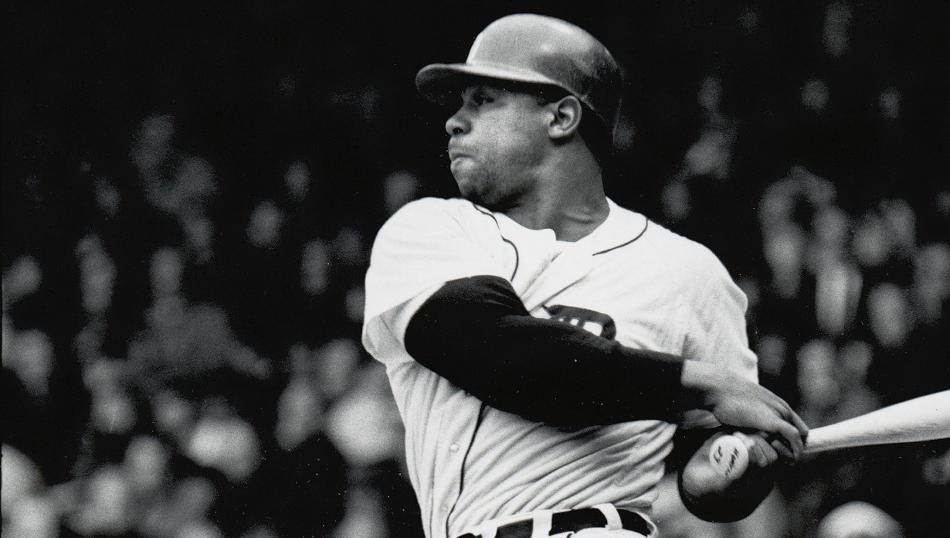
Horton_cbo69kqg_715cb9noStill, nothing showed Horton’s character more than that July weekend in 1967, when rioting began on a Saturday night in Detroit. The Tigers hosted the New York Yankees for a doubleheader the following afternoon, and Horton stood in left field studying his teammates, the visitors, the fans and something beyond the grandstands at Tiger Stadium.

“I kept seeing black smoke in the distance, and I thought it was just a fire somewhere,” Horton said, and he was correct. It was carnage from the second of what would be five days of rioting that would take 43 lives and wound more than 1,000 other people. When the second game ended, Horton discovered in the clubhouse what was happening. “I was sitting there, getting ready to take a shower,” Horton said, “and then I got to thinking. I just said to myself, ‘Man, I’ve got to go.'” … Read More

(via Sports on Earth)

Go to your home: Visualizing baseball team run-conversion efficacy

go home

In my latest post at Banished to the Pen, I attempt to visualize in graphic fashion the effectiveness of all thirty Major League Baseball teams at converting baserunners into runs and, having done so, speculate only a little bit wildly about the reasons why two of those thirty teams– the Detroit Tigers and San Francisco Giants– are not scoring as many runs as they probably should be given their large number of opportunities to do so (i.e., baserunners).

The full post is available here.

Window Shopping: We Got Robbed

The Detroit Tigers shot out to a hot start in 2015, but things have not been too good for Detroit since then. They’ve won just five of their last thirteen series. The team’s active six-game losing streak is its longest in four seasons.

The title of this year’s serial Tigers feature at this site, Window Shopping, comes from the common theme of Detroit season previews that, with respect to a World Series championship, the team was trying to keep open its “window of opportunity,” assuming that proverbial window had not already slammed shut under the weight of expensive long-term contracts, aging players, and perceived defensive burdens.

After the last month and a half, though, it is as if these window shoppers, gazing upon the Commissioner’s Trophy in a fancy Harrod’s storefront display (did we fight the Revolution for nothing??), reached into their back pockets in consideration of making the eventual purchase, only to find they suddenly had no money, no credit cards, no traveler’s checks, nothing. They’ve been robbed.

The Tigers are in a tailspin, and it isn’t exactly anyone else’s fault. Their recent struggles have come in games against teams largely regarded as mediocre or worse, including the Athletics, Angels, and Brewers. What’s happening?

After starting the season with an 11-2 record, the Tigers have gone 17-24, and their performance somehow has felt even worse. By my count, since April 21, the date they entered with that 11-2 mark, Detroit has a -19 run differential. Only two other American League teams– the White Sox and Red Sox– have worse run differentials during that period, and only one AL team, Toronto (187), has allowed more runs over that span than Detroit’s 185. Of course, the Blue Jays also scored 213 runs in those games, a number that dwarfs the Tigers’ 166 and is the most in the league. On the other hand, just seven AL teams have scored fewer than 166 runs since April 21, and two of them, Kansas City and Tampa Bay, still maintained positive run differentials. (Both Sox teams, along with Seattle, Baltimore, and Oakland round out this low-scoring group.) In terms of offense and defense (the fundamental terms of competitive team sports), it’s hard to be worse than Detroit right now.

Offense fueled the Tigers’ strong start, and its disappearance has triggered their decline. They averaged 5.38 runs per game through April 20. Since then, though, they’ve scored just 4.05 runs per game, a drop of more than a run and a third. Omit a blowout 13-1 win against the Twins on May 14, and that per-game scoring average falls to 3.83. No bueno.   Continue reading

Window Shopping: Shut the Door, Tip Your Cap

As I write this, his elbow likely is spontaneously combusting, but it’s beginning to look like the Detroit Tigers finally have a reliable closer. Joakim Soria has been both busy and successful this season, appearing in twenty-two of the Tigers’ forty-eight games so far, allowing just three runs and one blown save in that span. Eight of his twenty-two appearances have been on no rest, and six more were after just one day of rest. Since Joe Nathan went down with a season-ending injury, the ninth inning has belonged to Soria, and, on a couple recent occasions, part of the eighth inning as well. Soria’s success is quite welcome, and this expanded use of his closer also reflects well on manager Brad Ausmus, who was criticized for what appeared to be inartful handling of his relievers last year.

Whatever the cause of Soria’s rediscovered success this year, along with the positive contributions of his fellow relief pitchers, the Tigers suddenly find themselves with one of the best bullpens in baseball, as measured by ERA. (They were fourth-worst in 2014.) This reversal comes not a moment too soon for Detroit, where, with Victor Martinez back on the DL, the offense has evaporated like a mid-May snow melt. Thanks in no small part to Soria, though, the team was able to win two of three in Oakland while scoring just four runs in the entire series. The closer appeared on Tuesday night and Wednesday afternoon, allowing two hits, one walk, and no runs in 2.1 innings pitched to seal both victories. Below is the final pitch of yesterday’s game, which is not unpleasing to watch.

Continue reading

Window Shopping: Ian Kinsler’s Walking, Not Running

While the Detroit Tigers’ decision to trade Prince Fielder to the Texas Rangers for Ian Kinsler prior to last season initially came as a shock to Tigers fans, the positive early returns on the trade seemed to provide a calming influence. As I wrote in late April 2014,

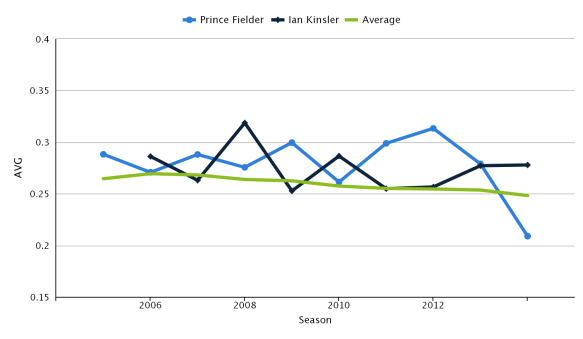
Kinsler has provided some real spark, though. Looking at the right side of this graph, you can see that, while he and Prince posted similar batting averages last season, Kinsler has kept the pace this year, but Prince has dropped off sharply with the Rangers.

chart

While Fielder has the edge in on-base percentage, probably due to his ability to draw walks (of the intentional and unintentional varieties), Kinsler’s hitting for more power (.133 ISO vs. .121 ISO) and is posting a better wOBA— a catch-all offensive metric– than Fielder (.319 vs. .277). They also have the same number of home runs (two), with Kinsler driving in nearly twice as many runs as Fielder (14 vs. 8), while stealing three bases (to Fielder’s zero, obviously).

Less than a month later, Prince’s season would be over, a completely understandable side effect of probably overdue neck surgery.

Kinsler powered right along, though, making 726 plate appearances in a career-high 161 games. His bat seemed to cool off in the second half of 2014 (.353 wOBA vs. .276), but he still managed to finish the season tied with Miguel Cabrera for the title of most valuable Tiger, as determined by fWAR (5.1 fWAR apiece), although much of that was due to Kinsler’s defense (and Cabrera’s lack thereof).

In reviewing last year’s statistics in anticipation of this season, Kinsler’s numbers jumped off the page for one main reason: his walks had disappeared. Continue reading

Window Shopping: What’s a Shane Greene?

Ain’t no change in the weather,
ain
t no changes in me.
And I ain’t hiding from nobody,

nobody’s hiding from me.

Detroit Tigers fans weren’t sure what to expect out of their new starting pitcher when Shane Greene arrived from New York this past offseason. As I noted in this Tigers season preview, the scouting report on Greene was, to be kind to his prospects, guarded: “an average pitcher — in Triple-A” with a major-league “path for . . . success [that is] very rarely traveled.” He had done moderately well in his fourteen-start rookie campaign, which included two wins– the first an eight-inning shutout– over the Tigers, and the primary question for him entering 2015 was whether he could replicate his success in limited outings across a full season’s worth of starts. After one month of baseball, the answer to that question, like most others at this point in the season, remains outstanding.

Continue reading