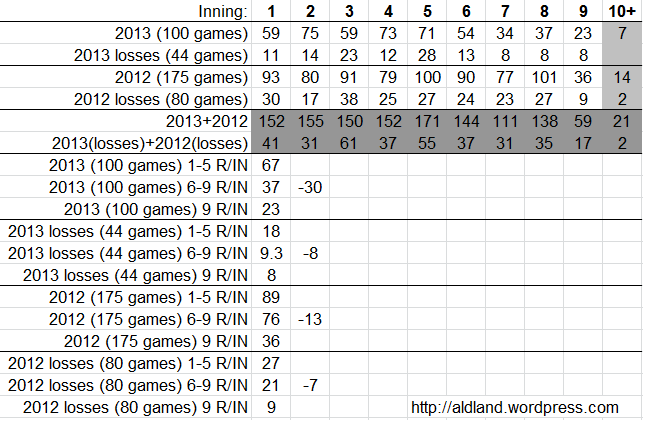
Bay of Cigs: 100 days of summer run distribution

ALDLAND celebrated tax day this year by taking a dive into the numbers behind the Detroit Tigers’ offensive production. Since last season, I had developed the feeling that this should-be offensive power was having trouble scoring late in games, hamstringing their ability to mount comebacks and generally secure a win in the later innings, and I wanted to investigate to see whether that really was the case.

The evidence I gathered in April appeared to support my hypothesis. The 2013 season was just twelve games old, though, and it was difficult to ascribe too much meaning to data gathered from such a small sample set. As of today, however, Detroit has played one hundred games in the 2013 campaign, so I decided to update the numbers:

Continue reading

Bay of Cigs: Forget what you know

This year’s Detroit Tigers are far from perfect, but they’re off to a good start on the strength of their starting pitching and the bats of Miguel Cabrera, Prince Fielder, Jhonny Peralta, Torii Hunter, Omar Infante, (increasingly) Victor Martinez, and (once again) Austin Jackson.

The weak link– the bullpen– has been both very obvious and very weak. Hoping for some addition by subtraction, the club sent onetime-closer Jose Valverde down to the minors, and a more focused “closer-by-committee” approach has emerged, centering around Joaquin Benoit and Drew Smyly, with an emphasis on not misusing Phil Coke.

One of the criticisms of manager Jim Leyland is that he likes to have go-to players to fill defined roles, and nowhere is this more applicable than in his handling of relief pitching. In short, Leyland wants to have one guy be his guy when it comes to closing out games in the ninth inning. His unwillingness to deviate from that approach has had exceedingly frustrating consequences when The Closer is someone less effective than the likes of a Craig Kimbrel or, say, a 2011-vintage Valverde. (This is especially true because the Tigers have trouble scoring late in games. If the bullpen blows a lead late, this team is unlikely to mount a comeback.) Even though fans would like to see Leyland be a bit more nimble with the way he utilizes his personnel, some of his attitude surely has rubbed off on them. The fans want to have someone who can be The Closer too.

Buster Olney launched a thousand blog posts with his suggestion that current Philadelphia Phillies reliever Jonathan Papelbon might make a good fit in Detroit. Papelbon has a great reputation as a closer, and, as Buster writes, “there are no questions about whether he could handle October,” which is where the Tigers’ expectations reside.

Team owner Mike Ilitch has shown little resistance to spending money on this iteration of the team, which means that the large contract that’s scaring other teams away from Papelbon is unlikely to be an issue in Detroit.

My opinion is that, if the Phillies are willing to part with Papelbon without demanding much beyond the absorption of his contract, the Tigers should get him. If his steady hand can turn these cardiac kitties into some cool cats come playoff time, it’ll be worth it.

That said, it probably is worth taking a look at how Papelbon would stack up with his new teammates if he were to catch a ride to Motor City this season.  Continue reading

Bay of Cigs: Run distribution, science(!), and the liklihood of a Detroit comeback

We’re a dozen games into the season and the Tigers, with a few hiccups, are off to a respectable 7-5 start. Despite the day/Pacific time starts and my living outside the Tigers Radio Network, I’ve been able to keep decent track of these first few series and, while mindful of small sample size they represent, I was beginning to notice something concerning.

Continue reading

LeBron James is the 2011-2012 MVP, and rightly so

Back in February, I asserted that LeBron James was the best basketball player ever, and at that point, he was. He had at that point, by a comfortable margin, a higher player efficiency rating than any player ever had achieved. (General explanation of PER in the previous post; full explanation here.) Although he regressed from 32.8 to 30.74 to finish the season, it still was good enough to be the tenth best season ever by an individual player. In so doing, James knocked David Robinson out of the top ten, meaning that James (4, 9, 10), Wilt Chamberlain (1, 2, 5), and Michael Jordan (3, 6, 7, 8) collectively turned in the ten best seasons of professional basketball ever played.

James’ competitors for the MVP this year weren’t even close to him:

Rank Player PER
1. LeBron James 30.74
2. Chris Paul 27.04
3. Dwayne Wade 26.31
4. Kevin Durant 26.20
5. Kevin Love 25.36
6. Dwight Howard 24.24
7. Blake Griffin 23.43
8. Derrick Rose 23.02
9. Russell Westbrook 22.94
9. Andrew Bynum 22.94

For comparison, Paul is the only other player whose 2011-12 charted on the top 100 all time— at #79.

______________________________________________

Previously
LeBron James is the best professional basketball player ever

LeBron James is the best professional basketball player ever

It might not seem like it, but, as discussed on ESPN Radio’s Mike & Mike this morning, LeBron James’ current season is the best season a professional player has ever had. John Hollinger, also of ESPN, created the Player Efficiency Rating (PER) metric for basketball players. In (his) general terms, “the PER sums up all a player’s positive accomplishments, subtracts the negative accomplishments, and returns a per-minute rating of a player’s performance.” It’s an advanced metric, and really, it’s a doubly advanced metric because it’s derivative of other advanced metrics. If you want it, the nitty gritty is here, but what PER allows us to do is compare individual players with their contemporaries and with those from other eras on equal footing.

The following is a list of the top individual full-season performances, based on PER, in the history of the NBA and ABA:

Rank    Player PER Season Tm
1. Wilt Chamberlain 31.84 1962-63 SFW
2. Wilt Chamberlain 31.76 1961-62 PHW
3. Michael Jordan 31.71 1987-88 CHI
4. LeBron James 31.67 2008-09 CLE
5. Wilt Chamberlain 31.64 1963-64 SFW
6. Michael Jordan 31.63 1990-91 CHI
7. Michael Jordan 31.19 1989-90 CHI
8. Michael Jordan 31.14 1988-89 CHI
9. LeBron James 31.10 2009-10 CLE
10. David Robinson 30.66 1993-94 SAS

The full list from Basketball-Reference is here.

James already has two of the ten best seasons, and he’s the only active player in that group. (His teammate, Dwayne Wade, is the next active player listed, at 13.) If the current season ended today, though, James would post a PER of 32.8, by far the highest mark ever recorded.

Perception is a valid and important check on the things statistics tell us. I feel like there are a million things one could write about James and perception, expectations, image, and legacy, all of which would get at the fact that the title of this post is something I’d guess most people reject as an initial, gut reaction but also something we all expected we would read, write, or say at some point. There are myriad potential lessons here. One is that these advanced metrics are a way of witnessing history in the moment, something that’s difficult to do based upon perception alone. Another is that, darn it, I hate LeBron and sabermetrics are for idiot-nerds. A third raises questions about the value we place on winning championships as a component of individual players’ legacies. A fourth is that Patrick Ewing, whose best season comes in at #117 on the big list, might not be the Dan Marino of the 1980s and 1990s NBA, and Kobe Bryant, whose best season so far comes in at #51, isn’t quite the heir to His Airness’ throne, or even Shaq’s big seat. And on and on.

Why I’m not going to see Moneyball

If you’ve set eyes upon an operating television, magazine, or newspaper in the last month, you probably are aware that the big-screen adaptation of Michael Lewis’ 2003 book Moneyball is coming out tonight, and I won’t be there to see it.

More than anything, I’m surprised this movie was a) even made, and b) made as a major picture featuring a star of the notoriety of Brad Pitt. The book, a work of nonfiction, is eight years old. It describes a way of thinking that has become uncontroversial, if not widely accepted, and that, as applied in the story told in the book, did not come to lasting fruition (i.e., Oakland is bad).

The celebrated nerd motif can work as general interest film for grownups if it adds an element of widely recognized and desired glamour. For example, 21 worked because it put the nerds in Vegas. Vegas unquestionably represents glamour, allure, desire, risk, and danger to all Americans, even those who’ve never been and never want to go, for whom it’s the forbidden other. Vegas attracts your attention, even if not your urge for physical presence, and seeing it through the eyes of sheltered nerds taking on the Vegas establishment allows the audience to feel the thrills and chills of the story. You didn’t need to understand specifically how they were cheating (or whatever), you just needed to understand that they were cheating, and you were along for the ride. Kevin Spacey and a major-marketed release were justified.

Baseball can’t carry nerd protagonists the way Las Vegas can, not even Major League Baseball, and especially not a team without household-name superstars, and really especially not a team without household-name superstars doing something like juicing or gambling. The players aren’t even the focus– it’s the administrative folks, and they aren’t Jerry Jones or Al Davis. Heck, even Marge Schott would make this more compelling. It isn’t a comedy baseball movie, and it isn’t a heartfelt tale of athletic achievement. It’s Titanic without the love story: great new idea gets carried out, and, albeit less dramatically, the boat sinks. And you know all of this before setting foot inside the theater.

It isn’t that I don’t like going to the movies– I’m looking forward to a few upcoming ones in particular (The Rum Diary, the Coen brothers’ Dave Van Ronk project, and J. Edgar)– but even thinking about sitting through a screening of Moneyball makes me tired. (Although if they promised to reveal the history of the Athletics’ elephant logo, I might change my tune.)