State College Delusional: What hasn’t changed

We haven’t said much about this Penn State mess because we’re busy and because really, what is there to say?

From the initial news of the grand jury investigation through the firing of Joe Paterno, the release of the Freeh Report, and this morning’s announcement of NCAA sanctions, it feels like this thing has reached at least a temporary landing point at which we can breathe, take stock of what’s happened, restore some perspective, and focus on what’s important (i.e., the victims).

All of us, that is, except for one group: current Penn State students. (There’s no point in even approaching the parallel universe in which the Paterno family steadfastly resides. That’s expected, if indefensible.) They rioted furiously when the university fired Paterno, and from the sounds of it, little has changed today. In anticipation of the announcement of NCAA sanctions, ESPN Radio’s Mike & Mike checked in this morning with a correspondent in State College, PA, who had clips from two students responding to yesterday’s removal of the Paterno statue outside Beaver Stadium. My attempted transcriptions, first of student one:

Removing the Paterno statue did nothing to heal us. How does that heal us?

The emphasis in this statement was on the “us,” as in, “us students.” To them I ask, why do you need healing? What happened to you? Unless Jerry Sandusky raped you, you are not a victim in need of healing. Of course it didn’t heal you. It has nothing to do with you.

Student two:

Doctor Rodney Erickson said that he was going to protect JoePa’s legacy. How does this protect his legacy?

First, the kid actually said “Doctor Rodney Erickson.” Just so we’re clear. Secondly, to answer his question, it doesn’t protect “JoePa[‘s]” legacy in any way. Paterno’s “legacy” was a charade, a falsity Paterno and others protected at the expense of children. In reality, Paterno’s legacy is this coverup. That’s the legacy Paterno advanced through his dying day, and that’s the legacy Erickson protected by removing a monument to Paterno’s fraudulent legacy. Third, now seems like as good a time as any to stop calling him “JoePa.”

I think we wanted to think that the students initially rioted because they didn’t quite understand, but now that all the information is out in the sunlight and there’s been time for clearer heads to prevail, the students at the geographic locus of this would come in line with the general public. We’re told that Penn State is a big school, that not everybody thinks the same way, that they aren’t wearing blinders. The only data points we get from them– the initial riots and rallies, the Big Brother-esque turning off of the campus televisions during the Freeh Report announcement, Matt Millen, incoming recruits, and now these comments– indicate that the PSU campus residents are as delusional as ever.

______________________________________________________

Related
ESPN’s Jeremy Schaap: Giving a Voice to Penn State’s Victims – Huffington Post

Previously
“It sounds like an attempt to avoid personal liability”
Joe Paterno to retire at season’s end
Growing Up Penn State

You’ll never guess who was the earliest advocate of an eight-team college football playoff

Intransigence by corporate interests, media interests, and Big Ten leadership all have been the objects of blame for college football’s failure to move away from the BCS-based postseason format, and many of those same interests will continue to face blame when dissatisfaction builds with the newly proposed “plus one” system set to begin after the current BCS contract runs out in 2013. Particularly in SEC and Big XII country, Jim Delaney, commissioner of the Big 10, has played the role of lightning rod, the embodiment of resistance new college football’s new competitive order

Interestingly, though, it appears that it was from Delaney’s Big 10 that the vision of college football’s yet-unrealized future first emanated. From The Milwaukee Journal, November 1, 1966:

Continue reading

Previewing the 2013 NCAA Men’s Final Four

They say that the first Super Bowl preview show begins shortly after the prior Super Bowl finishes, and with the crowning of Kentucky as the 2012 national champs late last night, today is the perfect time to post the first preview of the 2013 Final Four. There’s already much to discuss, and we can be sure that the 2013 Final Four will look much different from the one we saw over the last few days.

For one thing, most of the top players from the 2012 tournament– including Kentucky’s Anthony Davis and Michael Kidd-Gilchrist, Kansas’ Thomas Robinson, Ohio State’s Jared Sullinger, Michigan State’s Draymond Green, and Vanderbilt’s Jeffrey Taylor– will be gone to the NBA.

Another reason the 2013 Final Four will look different is that it will be played in Eastern Europe.

In one of the great moments of stealth marketing, the NCAA subtly announced during last night’s championship game that next year’s Final Four would take place in Alanta, Lithuania, a town of 464.

This is a sensible choice for basketball and non-basketball reasons, and it’s a great way to expand the NCAA’s brand abroad.

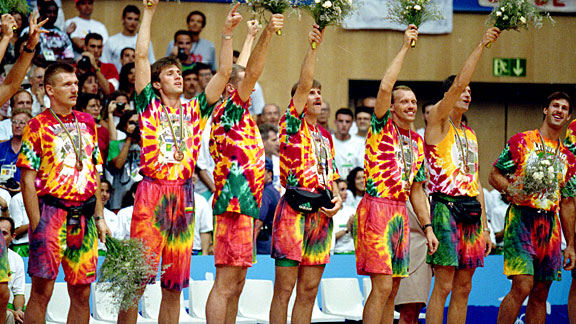
Lithuania has a strong, proud, and hip basketball tradition most notably marked by its 1992 Olympic team, known as “The Other Dream Team.” Led by Arvydas Sabonis, the Lithuanian squad represented their burgeoning democracy and their sponsors– Grateful Dead Productions– well, taking home the Bronze Medal by defeating Russia, their former overlords, in the Barcelona games.

After surviving a Napoleonic invasion and two World Wars, Alanta has displayed a ruggedness that deservedly caught the eye of the NCAA and shows that it is more than capable of hosting next year’s Final Four.

AD’s year in review

Thanks for dropping by this week and checking out our year-in-review posts, interspersed with our usual coverage, and thanks to Brendan for a great idea.

Top Sports Moments of 2011
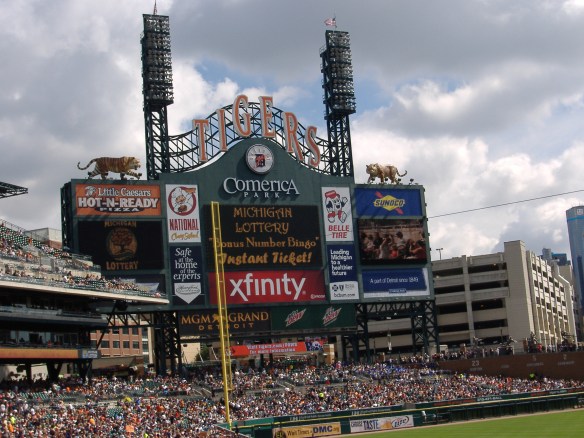
The scoreboard in left field.

If you’re looking for an official or objective list of the top stories of the year, I suggest you go elsewhere. What I like about our year-in-review features is that we’ve written about the stories, albums, and events that were most interesting or important to us, and, as will be immediately obvious, I’m going to follow suit.

1. Detroit Tigers playoff push

The Tigers obviously didn’t make it as far as they did in 2006, but this year was like that year in that Detroit beat the Yankees along the way. What was different about 2011, for me, was that I was a) living in Michigan, and b) writing and tweeting for a sports blog during much of the season. Both of these things measurably enhanced my experience of and connection to this year’s team, its successes, personalities, and volatility. It also was the first time in a few years that I was able to attend a game. I spilled much digital ink on this team in these virtual pages, and the posts are easy enough to find so I’ll spare you any detailed recap, except to say that, a few months later, I am able to appreciate the way the wheels came off as a suitable ending to a dramatic (by Detroit standards) season.

2. Vanderbilt’s football season

I didn’t put the Lions’ season on my list under the rationale that it still is ongoing, so this selection is cheating a little bit, but the college football regular season is over, so I’m running with it. I’ll hit on some of the high points in my Liberty Bowl preview that will go up later today, but first-year head coach James Franklin appears to have changed the culture at Vandy even faster than Jim Schwartz has in Detroit, tripling the win total with essentially the same players. As successful as he was on the field (I’ll always maintain that they were three plays away from a 9-3 record), Franklin may be even more successful on the recruiting trail. He already nabbed a Virginia quarterback recruit away from Virginia Tech, and he took a five-star QB recruit to the wire against LSU and Notre Dame. Next year looks even more promising, when Warren Norman is scheduled to return to the backfield alongside 2011 success stories Zac Stacy and starting QB Jordan Rodgers. 2012 will look even better if the Commodores can win the Liberty Bowl and finish this year 7-6.

3. Misbehaving College Coaches

This was a great year for teams I like– Spartans, Commodores, Tigers, Lions, and Red Wings– and it was a great year for sports writing, with the launch of Grantland, OutKick the Coverage, and The Classical, but like Magalan felt compelled to remark upon the marathon record-setter, I feel compelled to mention the names Jerry Sandusky, Jim Tressel, and Bruce Pearl. Sandusky is in a terrible league of his own, and I already have written here about Tressel and Pearl. Sparing the hand-wringing, defending, and analyzing, what I’ll say in the context of the posture of this post is that it is a welcome development that the NCAA is punishing coaches individually for the violations they commit or otherwise oversee. I hope the days of slippery escape artists like John Calipari, Pete Carroll, and Lane Kiffin are over.

Top Albums of 2011

Creating this list was a bit more difficult, not because I don’t like or know about music, but because I’m not quite as hip-to-the-modern-scene as many of my co-writers here. (See, for example, my punt on Amy Winehouse earlier.) Resort to a list of 2011 releases from a trusted source, something I suspect a lot of people writing bits like this do, was unavailing. That list jogged my memory on one album, Gregg Allman’s Low Country Blues, that Bdoyk actually tipped me off to initially. It didn’t make my list though, even though I had to cheat a little as you’ll see, because I didn’t think it was anything special. I liked it, but I don’t think it deserves to be one of the three best albums of 2011, even if I can’t come up with three.

1. Revelator – Tedeschi Trucks Band

This was an easy number one choice for me. I wrote a full review of the album back in September, and I don’t feel the need to supplement it now, except to add that it was the first record I played on my turntable after recently setting up my new stereo system.

2. June 3, 2011, Pine Knob – Phish

This is a concert, not an album, but I was in attendance, and it was a perfect concert night. Put attendance together with recording (free sample streaming), and I’m calling it an album. I went with a good friend, with whom I’ve seen the band once before, and everything went as smoothly as could be. The weather was perfect, the band was playing at a level they hadn’t reached in years. and it was my first visit to this historic outdoor Michigan venue. It definitely was the best I had ever seen them, and we had the feeling during the show that something special was going on, which made it all the more neat and enjoyable. Because amateur blogging about a Phish show registers somewhere between talking to another person about your fantasy minor league baseball team and a rambling monologue at a loud bar about that “drug trip” you had “back in high school,” I’ll close this by quoting bona fide Phish blogger Mr. Miner (the second Mr. Miner— I held that username as a prior legal nonconforming use on phishows.com), who wrote shortly afterwards that:

Sometimes a show—just one set—can launch thousands of dreams, taking the audience on a voyage so cosmic and coherent; so spectacular and superb that people will look back on it for years to come. Odysseys like the second set of Detroit’s Friday night exclamation reach the very core essence of Phish—four musicians pushing the boundaries of musical possibilities while taking 15,000 fans with them into the depths of the universe. With playing so together and inspirational, Phish opened yet another door last night, inviting us further into the future. And more than ever, the future is now.

…You get the idea.

3. Fall – Root Glen

As I suggested above, I didn’t hear a lot of 2011’s new releases, but I definitely heard this one. One of two releases by this relatively new band from New Jersey, I also wrote a full review of this EP last month. What I’ll add in this retrospective is that it is cool to listen to something for the first time and immediately recognize that it represents an important step up for a band you already liked. Before Fall, Root Glen had been successful at capturing their live sound in the studio, and this was great. After all, it was their live performances that gave them a following in the first place. But a lot of bands play live and just noodle and jam without much focus or commitment, and Fall is evidence of a group redoubling its effort to put forth an even higher quality of music they always had in them.

Thanks for reading us in 2011, and be sure to stick around for much more in the New Year.

Related
Magalan’s year in review
Bdoyk’s year in review

Exexpatriate’s year in review

Bpbrady’s year in review
ALDLAND’s year in review

Magalan’s year in review

Top 3 Sports Moments/Things of the Year:

1. Makau breaks the Marathon World Record in Berlin.

Don’t worry, we’ll talk SEC Football soon enough. But records in the Marathon don’t happen every year, and it’s getting much harder to break. So when Patrick Makau runs 26.2 miles in 2:03:38, it’s a big deal. Breaking the previous record by only 21 seconds in a race that is so long might not seem significant, but, umm, it is. I find it helpful to note that the time listed above means Makau ran the race with an average pace of 4:42.9 per mile. If you were a track star in high school, it is possible that you could run a mile in under 5 minutes. Once, maybe twice. To do it 26.2 times is truly difficult for me to comprehend.

2. The ALL SEC National Championship Game.

Since it is a moment that will actually occur in 2012, we’ll say the selection of two SEC teams for the title game. I’ll start by saying the whole situation stinks for Oklahoma State. They were certainly deserving of a shot against LSU. But so is Alabama. I didn’t agree with any of the talk about the LSU-Bama meeting on November 5 – I didn’t think it was terribly boring, and really enjoyed watching it.

Aside from SEC homerism, the moment is significant in that it might have finally tipped the scales for a move to some kind of playoff. It has, at the very least, put the structure of the BCS in doubt going forward. The run up to the national championship may look very different five years from now.

3. The Atlantic publishes Tyler Branch’s piece, The Shame of College Sports, in October 2011.

As should be clear by now, I love watching college football. But its hard to read that article and not feel unsettled by the current state of affairs. As revenues for college football continue to increase, I expect that we’ll eventually see some sort of real payment for players. Which is probably for the best.

Top 3 Albums of the year:

1. Here We Rest – Jason Isbell and the 400 Unit.

He was my favorite part of the Drive-By Truckers when we was with them, and I’ve loved each of the three albums he’s made since he moved on in 2007. This last one is yet another good addition to his body of work. He’s a heck of a songwriter, and you can rock out or relax at various points on the album.

2. The King of Limbs – Radiohead.

I liked it, sorry. Maybe it’s not as groundbreaking as stuff in the past, but I’ve caught myself listening through the album over and over again. I take that as a sign.

3. Barton Hollow – The Civil Wars.

These guys put out an incredible album this year, and then got a ton of publicity when Taylor Swift tweeted about their concert at the Belcourt Theater. The whole album is beautiful, and the title track is all sorts of acoustic kick-ass.

Related
Bdoyk’s year in review
Exexpatriate’s year in review

Bpbrady’s year in review
ALDLAND’s year in review

Should NCAA sanctions against Jim Tressel affect his ability to work in the NFL?

FOX Sports reports:

The NCAA hit Ohio State with a one-year bowl ban and additional penalties Tuesday for violations that started with eight players taking a total of $14,000 in cash and tattoos in exchange for jerseys, rings and other Buckeyes memorabilia.

Tressel was tipped to the violations in April 2010 but didn’t tell anyone — even after the athletes got caught last December but were allowed to play in the Sugar Bowl against Arkansas if they served suspensions to start the 2011 season. Among those in the group: starting quarterback Terrelle Pryor and leading rusher Daniel ”Boom” Herron.

Tressel, who guided Ohio State to its first national championship in 34 years after the 2002 season, was pressured to resign after 10 years with the Buckeyes. The NCAA hit him with a five-year ”show-cause” order which all but prevents him from being a college coach during that time.

”Of great concern to the committee was the fact that the former head coach became aware of these violations and decided not to report the violations,” the NCAA Division I Committee on Infractions wrote in its report.

Under a show-cause order, any school that hired Tressel would have to present its case for why it needed to employ him, and would risk severe penalties if he were to commit any further infractions after that.

The NCAA also issued a public reprimand and censure, put the Buckeyes on probation through Dec. 19, 2014, and reduced football scholarships from 85 to 82 through the 2014-15 academic year.

The full article is here.

This fall, Tressel, recently hired as the Indianapolis Colts’ in-game video replay consultant, delayed his first day on the job, apparently to comport with the suspensions Ohio State players were facing.

A five-year show-cause sanction is a different animal, though, and Tressel’s multi-week, self-imposed suspension of sorts is not as apt a comparison as NFL commissioner Roger Goodell’s suspension of Terrelle Pryor. Back in August, I wrote about the Goodell Doctrine and the Pryor Precedent (and the potential Benson Exception), which apparently reflect NFL policy in the context of the relationship between the NFL and the NCAA and situations in which those facing NCAA sanctions seek to avoid them by fleeing to the NFL.

At this point, I haven’t formed any opinion on how Tressel’s five-year show-cause sanction compares with Bruce Pearl’s three-year show-cause sanction except that there’s a two-year difference between the two and the men coach different sports. Right now, my only question in the Tressel matter is for Goodell: Will the NFL impose a five-year requirement on the Colts and all other teams that they must meet the show-cause burden before hiring Tressel for any job starting in the 2012-2013 season?

The Atlantic reveals the history of the NCAA and the true genesis of the “student-athlete”

In the October issue of The Atlantic, available now online, Taylor Branch lays out a behind-the-scenes history of the NCAA that is long, thorough, compelling, and readable. Amidst today’s increasingly loud chatter over major sanctions and paying players, Branch’s sober historical profile explains how the modern NCAA came to be, and how its shaky, yet grandiose origins led to the tenuous position it precariously maintains today.

While I try to keep things on the lighter side around here and leave the heavier stuff elsewhere, one bit of the story Branch carefully detailed jumped out at me: the origin of the “student-athlete” concept so foundational to the NCAA’s purported ideals and mission today. From the section of the article called “The Myth of the ‘Student-Athlete'”:

Today, much of the NCAA’s moral authority—indeed much of the justification for its existence—is vested in its claim to protect what it calls the “student-athlete.” The term is meant to conjure the nobility of amateurism, and the precedence of scholarship over athletic endeavor. But the origins of the “student-athlete” lie not in a disinterested ideal but in a sophistic formulation designed, as the sports economist Andrew Zimbalist has written, to help the NCAA in its “fight against workmen’s compensation insurance claims for injured football players.”

“We crafted the term student-athlete,” Walter Byers himself wrote, “and soon it was embedded in all NCAA rules and interpretations.” The term came into play in the 1950s, when the widow of Ray Dennison, who had died from a head injury received while playing football in Colorado for the Fort Lewis A&M Aggies, filed for workmen’s-compensation death benefits. Did his football scholarship make the fatal collision a “work-related” accident? Was he a school employee, like his peers who worked part-time as teaching assistants and bookstore cashiers? Or was he a fluke victim of extracurricular pursuits? Given the hundreds of incapacitating injuries to college athletes each year, the answers to these questions had enormous consequences. The Colorado Supreme Court ultimately agreed with the school’s contention that he was not eligible for benefits, since the college was “not in the football business.”

The term student-athlete was deliberately ambiguous. College players were not students at play (which might understate their athletic obligations), nor were they just athletes in college (which might imply they were professionals). That they were high-performance athletes meant they could be forgiven for not meeting the academic standards of their peers; that they were students meant they did not have to be compensated, ever, for anything more than the cost of their studies. Student-athlete became the NCAA’s signature term, repeated constantly in and out of courtrooms.

Using the “student-athlete” defense, colleges have compiled a string of victories in liability cases.

Branch’s article is revealing and worth spending a slow afternoon reading. It isn’t so much thought-provoking as it is informative, really because there’s just so much of a story to tell. One thought I was left with, though, was whether those fans jumping into the growing throng that seems increasingly driven not only to pay players and establish a football playoff system, but at dismantling the NCAA itself really want (or know) what they’re asking for. There exists an injustice in the current system, no doubt, but the current arrangement is drawing more fans than ever. What college sports fans like, in terms of an end product, is something built on the college sports business empire as it actually exists, not as the NCAA claims to want it to exist, and not as reformers would have it exist. The ripple effects of fundamental change that appear to be on the horizon with increasing inevitability seem unlikely to confine themselves to off-field matters, and they seem to be highly unpredictable. The present arrangement may be untenable, but if you’re enjoying what you’re seeing, you may find your self interest directing you to a position that would preserve this arrangement as long as it can last.

The full article is available here.

Why is Roger Goodell carrying water for the NCAA?

After delaying the supplemental draft to hear ovations from disgraced former Ohio State University quarterback Terrelle Pryor, NFL Commissioner Roger Goodell decided, contrary to the apparent application of NFL rules, that Pryor would be allowed to enter that draft, and, contrary to ready explanation, that Pryor would be suspended for the first five games of the regular season.

That Goodell would allow Pryor into the supplemental draft was not a surprise. Despite a likely inability to make the requisite showing of “changed circumstances,” Pryor was too (in)famous to be left out, and some teams had whispered an interest in him.

What is surprising, though, is the condition Goodell imposed on Pryor’s eligibility: a five game suspension. Indeed, Pryor cannot even practice with the team that drafts him–assuming a team drafts him– until Week 6 of the regular season. Pryor’s high-profile agent, Drew Rosenhaus, appeared to accept the terms of admission graciously: “We accept that voluntarily. It’s a small price to pay for him to have a chance to pursue his dream of playing in the NFL.” Pryor’s attorney was less gracious: “Terrelle is going to [the] NFL because the NCAA mandated that he feed their families but he couldn’t feed his own.”

The five-week suspension just so happens to exactly mirror the suspension Pryor would have faced had he returned to play at Ohio State, assuming he would face no further sanctioning. It’s unlikely that this is a coincidence, since it is a disproportionately heavy punishment when compared with other NFL game suspensions.

The obvious and unanswered question about the conditions of Pryor’s eligibility is, “why?” Goodell’s reputation, as established early and often through his treatment of players like Pacman Jones and Michael Vick, is as a tough, paternalistic disciplinarian. Players who violate league policy or the law can expect to be punished by the NFL under Goodell’s watch.

What was completely unexpected, however, was that Goodell would act to enforce violations of NCAA policy. Pryor has violated no laws, and no policies of the NFL. Why, then, is Goodell punishing him?

The only answer can be that Goodell is punishing Pryor for violating NCAA policies, something that 1) is absolutely beyond his authority, and 2) sets an untenable and inappropriate standard as applied to events in the recent past and the potential near future.

For example, what of Seattle Seahawks head coach Pete Carroll, who fled Los Angeles as his USC program went down in NCAA-sanction flames (to say nothing of Reggie Bush)? What if the new NCAA investigation of the University of Miami finds that current NFL players who played there violated NCAA rules? What if the NCAA’s ongoing investigation of Auburn turns up infractions by Cam Newton, the Carolina Panthers’ new starting quarterback?

Does this new aspect of the Goodell Doctrine, the Pryor Precedent, mean that all NCAA rule breakers who go to the NFL now can expect to face punishment from the professional league as well? And why wasn’t Pryor himself entitled to notice of this new punishment policy?

Finally, it is notable just how transparent a departure the suspension was from anything resembling the norm. After hearing the news of Pryor’s conditional eligibility at lunch yesterday and going to post a 140-character version of this post on Twitter, I found the feed full of links to similar reactions. Even for those on board with Goodell’s “new sheriff in town” approach before this week, I imagine this is a departure too attenuated to justify. What, after all, was Goodell’s motive here?