Getting to know Jordan Zimmermann in context

talking_with_new_detroit_tigers_pitcher__0_30325097_ver1-0_640_480

I’m going to continue to link to this baseball-season countdown clock in the introductions to my baseball-related posts this month because it’s an easy way to ease into the subject matter while framing the content that follows as timely, topical, and fresh (regardless of its actual timeliness, topicality, or freshness).

The Detroit Tigers added a number of new players this past offseason in attempts to replace departures from and fix preexisting holes in each portion– offense, starting pitching, relief pitching– of their roster. Having already discussed the offense here, my focus here is on the new addition likely to have the largest effect on the pitching staff: former Washington Nationals starting pitcher Jordan Zimmermann.

As demonstrated last week in his spring training interview on MLB Network, Zimmermann has the personality of a post-Lions Silverdome hotdog, but the Tigers didn’t sign him to a five-year contract so he would challenge Miguel Cabrera in the joke-telling department. All the team is asking Zimmermann to do is replace David Price’s position in the starting rotation, which, sure, Jordan, you can borrow this book of limericks.

Zimmermann is unlikely to be mistaken for Price, but a recent comparison with another Vandy alum, Sonny Gray, can serve as an entry point to the new Tiger’s recent performance. Continue reading

Extra! Extra! Read all about what you’ve already read!

paperboy-cover1

What’s with all the newsletters? Last week, I wrote about Bill Simmons’ new, post-Grantland website, The Ringer, which launched not with a splashy homepage prepopulated with articles, but with an email newsletter. Over a week later, TheRinger.com still exists as a simple placeholder page with little more than a button for subscribing to that email newsletter and podcast download links. As of this afternoon, Simmons & Co. have released a total of six newsletters.

Two days ago, FanGraphs announced that it too would introduce an email newsletter, and, later that day, the first issue arrived:   Continue reading

2016 Detroit Tigers still in search of man out standing in (left) field

After a disappointing 2015 season, which included some odd maneuvering at the trade deadline, the Detroit Tigers entered the offseason with a significant to-do list. They’ve already made acquisitions designed to address needs in the bullpen and starting pitching rotation, but, with three months until opening day, the team still has one major hole to fill.   Continue reading

Johnny Cueto vs. Daniel Murphy: World Series, Game 2

Last night, Johnny Cueto returned to the confident, successful form the Kansas City Royals expected when they traded for him earlier this season, allowing just one run and two hits (both soft singles by Lucas Duda) in the course of completing a 122-pitch complete game victory.

Early on, home-plate umpire Mark Carlson seemed to be calling a fairly large strike zone, which appeared to tighten as the game progressed. No Mets hitter looked to be more frustrated by Carlson’s calls than the suddenly homer-starved Daniel Murphy, who struck out twice and walked twice, failing to register a hit (or put the ball in play) for the first time this postseason.

What follows is a quick look at each of Murphy’s four plate appearances last night, with the goal of determining whether he or Cueto received any benefit from Carlson’s as-called strike zone.   Continue reading

Window Shopping: oY?

The notion of a “platoon split” refers to the fact that, on average, batters have more success against opposite-handed pitchers than they do against same-handed pitchers. Thus, right-handed batters generally fare better against left-handed pitching, and left-handed batters generally fare better against right-handed pitching. If you think this sounds like some Monty Hall voodoo, take a look at the numbers. It’s one of the oldest tricks in baseball.

Occasionally, however, a player will buck the trend and find himself with a reverse platoon split, meaning that he hits same-handed pitching better than opposite-handed pitching. Such appears to be the case this year for Detroit outfielder Yoenis Cespedes.

The 2015 season is shaping up to be a career-best for Cespedes. Here are his current offensive numbers:

yo2015His 3.2 fWar is good for twenty-second overall, and his 120 wRC+ (a comprehensive measure of offensive value) is third-best on his team, behind only Miguel Cabrera and the sensational J.D. Martinez. Pretty good.

What’s lurking behind those numbers, though, is something seemingly odd and definitely obviously foreshadowed by the words in this post you’ve read so far: a reverse platoon split. Cespedes bats exclusively right-handed, but, contrary to the long-prevailing trend, he has much more success against right-handed pitchers than left-handed pitchers. These are his current splits:

yo2015splitThese numbers aren’t even close. Continue reading

Window Shopping: Pigs in the Pen

It’s July, which means it’s time for MLB teams to sort out their trade-deadline strategy. While fans distract themselves with All-Star festivities, general managers are preparing to execute player transactions in attempts to load up for a playoff run or, in acceptance of their near-term fates as noncontenders, build for the future.

In this context, the Detroit Tigers find themselves in a bit of a bind. After a very strong start, they’ve slid back to a .500 record and have been entrenched in the middle of the AL Central, never too far out of first place, but never really within striking distance. Would a first-place finish from this position be unprecedented? Hardly. Can they claim a fifth-consecutive division title without making a significant trade this summer? Almost certainly not. The Tigers’ record is not a product of underperforming their potential; instead, it likely is a reasonably accurate reflection of this team’s collective ability to date, warts, lower-body injuries, and all.

There is no question that the Tigers should be buyers this month, however thin their wallet may be with currency in the form of desirable prospects. I can’t say with any certainty whom Detroit should acquire this month– starting pitchers Johnny Cueto and Cole Hamels are the most valuable targets on the market, but the sellers’ prices may be too rich for the blood of the Tigers’ farm system– but I do agree with the prevailing preference for bolstering the pitching rotation. Shane Greene‘s floor proved too low to allow the team to continue to wait to see how high his ceiling might go, Alfredo Simon’s regressed to the very average levels we should have expected out of him as a starter, and, with appearances in just four games in 2015, Justin Verlander’s projected resurgence isn’t happening. The return of game-calling extraordinaire Alex Avila to his precarious post behind the plate can’t fix that many holes, and neither, I suspect, can J.D. Martinez‘s unsustainable home-run rate. Detroit needs to find another starter.

The trade-deadline attention on the pitching rotation represents a shift of attention away from their bullpen, the conventionally identified leading source of all of the Tigers’ problems. Continue reading

Window Shopping: We Got Robbed

The Detroit Tigers shot out to a hot start in 2015, but things have not been too good for Detroit since then. They’ve won just five of their last thirteen series. The team’s active six-game losing streak is its longest in four seasons.

The title of this year’s serial Tigers feature at this site, Window Shopping, comes from the common theme of Detroit season previews that, with respect to a World Series championship, the team was trying to keep open its “window of opportunity,” assuming that proverbial window had not already slammed shut under the weight of expensive long-term contracts, aging players, and perceived defensive burdens.

After the last month and a half, though, it is as if these window shoppers, gazing upon the Commissioner’s Trophy in a fancy Harrod’s storefront display (did we fight the Revolution for nothing??), reached into their back pockets in consideration of making the eventual purchase, only to find they suddenly had no money, no credit cards, no traveler’s checks, nothing. They’ve been robbed.

The Tigers are in a tailspin, and it isn’t exactly anyone else’s fault. Their recent struggles have come in games against teams largely regarded as mediocre or worse, including the Athletics, Angels, and Brewers. What’s happening?

After starting the season with an 11-2 record, the Tigers have gone 17-24, and their performance somehow has felt even worse. By my count, since April 21, the date they entered with that 11-2 mark, Detroit has a -19 run differential. Only two other American League teams– the White Sox and Red Sox– have worse run differentials during that period, and only one AL team, Toronto (187), has allowed more runs over that span than Detroit’s 185. Of course, the Blue Jays also scored 213 runs in those games, a number that dwarfs the Tigers’ 166 and is the most in the league. On the other hand, just seven AL teams have scored fewer than 166 runs since April 21, and two of them, Kansas City and Tampa Bay, still maintained positive run differentials. (Both Sox teams, along with Seattle, Baltimore, and Oakland round out this low-scoring group.) In terms of offense and defense (the fundamental terms of competitive team sports), it’s hard to be worse than Detroit right now.

Offense fueled the Tigers’ strong start, and its disappearance has triggered their decline. They averaged 5.38 runs per game through April 20. Since then, though, they’ve scored just 4.05 runs per game, a drop of more than a run and a third. Omit a blowout 13-1 win against the Twins on May 14, and that per-game scoring average falls to 3.83. No bueno.   Continue reading

Window Shopping: Ian Kinsler’s Walking, Not Running

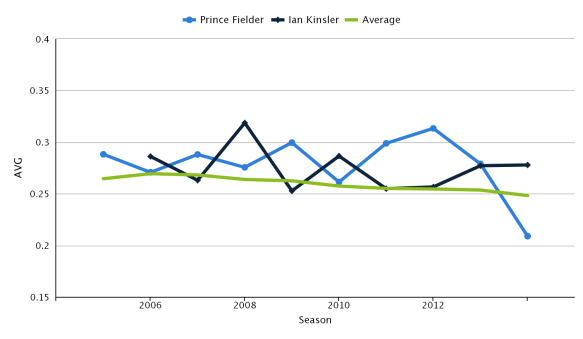
While the Detroit Tigers’ decision to trade Prince Fielder to the Texas Rangers for Ian Kinsler prior to last season initially came as a shock to Tigers fans, the positive early returns on the trade seemed to provide a calming influence. As I wrote in late April 2014,

Kinsler has provided some real spark, though. Looking at the right side of this graph, you can see that, while he and Prince posted similar batting averages last season, Kinsler has kept the pace this year, but Prince has dropped off sharply with the Rangers.

chart

While Fielder has the edge in on-base percentage, probably due to his ability to draw walks (of the intentional and unintentional varieties), Kinsler’s hitting for more power (.133 ISO vs. .121 ISO) and is posting a better wOBA— a catch-all offensive metric– than Fielder (.319 vs. .277). They also have the same number of home runs (two), with Kinsler driving in nearly twice as many runs as Fielder (14 vs. 8), while stealing three bases (to Fielder’s zero, obviously).

Less than a month later, Prince’s season would be over, a completely understandable side effect of probably overdue neck surgery.

Kinsler powered right along, though, making 726 plate appearances in a career-high 161 games. His bat seemed to cool off in the second half of 2014 (.353 wOBA vs. .276), but he still managed to finish the season tied with Miguel Cabrera for the title of most valuable Tiger, as determined by fWAR (5.1 fWAR apiece), although much of that was due to Kinsler’s defense (and Cabrera’s lack thereof).

In reviewing last year’s statistics in anticipation of this season, Kinsler’s numbers jumped off the page for one main reason: his walks had disappeared. Continue reading

Window Shopping: What’s a Shane Greene?

Ain’t no change in the weather,
ain
t no changes in me.
And I ain’t hiding from nobody,

nobody’s hiding from me.

Detroit Tigers fans weren’t sure what to expect out of their new starting pitcher when Shane Greene arrived from New York this past offseason. As I noted in this Tigers season preview, the scouting report on Greene was, to be kind to his prospects, guarded: “an average pitcher — in Triple-A” with a major-league “path for . . . success [that is] very rarely traveled.” He had done moderately well in his fourteen-start rookie campaign, which included two wins– the first an eight-inning shutout– over the Tigers, and the primary question for him entering 2015 was whether he could replicate his success in limited outings across a full season’s worth of starts. After one month of baseball, the answer to that question, like most others at this point in the season, remains outstanding.

Continue reading

Window Shopping: Tigers Roaring Out of the Gate

At one month old, the MLB season now has accrued a sufficient sample size of free time to permit me to compile the opening post of this site’s regular Detroit Tigers series for 2015, Window Shopping. Last year, I came out of the gate a bit too hot, burned out, and had to take the month of June off. This year finds your resident Tiger tracker more balanced and measured in his approach. This year’s Detroit Baseball Tigers have a more balanced look too.   Continue reading