Yes, the Cardinals hack was a federal crime (via The Volokh Conspiracy)

According to press reports, front-office personnel of the St. Louis Cardinals used a guessed password to gain access to a private database of player information held by the Houston Astros. Over at ESPN, legal analyst Lester Munson makes the startling claim that this may not be a crime . . . . This is just wrong. … Read More

(via The Volokh Conspiracy)

If he could do it again, Chris Webber would have gone to Michigan State?

The strong implication of Chris Webber’s comments on this morning’s Dan Patrick Show is that, if he could begin his basketball career again, he would have accepted Tom Izzo’s offer to become a Michigan State Spartan:

Continue reading

Mike & Mike at Fifteen

IMG_20150302_191518

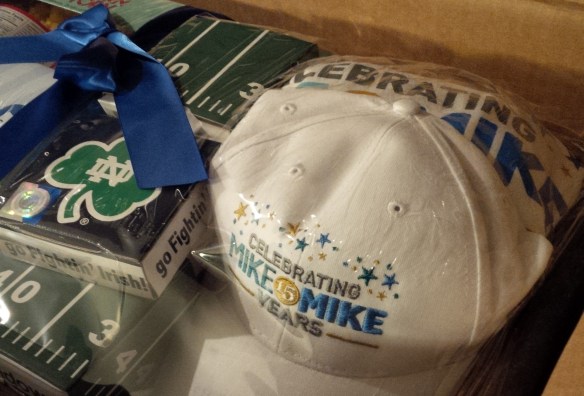
ESPN Radio’s national morning show, Mike & Mike, turns fifteen on Friday, and the guys were kind enough to send some of their fans a gift basket as a way to say thanks for tuning in. Fifteen years is a long time to hold down a national morning radio talk show, and it’s better to start out broadcasting from a supply closet than to end up in one. I can say this about Mike & Mike: you wouldn’t be reading this website without them. Would I write that if we hadn’t just received six pounds of apparel, signed photographs, flavored popcorn, and enough Notre Dame cookies to make me look like Golic? Sure would. Has our coverage of the Worldwide Leader been tainted by the free copies of ESPN The Magazine that started appearing outside our door a couple years ago? Sure hasn’t. (Judge for yourself.) More than cookies, clean laundry, and magazines, though, all I really want from ESPN is for them to bring back the original Mike & Mike theme song (I’ll mail you a cookie if you can find it online), and maybe be a little kinder to Detroit.

The selfishness of Colin Cowherd’s critique of Dan Patrick

dan patrick show

For reasons known, if at all, only to him, ESPN Radio’s Colin Cowherd wrapped up his Super Bowl coverage by taking a shot across the bow of former ESPN personality Dan Patrick:

Dan Patrick doesn’t work as hard as Jim Rome. Not even close. . . . Patrick needs thirty-five producers to fill a segment. Rome doesn’t. Bayless doesn’t. I don’t.

Cowherd is hardly a moral standard-bearer in this space, and his comments, like most of the things he says that garner attention outside his own sphere, are designed only to bolster himself, typically at the expense of others. Taking Patrick to task apparently for the sin of granting his (four) producers a more audible and visible role on his program is both nonsensical and selfish.

DP Show producers Seton O’Connor and Paul Pabst’s responses to Cowherd show the factual absurdity of Cowherd’s remarks:

The people actually hurt by Cowherd’s statements, however, are Cowherd’s own support staff, who probably are wishing they worked for Patrick, or someone like him, rather than Cowherd.

Radio shows are similar to sports team coaching staffs, with the on-air host as the head coach, and the typically off-air producers as coordinators and assistant coaches. Just as few in the coaching business envision themselves as lifelong defensive line coaches, for example, few in the radio business want to spend the entirety of their professional careers screening listener telephone calls. A sports team’s success provides exposure to the coaching staff, allowing the coordinators and assistants to move into head-coaching positions elsewhere. Further, good head coaches are wise to create an environment in which their assistants receive outside attention and have opportunities to move into more senior positions. It isn’t that head coaches want to lose their talented assistants. Given the inevitability of those departures, though, head coaches know they can recruit better assistants, who are destined for greater things, by offering them the opportunity to gain exposure while working under them. The notion is not unlike the one Kentucky basketball coach John Calipari employs with his player recruits.

By allowing his support staff to be heard and seen on his show, Patrick affords them individual opportunities that would be more difficult for them to come by without that exposure. Patrick’s producers might eventually leave to pursue their own interests or stay longer because they’re happier with the more prominent role Patrick provides them. Regardless, Patrick has styled his show to serve as a platform for more people who work on the show than just the on-air host.

Cowherd has taken the opposite approach, and his attack on Patrick bears out Cowherd’s selfishness. He demands all of the attention and credit for his own successes, and the people most hurt by his critical comments likely are those who work on his show, not Patrick’s.

 ________________________________________________________

Related
Online sports media critics: When Colin Cowherd starts to make sense, it’s time to reevaluate your approach
A note on rants

Jordan Schafer is Highly Questionable
College football wrapup: 2014-15

The 2014 college football season is in the books, and Ohio State is the first school to win a national championship determined by a postseason playoff system.

Beyond the usual discussion of champions and coaching legacies (quickly: Urban Meyer– three national championships at two different schools, evil; Nick Saban– four national championships at two different schools, merely soulless), one of the central season-in-review topics of conversation, at least in these parts, is whether the SEC is over. Surprisingly but also not surprisingly, Paul Finebaum, voice of the SEC, answers the question implied in the previous sentence in the affirmative. (UPDATE: PFT Commenter emphatically concurs.) Although he’s been developing his position over the course of his daily radio show since roughly the first of the year, he summed up the general point in his appearance on Keith Olbermann’s show just before the national championship game:

In short: “It was a pretty bad year for the SEC.”

Although I contemplated the notion of Peak SEC at least as early as December 2012 and later pegged the possible date somewhat more recently, I’m not sure I agree that the SEC is over.

The SEC’s bowl record was 7-5. (They were 7-3 last year.) The Pacific Twelve was 6-2 (exclusive of Oregon’s national championship loss), the Big Ten was 5-5 (exclusive of Ohio State’s national championship win), the Big XII was 2-5, and the ACC was 4-7. In other words, among the power five conferences, the SEC had the most teams playing in bowl games and notched the second-best winning percentage.

What seems to concern Finebaum, though, is a sudden lack of championships. That people think the SEC is done for because one of its members hasn’t played for a national championship in a whole year and hasn’t won one in a whole two years is a testament to the never-before-seen degree of dominance the conference produced during the BCS era. Prior to Ohio State’s inaugural CFP championship on Monday, the Big Ten had 1.5 national championships since 1970. The SEC had nine in the BCS era (i.e., since 1998) alone. The ACC had two BCS championships, the ACC had two, the (now-defunct for football purposes) Big East had one, and the then-Pac Ten had one, since vacated.

After the hunt for Mississippi October turned up empty and OSU knocked Alabama out in the semis, the SEC may need to do a little more to earn its seeds next year, but I’m not sure we can say the conference is measurably weaker simply because it failed to produce a national champion this year. If anything, the above suggests the conference is as deep as ever.

_____________________________________________________

Transitioning toward the offseason and the 2015 season, I’ll use this space to remind everyone that Michigan State’s only losses in 2014 were to Ohio State and Oregon. The Spartans face both teams again in 2015, albeit without the aid of their departed defensive coordinator, Pat Narduzzi. Continue reading

Ohio State claims the first College Football Playoff championship

Following a hot-knife-through-butter opening touchdown drive for the Oregon Ducks in last night’s national championship game, the Ohio State Buckeyes took over the game and never relinquished control. OSU running back Ezekiel Elliott averaged 6.8 yards per carry, and it felt like more than that in the second half, when Ohio State called the same counter run play seemingly on every down and repeatedly executed it successfully. Elliott was so hungry for more yards that he tried to eat confetti after the game.

After that initial Oregon drive, the Buckeye defense, lead by coordinator and former OSU head coach Luke Fickell, found the answer, though, and Oregon’s bucket of tricks soon ran dry. Even in the second half, when Oregon’s defense produced a couple of turnovers, Marcus Mariota and the offense couldn’t make any progress.

Oregon accumulated its twenty points with two touchdowns, that opening-drive score and a one-play, seventy-yard TD pass early in the third quarter, and two field goals. Those two field goals, along with a white-flag punt with eight minutes to go in the fourth quarter, felt uncharacteristic of a school that, in recent years, lead the charge of pedal-to-the-metal offense.

In the end, Ohio State ended up knocking off Oregon by nearly as wide a margin– 42-20– as the one by which Oregon defeated Florida State in the semifinal round.   Continue reading

College Football Playoff Championship Preview

Oregon meets Ohio State tonight in the inaugural College Football Playoff finale, and I’m most excited about the ESPN Megacast, which, in addition to the above, includes an ESPN Radio play-by-play broadcast as well. ESPN gets knocked around plenty for doing things like bowing to the will of “partners” like the NFL at the expense of its own journalistic integrity or hosting a platform for grey-matter destroyers like Skip Bayless, Stephen A. Smith, and Colin Cowherd, but there are times when they leverage their resources to make significant improvements to the fan experience. ESPN introduced the Megacast concept for the final BCS championship game one year ago, and it was such a success that it’s back again this year, bigger and better than ever. In the interim period, other networks have experimented with the concept, loosely defined, in other sports, and I believe this is the way we will enjoy all major sporting events in the near future.

(If at this point you are wondering what ESPN Goal Line is, it appears to be a Briagdoon-like offering that will materialize on your TV sometime today, maybe. Anyway, you can find me tuning into ESPN Classic’s “sounds of the game.”)

Game Comments

As Sports Illustrated graphically illustrated in this week’s issue, Ohio State and Oregon actually were quite close to each other this year in statistical terms. Initially, there are two reasons to question that apparent parity, however: 1) Oregon plays in the stronger Pacific Twelve conference, while OSU spent much of the season feasting on relatively weaker conference opponents, and 2) Ohio State earned much of its production with quarterbacks not named and thought to be superior to Cardale Jones, the man who will be under center for the Buckeyes tonight. It is right to regard Oregon as the better team in this matchup.

There are a number of factors that cut against Oregon’s edge, however:   Continue reading

Hockeytown, Hockey home

joelouisoustideOn Saturday, January 18, 2014, the Detroit Red Wings beat the visiting Los Angeles Kings 3-2 in a shootout. It was the best hockey game I’ve ever seen. I’ve watched innumerable Red Wings games over the years, including playoff wins over rivals and Stanley Cup wins. I’ve seen them in person before too, watching them lose to their rivals in Denver, Nashville, and Chicago. (I even saw an intra-squad scrimmage.) This was my favorite game.

It was my first trip to Joe Louis Arena, the historic home of hockey in Detroit for only a little while longer, and everything went perfectly. We stayed in Greektown, where we enjoyed an authentic Greek lunch prior to the game. When we were ready to head to the arena, we took the accurately named People Mover and were there before we knew it.

Once inside, we had time to enjoy the statues of great Red Wings past on a full lap around before finding our great seats, where we watched the team warm up and tried to read all of the banners hanging from the rafters. The experience was extremely satisfying and fulfilling, as was the Little Caesar’s pizza, which is better there than it is anywhere else in the world.

IMG-20140118-00061

IMG-20140118-00060

Hockey games are subject to all kinds of random variation, so it was especially wonderful when the game itself matched and then elevated the tenor of the evening. After a scoreless first period, the Red Wings could not kill off successive minor penalties, and the Kings’ power-play goal gave them a 1-0 lead. Less than a minute later, however, Detroit’s Henrik Zetterberg tied the game with an even-strength goal. That sequence essentially repeated itself in the third period, when the Kings scored a power-play goal with just 2:15 to go in the game. Detroit’s Niklas Kronwall tied the score at two with just twenty-seven seconds to go in the game, sending it to overtime.    Continue reading

Who’s conflicted about sports? Giancarlo Stanton theme-and-variation edition

I didn’t expect the opportunity to write another post about an ESPN SportsNation poll to arise so soon after the last one, but rumors of a $300 million contract for Miami slugger Giancarlo Stanton have ESPN asking its totally equipped to answer this question audience whether they think the potential contract is a good idea.
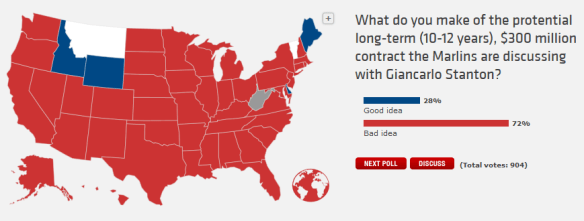
Here’s how the responses look:

stanstentiaWhile we could discuss angsty West Virginia’s inability to make up its mind on this question, the interesting twist, for our purposes, is that Montana and Vermont have entirely declined to weigh in. Their silence leaves us with a void into which we are left to impute existential meaning (or, in Vermont’s case, ice cream). Are Montanans and Vermonsters so disgusted by the very asking of the question that they refuse to dignify it with any response? Or, in an act of humility, have they recognized their own shortcomings with respect to the ability to analyze the relative merits of a long-term arrangement fraught with numerous physical, financial, and psychological components, a task that escapes mastery by even the leading minds in the field, and decided to refrain from acting beyond the scope of their limited, though completely normal, faculties? Or, to consider yet a third alternative, are they already out skiing and/or loaded up on Heady Topper and thus too busy to be bothered to respond?

Based on my hypothetical polling of my actual friend, a Vermont native who lived in Montana, I suspect these two electorates simply may not have an opinion on the matter. As we now have seen, such a posture so confounds ESPN/SportsNation’s “embrace debate” mentality that their reaction is to wipe you off the map.

UPDATE: Montana and Vermont have broken their silences, unanimously agreeing that this contract is a really bad idea! As always, click the map above to see the latest results.