ALDLAND Podcast

The middle of July is one of the slowest times in sports, but the MLB came through by banning Ryan Braun for the remainder of the season for violating its drug policy and provided us with more than enough fodder for a podcast. Listen as Marcus and I discuss the Braun story and related subplots, as well as our thoughts and advice on workout gear and a recap of Lefty’s big win in Scotland.

_______________________________

Download the ALDLAND podcast at our Podcasts Page or stream it right here:

The Many (okay, two) faces of Ryan Braun

Yesterday, Ryan Braun, the Milwaukee Brewer who won the 2011 NL MVP and 2007 NL Rookie of the Year awards, agreed to a sixty-five game suspension from Major League Baseball for his violation of MLB’s drug policy and released the following statement:

As I have acknowledged in the past, I am not perfect. I realize now that I have made some mistakes. I am willing to accept the consequences of those actions. This situation has taken a toll on me and my entire family, and it has been a distraction to my teammates and the Brewers organization. I am very grateful for the support I have received from players, ownership and the fans in Milwaukee and around the country. Finally, I wish to apologize to anyone I may have disappointed — all of the baseball fans especially those in Milwaukee, the great Brewers organization and my teammates. I am glad to have this matter behind me once and for all, and I cannot wait to get back to the game I love.

Braun failed a drug test back in October 2011, but he was successful in overturning a fifty-game suspension on appeal by identifying a procedural deficiency in the testing process. During the pendency of that appeal, Braun stated:

This is all B.S. I am completely innocent.

Following its resolution in his favor in February 2012, Braun held a press conference where he issued a long statement, excerpted here:


[T]this is without a doubt the biggest challenge I’ve ever faced in my life, and it’s made it that much more challenging that I’ve had to deal with it publicly. But I truly view this challenge as an opportunity, just as I’ve viewed every other challenge in my life – as an opportunity. I’ve tried to respect this process, even though the confidentiality of the process was breached early on. I’ve tried to handle the entire situation with honor, with integrity, with class, with dignity and with professionalism because that’s who I am and that’s how I’ve always lived my life.

If I had done this intentionally or unintentionally, I’d be the first one to step up and say, “I did it.” By no means am I perfect, but if I’ve ever made any mistakes in my life I’ve taken responsibility for my actions. I truly believe in my heart, and I would bet my life, that this substance never entered my body at any point.

I’ve always stood up for what is right. Today is about everybody who’s been wrongly accused, and everybody who’s ever had to stand up for what is actually right. Today isn’t about me, it isn’t just about one player – it’s about all players. It’s about all current players, all future players and everybody who plays the game of baseball.

Ultimately, as I sit here today, the system worked because I am innocent, and I was able to prove my innocence. After today I look forward to returning my focus to the game of baseball, being able to get back with my teammates, allowing my life to return to some sense of normalcy and focusing on helping our team get back to the post-season.

Braun closed the brief question-and-answer period with this statement:

I guess the simple truth is I’m innocent. I’ve maintained my innocence from Day 1, and ultimately I was proven to be innocent.

Counterpoint: Marijuana is a performance-enhancing drug

Between a possibly shifting consensus on national drug policy and the sporting world’s intense focus on performance-enhancing drugs over the last decade, one oft-repeated– usually accompanied by a chuckle– and seemingly unobjectionable statement has been that marijuana is not a performance-enhancing drug. Faaaarrrr from it, Manti Te’o might say. But is that true?
I. Correlation

There are plenty of athletes who are famous, in part or in whole, for their marijuana use. Nate Newton. Ricky Williams. Tyrann Mathieu. Randy Moss. Tim Lincecum. Michael Vick. Michael Beasley. Every UCLA basketball player ever. For example.

In 1997, the New York Times reported that “60 to 70 percent of [the NBA’s] 350-plus players smoke marijuana.” A year ago, a former professional football player said at least 50 percent of NFL players smoke marijuana, while multiple NFL general managers said it’s more like 60 or 70 percent.

Keep reading…

News clips

Spending all day on the road meant I got to hear all the daytime sports radio I could handle. Thrilling, I know. I did pick up a few interesting nuggets, though:

– If Johnny Manziel wins the Heisman Trophy this year, as experts now expect, he will be the first freshman to do so. He won’t be the youngest winner, though. That distinction belongs to Mark Ingram, Jr.

– Apparently there’s some sort of adderall flap surrounding the Philadelphia Eagles and other NFL players. All the obvious issues aside, ProFootballTalk.com’s Mike Florio said that he thinks the adderall story is a cover up. Because the NFL has a policy of not commenting or elaborating on players’ positive drug tests, the players are free to say whatever they’d like about the test. Florio thinks that adderall is the convenient cover story du jour for players who actually tested positive for a more controversial substance.

– Kentucky hired Florida State defensive coordinator Mike Stoops to serve as Joker Phillips’ replacement at the football head coach position. While Kentucky local sports talk radio listeners generally approved of the hire, citing the successes of the Stoops family and Mike’s own rapid improvement of the FSU defense, no one mentioned the only factor that matters right now for the future success of UK football: program funding. Don’t forget that the UK athletic department just spent more on a preseason basketball pep rally than it did on an entire year of football recruiting. For Stoops’ sake, I hope he negotiated a substantial increase in funding for the football program. If not, his pedigree and resume will be irrelevant.

– Before leaving Army for Duke, Mike Krzyzewski interviewed at Vanderbilt but didn’t take the job because the VU athletic director at the time, fearing media exposure of an ongoing search, wouldn’t let Coach K visit the campus.

ESPN: Outside the Lines delivers the definitive Dock Ellis experience

Commodawg sent me a quick email containing only a url link and a note: “I’m guessing this is in your wheelhouse.” The link led to an ESPN/Outside the Lines feature, “The Long, Strange Trip of Dock Ellis.” Commodawg was right: I am never not on drugs when working on this website, an admission that likely comes as no surprise to ALDLAND’s reader(s), so this piece is pretty squarely in my wheelhouse.

I’ve read all the stories about Ellis. I’ve seen all the videos, including the one everybody considers high art (no pun intended, seriously; it’s way overrated, its only redeeming aspect being the employment of actual audio of Ellis) and the one of former Deadspin editor A.J. Daulerio’s less entertaining stunts, in which he attempts to pitch a no-hitter in a video game while under the influence of LSD. Save yourself some time and watch neither.

The only real rub in the Ellis story at this point is whether Ellis really was on acid when he pitched that no hitter. Some recent writers (again, I’m sparing you the links) have advanced a view of Dock that suggests he was good at making up and perpetuating stories to fuel a love of the spotlight, implying that the most famous story about him was such a fabrication. Obviously that’s a boring road to go down.

This ESPN/OTL piece by Patrick Hruby and Joe Ciardiello blows right by all of that, though. It’s transcendent not because it’s about drugs, but because it transcends the debates and localized tropes that bring people to Ellis and tells a real story that answers all of these lightweight questions without even asking them because it starts with little baggage. It just tells the story of the man. Don’t feel bad if you found your way to Ellis, even to this post, because you kinda want to find out what it’s like to take LSD– that’s the reason anybody who didn’t know him or isn’t a weirdo fan of the Pirates finds their way to him– but know that your preconceived inquiries will be both resolved and shown to be irrelevant. The digital design features of the piece play no small part in contributing to this article and deserve separate comment from someone authorized to make such comments, but they extremely appropriately add to the experience, both visually and substantively.

Rereading what I just sputtered, maybe this one does convey what it’s like to be on acid after all.

http://sports.espn.go.com/espn/eticket/story?page=Dock-Ellis

(HT: Commodawg)

Totally disinterested person offers opinion on 2013 MLB Hall of Fame candidates

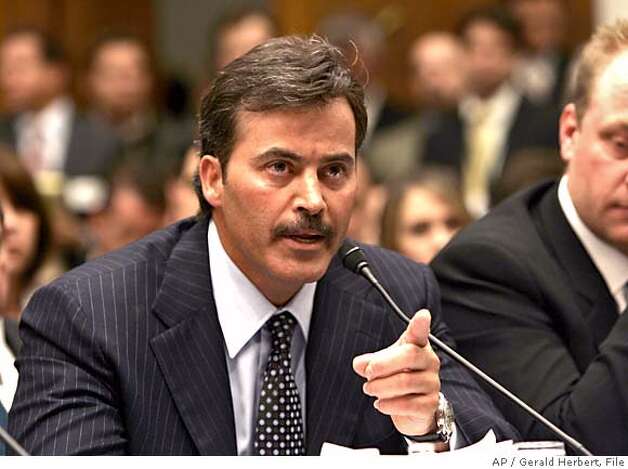
ESPN Dallas/Fort Worth reports that Rafael Palmeiro, apropos of nothing at all, said that Barry Bonds and Roger Clemens belong in the baseball Hall of Fame. Palmeiro certainly doesn’t have any personal interest in Bonds’ and Clemens’ induction. It’s not as though, if Bonds and Clemens don’t get in, Palmeiro has no shot at all, or anything.

Palmeiro was voted on just 11 percent of the ballots in his first attempt at the Hall of Fame in 2011. He received 12.6 percent in 2012, well short of the 75 percent needed from voting members of the Baseball Writers Association of America to make it in.

Oh well. Maybe he wasn’t going to make it anyway, regardless of what happens to those who rode the PED wave to higher heights than he. Why he wants to cast his lot with these two is beyond me, though, as is how exactly we let him finger-wave his way back into the news, if only for a moment.

The Weekend Interview: Ricky Williams

The Weekend Interview is back, and this time, the subject is Ricky Williams. A top pick out of the University of Texas, the running back played in the NFL for New Orleans, Miami, and Baltimore, and in the CFL for the Toronto Argonauts, before retiring in February.

Williams was one of the most curious characters: supremely talented, but with interests that strayed far from– and at times took him off of– the gridiron. At just thirty-five, Williams is a vocal person in retirement, recently confounding Dan Le Batard and Dan’s father (and anybody else watching) on the topic of head injuries and football.

Usually I have to subtly toss the “imaginary content” tag on these interviews, but not this time. Here‘s Williams and me on Monday (holiday weekend) afternoon:  Keep reading…

London Olympics organisers hit dead note with opening ceremony plans

The cheeky Guardian reports:

The London 2012 opening ceremony is going to be called Isles of Wonder, but there can be no wonderment more wonderful than the fact that Olympics organisers wanted Keith Moon to perform.

Moon has been dead for 34 years.

The drummer for the Who died in 1978 after ingesting 32 tablets of clomethiazole, a sedative he had taken for alcohol withdrawal symptoms.

The band’s manager, Bill Curbishley, told the Sunday Times he had been approached to see if Moon “would be available” to play with the surviving members this summer.

“I emailed back saying Keith now resides in Golders Green crematorium, having lived up to the Who’s anthemic line ‘I hope I die before I get old’,” came the excellent reply.

“If they have a round table, some glasses and candles, we might contact him.”

For its part, the staff of the Guardian is just really looking forward to seeing Jesse Owens compete.

They also could’ve gone with a “Pictures of Lily” reference (“[]he’s been dead since 19[78]”), but it wouldn’t have rhymed and seriously, how did the London Olympic Committee miss this one? Moon isn’t just the one-time drummer of a classic rock band. One could be forgiven for not knowing the life status of the drummer from Mot the Hoople. I’d even give you Faces or the one-armed guy from Def Leppard. But Moon is the famously dead drummer of one of the biggest British rock bands ever. I mean, there he is atop British Drummergod Mount Olympus alongside John Bonham (Led Zeppelin), Charlie Watts (Rolling Stones), and Ginger Baker (Cream, Blind Faith, Ginger Baker’s Air Force). This would be like the 1996 Atlanta Olympic Committee inviting Duane Allman to perform or the 2096 Alanta Olympic Committee inviting Jerry Garcia.

Speaking of Atlanta and dead musicians, though, now that someone finally put CNN’s hologram technology to value-adding entertainment use, maybe Moon can make it after all.

From champs to chomped: How Urban Meyer broke Florida football (via Sporting News)

The uproar and controversy of Urban Meyer’s stunning recruiting coup at Ohio State settled in and Stefon Diggs, still on the Buckeyes’ wish list, was debating his future.

Diggs, the second-highest rated wide receiver in the country, had narrowed his list of potential schools to Maryland, Florida and Ohio State. For more than a week following National Signing Day on Feb. 1, and before Diggs eventually signed with Maryland, Meyer relentlessly pursued Diggs.

Multiple sources told Sporting News that Meyer—who won two national championships in six years at Florida and cemented his legacy as one of the game’s greatest coaches—told the Diggs family that he wouldn’t let his son go to Florida because of significant character issues in the locker room.

Character issues that we now know were fueled by a culture Meyer created. Character issues that gutted what was four years earlier the most powerful program in college football. … Read More

(via Sporting News)

__________________________________

Related:
Urban renewal: Once Meyered in the Swamp, a Buckeye nut returns to his roots

Scrutiny of the Bounty: Chapter 2 – The Pretension

The prequel to this story solidly in the rearview mirror, we’ve moved past the command performances of the shock and the horror, and it’s time for the heavy-hitters to weigh in. They haven’t necessarily taken more time to consider the issues presented, even though they usually write for publications that facilitate such pondering through less-frequent publication schedules, but they are Voices, and so they must speak. Why look, here comes Charles P. Pierce right now!

I like Pierce’s writing a lot– he’s Grantland’s best writer– but his last couple articles have fallen off a bit for me. His previous one, about Ryan Braun, definitely felt rushed and awkwardly framed. What bothers me about politics coming through in sportswriting isn’t that I might not agree with the writer’s policy preferences or that I think politics and sports have no overlap (Congress and baseball excepted). It’s that a political lens often seems simultaneously inapplicable and overemphasized. In other words, it’s very unlikely that you are Hunter Thompson and that Richard Nixon is living in the White House phoning in plays for the Redskins. (Quite unlikely, since they’re both dead.) Sometimes it’s best to keep your separate worlds separate. (That’s my experience, anyway.) The point is that Ryan Braun’s situation doesn’t really have much to tell us about our overlord oppressors and the historical War on Drugs.

Follow that up with Pierce’s swing at Gregg Williams’ bounty program, which oozes pretension from the get-go. First-sentence Harvard name drop? Check. First paragraph West Wing reference? Check. We’ve got a mini-thesis on the Mesoamerican ball game before we even scrape the surface of the illusory NFL, with its “silly pretensions” (as opposed to the serious ones that he employs), “preposterous prayer circles,” and “the  dime-store Americanism that’s draped on anything that moves.” Oh, and how could we forget the “suffocating corporate miasma,” whatever that means. The word “Queegish” soon follows, and I realize it’s past my bedtime here in flyover country.

The crux of Pierce’s high-minded caterwauling is a more hushed, but apparently equally urgent Denny Green moment: The Saints’ crime was showing us in daylight that the NFL is what we thought, in the darkness of our willfully ignorant minds, it was. That’s fine. Loss of innocence isn’t not an angle of approach here. It does seem like, though, if football still had its shroud of innocence, it would’ve gone with more of a bang. The head injury issue probably fits the bill a little better, if we’re looking for a recent example, but nobody asked me, and I think we’ve known the real deal about football for awhile.

Next to drummed up (not to say inauthentic) outrage, an apparently necessary exercise in which the horribles are trotted out and reacted to as if witnessed for the first time, and now we’re nearly into a mad libs piece adapted from a reflection on McGwire and Sosa’s home run chase after the word was out on steroids.

This is getting boring to write, which may say something about your experience in reading it. The point is that I am disappointed in Pierce’s article because it seems so unoriginal, overreactionary, and unessential. I never did get into Gregg Easterbrook, but based on what Drew Magary tells me, I think Pierce could be his liberal brother. Pretension is what happens when the stuff that you get to do when you’re a really good writer outpaces and overburdens the thing that made you a good writer in the first place. That’s one way to get to it anyway.

_________________________________________________

Related:
Scrutiny of the Bounty: A prequel