Madness: The NCAA Tournament’s structural flaw

The organizing principle of a competition arranged in the fashion of the NCAA men’s basketball tournament is that better teams should have easier paths for advancement, the goal being for the best teams to meet as late as possible. Tournament organizers therefore employ a seeding system that awards teams believed to be the strongest with the best seeds (i.e., the lowest numbers) and first pits them against teams believed to be the weakest.This is sensible, logical, and good. Anything can happen once the games begin, of course, but if Michigan State and Kansas, for example, are the best teams in this year’s tournament, the tournament should be designed such that those two teams are most likely to face off in the final, championship round. Generally speaking, this is how the NCAA tournament is organized.

From 1985 until 2000, the tournament’s field held steady at sixty-four total teams. In 2001, it expanded to sixty-five teams, adding a single play-in game to determine which team would be the sixteenth seed to face the number one overall seed. In 2011, the tournament field expanded to sixty-eight teams, its current size, with four play-in games.

Many people dislike the fact that the tournament has expanded beyond a seemingly optimal sixty-four-team field, but all should agree that, however many teams and play-in games are included, the tournament should be organized such that the projected difficulty of each team’s path through the tournament is inversely proportional to its seed position. As currently constructed, however, the tournament deviates from this basic principle.

All play-in games are not created equal. Two of the four fill sixteenth-seeded positions, while the other two fill eleventh-seeded positions, and the latter grouping is the culprit here. The NCAA and its broadcast partners no longer refer to the play-in games as the “first round,” thankfully, but, however labeled, these games constitute a significant structural hurdle for their participants. It’s difficult enough to win five consecutive games against the nation’s top competition; adding a sixth game places the play-in teams at a major disadvantage.

If a tournament organized in this fashion is to proceed with sixty-eight participants, play-in games are a necessity. The heavy burden of participating in an extra round of competition should be apportioned in accordance with the tournament’s organizing principle, however. In this instance, that should mean applying it to the lowest-seeded (i.e., highest number) teams. Using two of the play-in games to determine eleventh-seeded positions inappropriately and adversely distorts the degree of difficulty for those two positions.

2016bracket

This year, the unduly burdened teams are Vanderbilt, Wichita State, Michigan, and Tulsa, which are competing in play-in games for eleventh-seeded spots in the tournament’s first full round. Each of these teams would be better off as a twelfth, thirteenth, or even fourteenth seed (to say nothing of an eleventh seed in the West or Midwest regions, where eleven seeds are not similarly encumbered) than they are as participants in eleventh-seed play-in games.

If the tournament committee really believes each of those four teams belongs in the tournament and is deserving of an eleven seed, or thereabouts, it should pick one from each pairing– Vandy/WSU and Michigan/Tulsa– to be the eleventh seed, make the other the twelfth, bump the remaining lower seeds in the region down by one, and have the existing fifteenth seed play the existing sixteenth seed in a play-in game instead. (This wouldn’t be a clean fix in the East region, which already has a Florida Gulf Coast/Fairleigh Dickinson play-in game for the sixteenth seed, but the Midwest region has no play-in games, so one of Michigan/Tulsa could be moved to the eleventh or twelfth seed there, bumping Hampton and MTSU into a play-in game for the sixteenth-seed position in that region.)

Two of the eleventh-seed play-in participants, Vanderbilt and Michigan, likely were two of the last teams to earn at-large bids to this year’s tournament. Even if that’s true, though, it shouldn’t matter. The in/out decision is binary: a team is either in the tournament or it isn’t. Once the field is determined, the committee then should seed the teams based on their basketball merit. If the committee thinks so little of Vanderbilt, Wichita State, Michigan, and Tulsa that it wants to put them through the paces of a play-in game, it should have seeded them lower than eleventh.

The current arrangement of the NCAA tournament play-in games constitutes a structural flaw not because those preliminary games exist, but because of the seed positions they involve. If the NCAA insists on using the play-in-game arrangement to include sixty-eight teams in the tournament, it should use those play-in games in a manner that aligns with the tournament’s overall organizing principle of strength-based seeding. In practice, no tournament of this sort will be perfectly balanced in its initial arrangement, but the current structure clearly is contrary to that fundamental organizational principle and unnecessarily distorts the balance of the entire tournament.

Bill Simmons launches new site with help from Tom Izzo

17ljkjc5cv55rjpg

Bill Simmons is back. The Sports Guy’s post-Grantland project, The Ringer, launched today. Although the site has had a social media presence for a few weeks (and Simmons’ now-eponymous podcast returned before that), action really got underway this morning, when Simmons publicly announced a number of the new website’s hires, and continued this afternoon, when he released the site’s first email newsletter.

The newsletter is The Ringer’s first substantive textual offering. It begins with a Simmons monologue on the name-selecting process for the new project, followed by a timely NCAA tournament article that leads with a nice picture of Tom Izzo and Denzel Valentine. (Bold prediction contained therein: “Sparty is going to be a tough out.”)

After that comes a Game of Thrones season preview, because this is the internet, after all, and the newsletter closes with a list of the three best-dressed people on Billions, which I just used Google to learn is another television show.

If The Ringer is reminding you of Grantland, that could be because of the substantial overlap in the two sites’ subject areas– basketball and premium-network television– and staff– including Katie Baker, Jason Concepcion (@netw3rk), and Brian Curtis. Tracking the similarities between The Ringer and Grantland will be both easy and less interesting than noting the differences, which are what could show us what, if anything, Simmons learned from his last venture.

ringer

We’ll check back in once things have been up and running for a little while. In the meantime, here’s hoping BS can bring the following Grantland alums back into the fold: Brian Phillips, Rembert Browne, Mark Titus, Louisa Thomas, Charles Pierce, Chuck Klosterman, and Norm Macdonald.

_______________________________________________________

Related
Writing about writing about writing: Grantland

If he could do it again, Chris Webber would have gone to Michigan State?

The strong implication of Chris Webber’s comments on this morning’s Dan Patrick Show is that, if he could begin his basketball career again, he would have accepted Tom Izzo’s offer to become a Michigan State Spartan:

Continue reading

Michigan State Final Four Preview

Michigan State’s back in the Final Four, and they take on Duke tonight at 6:09 on TBS. In the spirit of the Final Four, here are four good reads on the 2015 Spartans to get you ready for tonight’s game:

Go Green!

ND Confessional: Sacrifice for Success

nd-uk

With thirty-four seconds remaining in their game against Kentucky, Notre Dame called timeout. The score was tied at sixty-six, and the Irish had just turned the ball over to the Wildcats. The shot clock was off.

As soon as Kentucky inbounded the ball, ND fouled, sending the UK ballhandler to the line. He made both shots, giving the ball back to Notre Dame down 68-66, with thirty-three seconds left on the clock and the chance to tie the game or take the lead and claim a berth in the Final Four.

ND could have had the final possession of the game with more than thirty seconds on the clock, down two, down one, or still tied, if they had fouled Kentucky immediately. The preceding paragraph would have described reality. It does not, because they did not.

Instead, the Irish passively allowed Kentucky to write the script for the game’s final seconds, their foul coming with a mere six seconds left on the game clock. Why wait so long? A quick foul seems like the obvious play. Even if Kentucky made both free throws– and they might not!– Notre Dame still would have nearly a full-length possession in which to tie or take the lead. In essence, an immediate foul inverts in ND’s favor the situation that existed coming out of ND’s timeout. Sure, they might be down two points rather than tied, but they seemed content to grant Kentucky that opportunity to score anyway. The only difference is time.

The Sound of Madness

gusjohnson

Hello Madness, my old friend
I’ve come to talk with you again,
because a vision loudly creeping
left its seeds while I was sleeping,
and the aural vision that was planted in my brain
still remains
within the sound of Madness.

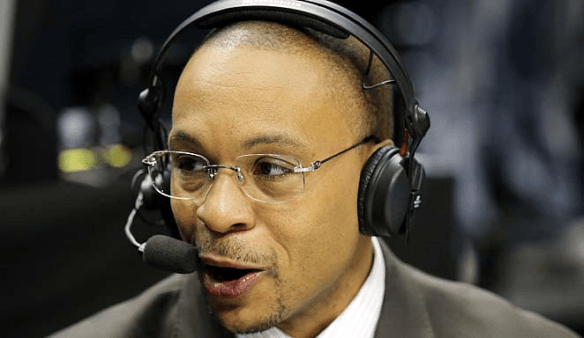
Last night, Fox Sports Live teased us by announcing a late-March appearance on their program of the great Gus Johnson, the Detroiter who rose to prominence as a college basketball announcer for CBS, working the NCAA men’s basketball tournament from 1996 to 2011. If you don’t recognize his name, surely you’ll recognize his voice. In short, Johnson was the genuine article, calling wild tournament games with pitch-perfect passion. None were better. None could be better. Cry while you while away your day with the Gus Johnson Soundboard.

Cry because, in 2011, Fox Sports hired Johnson away from CBS, and CBS let him leave, but CBS retained the broadcast rights to the tournament. Fox’s attempt to convert Johnson into the American voice of soccer did not work.

In Johnson’s absence, CBS appears to have tabbed Bill Raftery as Johnson’s spiritual replacement, a role for which he is ill-suited because 1) Johnson himself is irreplaceable and 2) Raftery is not a good broadcaster. That second point is an Unpopular Internet Opinion, so you have to read another paragraph on the subject.

Raftery seems ok enough in one-on-one settings away from a basketball broadcast, such as this segment on last week’s episode of Garbage Time. Get him on an NCAA tournament broadcast, though, and he is the worst. In a word: unlistenable. I’ve never heard anyone work so hard to consciously fabricate an air of spontaneous passion. Raftery is the unintentionally funny kid in high school who became self-aware, realized why people liked him and thought he was funny, and then actively tried to replicate his past affect to gain popularity, something that’s even more tortured to witness than this sentence is to read. Raftery is Tony Montana, who becomes a reckless wreck after buying too deeply into his own product. I’d rather hear Brian Collins call a tournament game than Bill Raftery.

The present situation is untenable. There can be no missions accomplished, no peace in our time without a reunification of Gus Johnson and the NCAA tournament. Messrs. Berson and Shanks: Tear Down This Wall.

And the people bowed and prayed
to the neon god they made.
And the sign flashed out its warning
in the words that it was forming.
And the sign said, “The words of the prophets are written on the subway walls
and tenement halls
and whispered in the sound of Madness.”

#FreeGusJohnson

Tom Izzo Is The Best Coach In Modern NCAA Tournament History — By Far (via FiveThirtyEight)

A No. 7 seed unseats a No. 2 in the NCAA tournament’s second round about twice every three years, but there was something about Michigan State’s upset of Virginia on Sunday that felt more routine than that. Perhaps it was the fact that the Spartans had toppled the Cavaliers just last season, but beyond that, no second-week tournament run from Michigan State qualifies as surprising at this point. As you might have heard, Izzo’s Spartans are now 13-1 all-time in the round of 32, and they’ve visited the Final Four more often (six times) than they’ve lost in the tournament’s opening weekend (five times).

Digging deeper into the numbers only solidifies Izzo’s reputation as Mr. March. A few years ago, FiveThirtyEight editor-in-chief Nate Silver wrote about how unlikely Izzo’s teams were to have consistently advanced as far as they did from the seeds at which they started — and that was at the very beginning of the five-season stretch (from 2010-present) where the Spartans advanced to four regional semifinals and one regional final. By any standard, Izzo’s teams tend to wildly exceed their expectations once the NCAA tournament commences. … Read More

(via FiveThirtyEight)

ALDLAND’s March Madness Bracket Challenge: Sweetening the Pot

On Monday, Brendan announced ALDLAND’s 2015 March Madness bracket challenge. This is our fourth year hosting an NCAA tournament contest, and our second in a row partnering with Baddeus Thaddeus Lenkiewicz. Important: there still is time for you to join. Click here to submit your picks for a chance to win limitless fame and one of the other “prizes” Brendan detailed in his post.

As an added incentive, we are bolstering the first-place prize package with a Mike & Mike Fifteenth Anniversary t-shirt from the gift basket the Mikes sent us for being such good listeners and always finishing our dinners before getting up from the table. Shirt is one-size-fits-you because they only sent us one (a Golic-ish XL).

Enter your picks here, and read about all the details here.

March Thadness is Back: Join Our Bracket Challenge Now to Win

Here we are on our thirdfourth year of the ALDLAND March Madness bracket challenge and our second year of partnering with the esteemed Baddeus Thaddeus Lenkiewicz. Who won last year? Everyone who participated, of course. Did we make good on any of the prizes we said we would offer? Maybe? Anyway, here is what we have on tap for this year.

  • 3rd Place: I will send you one of the invites I have for Google Inbox. We will mention you on the ALDLAND Podcast when it is resurrected.
  • 2nd Place: You get to come on the ALDLAND Podcast for a segment discussing Gaelic Football, so start studying up. Blog founder AD will also sign five baseball cards of your choice.
  • 1st Place: You get to come on an entire ALDLAND Podcast and we will write a post about how great you are at making a bracket. If you pay your way to Atlanta you can take in a game at Turner Field with blog founder AD and he will buy you an ice cream or a hot dog, but not both.
  • Last Place: You have to go to New York and spend an entire weekend with Bad Jeremy. If you are Jeremy, there is no penalty for finishing last, the reason for which should be obvious.

Join and enter your picks here.

A Statistical Appreciation of the Washington Generals And Harlem Globetrotters (via FiveThirtyEight)

gtRed Klotz, the founder and longtime coach of the Washington Generals, the Harlem Globetrotters’ perpetually feeble opponents, died at age 93 last week (I highly recommend Joe Posnanski’s remembrance). Klotz’s all-time record as a head coach of the Generals and their namesakes was something like six wins and 14,000 losses — they lost 99.96 percent of the time.

How exactly did the Generals lose so consistently? How much of it was their conceding games on purpose, as opposed to simply being really bad at basketball?

Let’s first get a sense for how good the Globetrotters were. … Read More

(via FiveThirtyEight)