
Window Shopping: What’s a Shane Greene?

Ain’t no change in the weather,
ain
t no changes in me.
And I ain’t hiding from nobody,

nobody’s hiding from me.

Detroit Tigers fans weren’t sure what to expect out of their new starting pitcher when Shane Greene arrived from New York this past offseason. As I noted in this Tigers season preview, the scouting report on Greene was, to be kind to his prospects, guarded: “an average pitcher — in Triple-A” with a major-league “path for . . . success [that is] very rarely traveled.” He had done moderately well in his fourteen-start rookie campaign, which included two wins– the first an eight-inning shutout– over the Tigers, and the primary question for him entering 2015 was whether he could replicate his success in limited outings across a full season’s worth of starts. After one month of baseball, the answer to that question, like most others at this point in the season, remains outstanding.

Continue reading

Snapshot: How good has the Detroit Tigers starting rotation been to date?

No, Justin Verlander hasn’t appeared in a single game this season. Yes, it’s still early in the year to be issuing deeply meaningful assessments of baseball team performances. No, I still have not pulled together a proper introductory post for this season’s Tigers series. Instead, you’ll have to get by with this extensive team season preview, which remains not wholly inaccurate, a writeup on Detroit’s bounceback from its first loss in Pittsburgh, a quick peek at changes in team base-stealing profiles, a podcast from earlier this week, and the following snapshot of the Tigers’ rotation through twenty-one games.

This morning, Baseball Prospectus released a new pitching metric, Deserved Run Average (“DRA”), which is designed as a replacement for ERA. You can read more about DRA here (and a nauseatingly detailed exposition of it here), but the one-line summary is simple: “By accounting for the context in which the pitcher is throwing, DRA allows us to determine which runs are most fairly blamed on the pitcher.” After all, that’s what we want to know when we look at a pitcher’s ERA. DRA, it would appear, allows us to know that with greater accuracy.

With that new tool in hand, here are 2015’s most valuable pitchers so far, factoring in their newly calculated DRA:
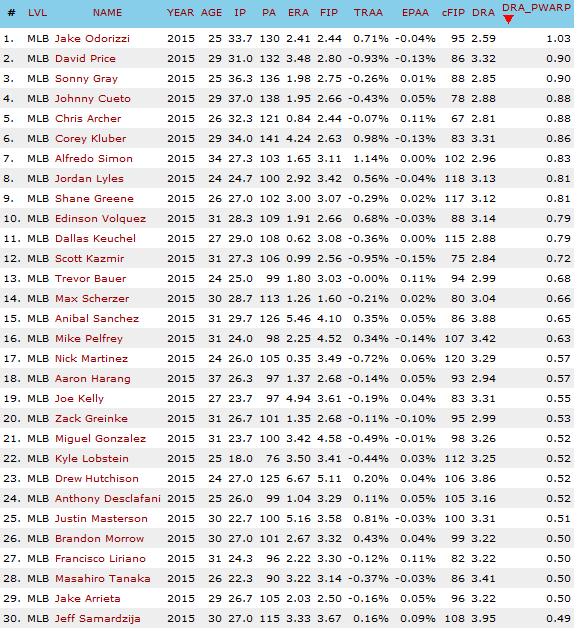
dra-pwarp-4-29-15Plenty of familiar names on that list, especially for Tigers fans, who will find all five of this season’s starters– David Price (#2), Alfredo Simon (#7), Shane Greene (#9), Anibal Sanchez (#15), and even Kyle Lobstein (#22)– among the thirty most valuable pitchers of this young season.

Through thick and thin offensive production thus far, plenty of credit for the team’s 14-7 record is due to the starting rotation, which, you need not be reminded, unloaded Max Scherzer, Doug Fister, and Rick Porcello in the past two offseasons. Surprisingly, so far, so good.

An audible discussion of current baseball stories

While the ALDLAND Podcast continues to take a technical hiatus, I was a guest on this week’s episode of the Banished to the Pen podcast, where we discussed current baseball stories ranging from StatCast to Chicago Cubs prospects to the Detroit Tigers and the rest of the fightin’ AL Central.

You can download or stream the entire podcast here.

The Criminal Mind: Measuring Radical Changes in Base-Thieving Habits

https://www.youtube.com/watch?v=4-yDZdHn6mw

My latest post at Banished to the Pen highlights those teams that made the most radical changes in their base-stealing proclivities from one season to another.

The full post is available here.

A fresh glance at Babe Ruth, upon the resumption of baseball

My latest post at Banished to the Pen contributes to the spirit of the opening of a new baseball season with a quick look back at one of the game’s most accomplished players.

It is nice to see the rookies of today showing respect for their elders, but modern celebrants of the game sometimes fear that reexaminations of their childhood heroes will alter their images and understandings of past giants in adverse fashion. For Babe Ruth, a truncated, targeted retrospective does serve to modify the Ruthian folk zeitgeist, but, in his case, it does so exclusively to enhance the stature of the Sultan.

The full post is available here.

Detroit Tigers 2015 Season Preview

https://www.youtube.com/watch?v=fdkVsnZk2MI

My own Detroit Tigers series for the upcoming season– name to be revealed in due course, but let’s just say I wish Wallside Windows would sponsor it– will be underway at this site soon. In the meantime, I have collaborated with Mark Sands to produce an extensive preview of the 2015 Detroit Tigers for Banished to the Pen, which is available today.

The full post is available here.

The Best Baseball Research of the Past Year

With the Super Bowl in the rear-view mirror, it’s time to get ready for baseball season, and what better way to do that than to peruse some of the best baseball articles from the past year, as identified by the Society for American Baseball Research, which has chosen fifteen (non-ALDLAND) finalists for awards in the areas of contemporary and historical baseball analysis and commentary?

My latest post at Banished to the Pen highlights each finalist and includes a link to cast your vote to help determine the winners.

As a preview, here’s my summary of my favorite article of the bunch:

Jason Turbow, “The Essence of Velocity: The Pitching Theory That Could Revolutionize Baseball, If Only The Sport Would Embrace It,” SB Nation, June 18, 2014. Turbow profiled Perry Husband, a former player who reinvented himself as a pitching coach. Really, Husband is a pitching theorist, and he labeled his theory “Effective Velocity.” The basic notion is that what matters in terms of pitch speed variation is not the actual difference between the speed of pitches but the difference in speed as perceived by the batter. This is significant, because Husband determined that actual speed and batter-perceived speed diverge for pitches thrown in certain locations. In short, pitches up and in gain effective velocity, while pitches down and away lose effective velocity. For both situations, the difference between actual and effective velocity can be between one and five miles per hour. Husband also had a revelation about the hitting process: luck is a more prevalent factor in a batter making contact than generally assumed, and hitting success depended more on pitcher mistakes. According to Husband, success in hitting, to the extent it is subject to the batter’s control, is dependent upon the batter’s ability to adjust to pitch-speed variances, and most batters cannot handle an effective velocity spread of more than five miles per hour. The very best hitters, Husband said, might be able to handle an eight mile per hour effective velocity spread. Pitchers know they need to mix speeds, but when they throw pitches to the areas where they disadvantageously gain or lose effective velocity, they neutralize the effect of their speed mixing. The one problem for Husband? He couldn’t find any Major League teams to buy into his theory. Turbow’s article tracked Husband’s search for acceptance in engaging fashion.

Read about the other fourteen nominees, see my ballot, and cast your vote here.

Max Scherzer scouting report (backup catcher ed.)

My first post over at Banished to the Pen, a new baseball blog, takes a very serious look at a rumor of debatable seriousness: that the Texas Rangers considered adding Max Scherzer as a backup catcher before he signed as a starting pitcher for the Washington Nationals.

The full post is available here.