Everyone’s Going to be Worse: 2024 Detroit Tigers Season Preview Notes

Many have published their previews of the 2024 Detroit Tigers season. What follows are my notes from those previews, primarily the corresponding Baseball Prospectus annual chapter and its PECOTA projections, along with my own annotations and recent news updates.

Everyone’s Going to be Worse

Only the really hopeless Athletics and White Sox scored fewer runs than the Tigers in 2023. The reason the Tigers’ offensive outlook today isn’t hopeless (as any good Detroit fan will tell you too many times) is because Spencer Torkelson had a really good second half last season, and that’s going to be his new baseline for his major-league career, which really will begin this year. His 121 wRC+ and a homer every 16.2 plate appearances– his second half– sounds a lot more like a good first baseman than a 95 wRC+ and a homer every 31.3 plate appearances– his first half. Torkelson is the case study that proves Tigers fans’ optimism for 2024 is grounded in reality: all good trends will be banked as established new normals, while any bad trends have reasonable explanations and therefore safely may and should be ignored.

The cold baseball computer isn’t buying the Midwestern thaw. PECOTA projects every Tigers hitter listed in the team’s BP annual chapter to be worse in 2024 than he was in 2023. Can that sentence really be true? I don’t know whether it can but it is. Sure, some of these guys are Not Ready For Primetime Players, minors types whose prospect statuses merit their mention but, at least for this year, understandably don’t project as majors talent. But it really is bad news for all of the alleged major-league talent.

Continue reading

One Man’s Treasure: Checking in on the top MLB prospects of 2019

Cleaning out a bookshelf I discovered a pristine copy of the Baseball Prospectus Futures Guide from 2019, a book the primary function of which is to present BP’s top 101 MLB prospects headed into the 2019 season. By the time I started reading the book (last month), the guys on that list had had five seasons in which to make good, bad, or otherwise on their cited major-league potential. How well did they– and the BP prospect team– actually perform? I now can tell you with some ease and endeavor to do so here. What follows is my present-day annotation of that 2019 list, featuring total WARP from 2019 to present and quotations from BP’s own commentary then and now (i.e., prior to the 2023 season, since the public continues to await the arrival of the 2024 BP Annual).

Quick hits:

  • Biggest miss? Probably Jo Adell (#2, -0.9 WARP) or Forrest Whitley (#7, yet to debut).
  • Biggest diss? Maybe Sean Murphy (#95, 11.9 WARP, by far the lowest-ranked prospect to earn an all-star nod) or Sandy Alcantara (#73, 15.5 WARP, with a Cy Young award and two all-star appearances).
  • Of the 101 prospects listed, five (Whitley, Seuly Matias (#52), Victor Victor Mesa (#71, just ahead of Alcantara), Kristian Robinson (#100), and Kyler Murray (#101, yes that Kyler Murray) have not appeared in the majors, and eleven others have been worse than replacement level. On the other side, eleven have accumulated double-digit WARP.
  • Distribution of double-digit WARPers (and sub-2 WARP or N/A) [and free agents/not debuted]:
    • 1-10: 2 (4) [1]
    • 11-20: 3 (3) [1]
    • 21-30: 1 (5) [2]
    • 31-40: 1 (3) [0]
    • 41-50: 1 (5) [2]
    • 51-60: 1 (4) [2]
    • 61-70: 0 (7) [1]
    • 71-80: 1 (6) [2]
    • 81-90: 0 (7) [3]
    • 91-101: 1 (10) [3]

Does this suggest you’re as likely to land on a star as a black hole no matter where you place on this list? The graph at the end of this post generally illustrates that there’s more value in the top half, though still a good mix of mediocrity and land mines. And the second half isn’t exactly dumpster diving, even if name recognition does fall off precipitously.

What should someone holding BP’s 2024 prospect list learn from this exercise? Your time may be better spent elsewhere. If you insist on reading it, maybe stop once you hit the sixties, and don’t parse the individual player comments. For better or worse, even the professionals can’t really predict baseball.

Continue reading

Are the Detroit Tigers a playoff team in 2023?

The 2023 MLB playoffs started two weeks ago without the Detroit Tigers, who’d been officially eliminated about a week beforehand and effectively eliminated long before that. Still, taking a look at the baseball being played this October, it’s difficult to escape the feeling that the Tigers had been a 2023 playoff team.

Infield/Catcher
Willy Adames*
Willi Castro
Kody Clemens
James McCann
Isaac Paredes

Outfield
Nick Castellanos
Avisail Garcia
Robbie Grossman
J.D. Martinez

Pitcher
Andrew Chafin
Chad Green*
Joe Jimenez
Michael Lorenzen
Joe Mantiply
Matt Moore
Erasmo Ramirez
Max Scherzer
Gregory Soto
Julio Teheran
Caleb Thielbar*
Justin Verlander
Justin Wilson

All of the foregoing players were rostered on 2023 MLB teams that made the playoffs and previously played for the Tigers or *one of their farm teams. Don’t let anyone tell you they can’t build a winner in Detroit. Also don’t let anyone forget that the AL East put three teams in the 2023 MLB playoffs, and those three teams posted a collective 0-7 postseason record this year.

Miguel Cabrera’s final game: Detroit Tigers legend has Hollywood ending to his career (via Detroit Free Press)

Miguel Cabrera’s final game will be remembered for years in Detroit.

It does not matter that the legendary Detroit Tigers slugger was 0-for-3 with a walk on Sunday. The pageantry to celebrate Cabrera’s remarkable career in front of a sold out crowd at Comerica Park outweighed the Tigers’ 5-2 win over the Cleveland Guardians.

Cabrera’s final moment as a pro baseball player came in the field as a defender. Though he spent the entire season, and started Sunday’s game, as the designated hitter, Cabrera entered the field in the eighth inning as the first baseman to be honored one final time.

His Tigers teammates did not take the field with Cabrera, allowing the Comerica Park fans to serenade the retiring superstar with adulation.

As if it were scripted, the first batter of the inning, Cleveland left fielder Steven Kwan, hit was a ground ball to the legend, who fielded it and made the play at first unassisted with his fists raised in the air.

The future Hall of Famer left the game after the play as Tigers fans tearfully cheered. Cabrera hugged his kids, manager A.J. Hinch and each teammate while making his way off the field. Before entering the dugout for the final time, Cabrera stopped and waved with both hands in the air to Detroit fans, tapped his heart then touched the dirt. He broke down in tears for the first time as he left the field for the final time ever. … Read More

(via Detroit Free Press)

Ronald Acuna’s 40/70 season in context

Image

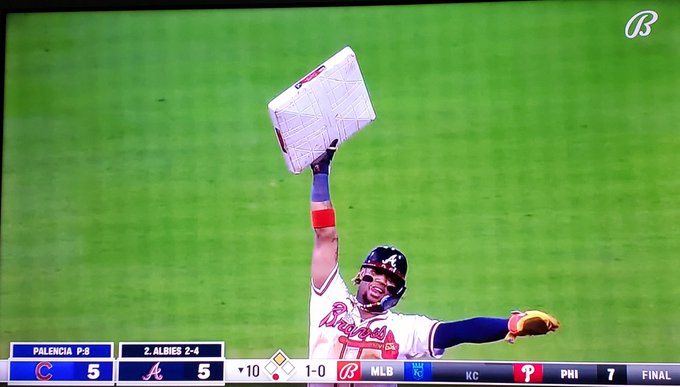
Last night, Ronald Acuña stole his seventieth base of the 2023 season. In so doing, he became the only player in the history of Major League Baseball to steal at least seventy bases and hit at least forty home runs in the same season. In that simple–and extraordinary– sense, there is no context for Acuña’s 2023. He stands (and hits, and runs, and slides) alone. And, as MLBTR reports, no one else is particularly close: “No player with at least 40 homers in a season had ever stolen as many as 46 bags in the same year before Acuña exponentially raised the bar in 2023.”

Adding some context emphasizes the rare and special nature of this achievement, though, and so has some contributory value. Most immediately, it’s worth noting that Acuña achieved his feat during an era in which base stealing is relatively rare. Yes, new rule changes this year do seem to have triggered a rebound in what many presumed was a lost art, but compare, for a quick example: the 2022 MLB season saw roughly 1,000 fewer bases stolen than in 1990, Rickey Henderson’s MVP season. Even with those leaguewide rule changes, Acuña himself still stole more bases in 2023 than two other teams.

That’s a base-stealing feat Henderson accomplished too. In 1982, his MLB-leading 130 stolen bases bested eleven other clubs, with comparable results throughout the 1980s. That doesn’t diminish the shine on Acuña’s 2023, though; instead, it enhances it.

First, Henderson never hit more than twenty-eight home runs in a season, and he barely approached double-digit bombs in his most larcenous years on the basepaths. Doing both at the same time is what makes Acuña special. (Even the great Mike Trout’s stellar rookie season– 30 HR/49 SB– did not shine quite so brightly by this measure, and he commenced his base stealing opt-out soon after.) Second, anything to do with Henderson and stolen bases commonly was presumed to be untouchable, residing on the same block as batting .400 or hitting safely in fifty-six consecutive games. That Acuña’s 2023 now is a topic of neighborhood conversation there shows just how special it is.

Rants to High Heaven

Because this site traffics in both sports talk and sports talk talk, the passing of one of the legendary sports talkers of our time merits note. This morning, Paul Finebaum posted a farewell message to Phyllis from Mulga, who is in the pantheon of sports-talk radio callers and the author of truly compelling rants, including a hall-of-fame composition back in 2013 that merited special mention in these pages. If you’re going to tell the truth, then you’ve got to tell the truth: there are no Cowturds in heaven, Phyllis.

_________________________________________________________

Previously:
A note on rants

Rays of Offense, Clouds in Detroit?

Our quizzically titled series examining the comparative stature of the 2023 Detroit Tigers continues today with a quick look at the offense. The above-referenced prompt for this focal selection is the sort of remarkable occurrence that follows a remarkable team record; in this case, the Tampa Bay Rays’ 25-6 mark to start the season. (That sixth loss, which came on Sunday to the Chicago White Sox, itself is noteworthy to Detroit fans, who surely have been recalling the 1984 Tigers’ record-setting 35-5 opening pace.) Detroit’s sub-middling 12-17 record portends lower offensive rankings for their players, and that’s exactly what we find.

As with the overall player-performance leaderboard, the results here are fairly grim. While the Rays’ roster includes six of the top twenty-five batters according to weighted runs created plus (wRC+), the Tigers don’t even have a single hitter in the current top one hundred hitters by that metric.* If you read last month’s article, you probably will guess, correctly, it’s Matt Vierling leading the way. His 112 wRC+ is good enough for 106th place on the list. Eric Haase (108 wRC+, 114th) and Kerry Carpenter (104 wRC+, 127th) are the only other Tigers who have hit at an above-average level so far in 2023, and it’s a big dropoff after Carpenter, with Riley Greene checking in at 205th place with his 78 wRC+.

Viewed as a whole, the Tigers actually are not the worst team by wRC+, with the Colorado Rockies and Kansas City Royals managing to get lower than Detroit’s 80 wRC+ team mark. Mitigating whatever silver lining of marginal upside that status might thus far provide, however, is the fact that the Tigers have scored the fewest runs of any MLB team, albeit in fewer games played than any other team.

We clearly are scraping the barrel here, so I’m going to stop now. At this moment, the Tigers are just underway against the visiting New York Mets and their new starter, Justin Verlander. Detroit is hoping for a repeat of yesterday’s modest drubbing of the Mets’ Max Scherzer, and early returns– a 2-0 lead thanks to back-to-back homers from Greene and Javier Baez– look promising.

* MLB Network, which created the Rays graphic reproduced at top, failed to disclose therein that these rankings only hold using a lower-than-expected threshold for minimum plate appearances. For comparison, limiting the list to qualified batters places just three Rays in the top twenty-five. I was able to replicate MLBN’s results by dropping the minimum plate appearances to seventy.

_______________________________________________________________

Previously
Do the 2023 Detroit Tigers have the worst MLB players?

Baseball’s Pitch Clock Has Transformed Game Length—and Not Just in the Obvious Way (via The Ringer)

Fans who follow baseball closely, and a good many people who don’t, know that the pitch clock has cut almost half an hour off the average MLB game time this year. What may be even more remarkable, though not nearly as widely remarked on, is how alike in length this year’s games have been. April 25’s 15 contests included close games and lopsided games, shutouts and slugfests. But there weren’t any extra-long games that were balanced out by a bunch of extra-short ones. Only 36 minutes separated the longest game (2:52) from the shortest game (2:16). Every East Coast game was over before 10 p.m. ET, and every West Coast game ended shortly before 12:30 a.m. ET. On that night, you could almost set your watch to baseball—traditionally, and either famously or infamously, the sport with the most malleable, variable approach to time.

April 25 was one day, but that predictable pattern is pretty representative of this season as a whole. Most of the pitch-clock headlines have, understandably, been about the total time saved relative to last year: At this rate, over a 2,430-game regular season, MLB will have trimmed more than 68,000 minutes, 1,130 hours, or 47 days of hitters lollygagging in and out of the batter’s box and pitchers either staring into space or peering in at signs for the pitches they’d eventually get around to throwing. But the games aren’t just shorter than the ones MLB fans had grudgingly become accustomed to. They’re also significantly more uniform in duration. And even more than the reduction in average game length, it’s the reduced variation in game length that has truly transformed the sport into something unseen in living memory.

Baseball’s trademark refusal to stick to a timetable has long been a source of delight or a source of frustration, depending on the observer. In 1971, Roger Angell wrote, “Since baseball time is measured only in outs, all you have to do is succeed utterly; keep hitting, keep the rally alive, and you have defeated time. You remain forever young.” Eight years later, Herb Caen expressed the same concept a little less lyrically and romantically: “The clock doesn’t matter in baseball. Time stands still or moves backward. Theoretically, one game could go on forever. Some seem to.” … Read More

(via The Ringer)

Do the 2023 Detroit Tigers have the worst MLB players?

It is early in the 2023 MLB season. Very early. Less-than-two-weeks-in early. Not-even-ten-games-played early. Additionally, I take no pleasure in writing what you’re reading, because it is not good news, and because it now is nearly almost-astonishingly early in the 2023 MLB season.

On the other hand, if the thing I was writing was good news, I might not qualify it or hesitate to write about it or share it with the many manys of readers of this website. If the 2023 Detroit Tigers were so extremely separating themselves from the MLB pack in such a singular– but also good– fashion, you would be reading about it here, and you would want to be reading about it here. This is that, but the bad version.

By way of substantive introduction, Detroit does not have the worst record in baseball. They’re very close to having the worst record, and the reason they don’t have the worst record is at least partially circumstantial. The Tigers are tied with the Oakland A’s for the fewest wins (two apiece), but the A’s have played– and lost– one more game than has Detroit. Oakland seems to have better players than Detroit, though, at least if you grant any credence to FanGraphs wins above replacement as a reasonable general indicator of player performance. According to that metric, Kyle Muller, Ryan Noda, and Zach Jackson each have contributed more to the A’s than any player has contributed to the Tigers.

Considering the fact that, by fWAR, the Tigers’ best player so far in 2023 has been Matt Vierling, and further considering that Vierling is by that same measure the 258th-best player in baseball this season, it isn’t that surprising that another team might have multiple players who have been better than the Tigers’ best player. Nor probably is it surprising that more teams than just Oakland would, so far, have multiple players better than the Tigers’ best player. Maybe it’s mildly surprising that every other team in baseball has multiple players who rank higher than the Tigers’ best player on the fWAR leaderboard, but you probably figured that’s where this was going to end up.

Vierling, in case you never heard of him before two weeks ago, was a fifth-round pick out of Notre Dame by the Philadelphia Phillies, for which he debuted in 2021. In thirty-four games that season, he hit .346/.364/.479 and played first base and outfield. In 117 games in 2022, he hit .297/.351/.648 and played all over the field. On January 7, 2023, the Phillies sent him to Detroit along with Nick Maton and Donny Sands in exchange for Gregory Soto and Kody Clemens. Vierling played especially well in the Tigers’ two wins this season, both of which came on the road against the defending-champion Houston Astros. In those two games, he had six hits, including a home run and a double, a walk, and three RBI. In the rest of the games, he has a total of two hits (both singles) and one walk.

The Tigers are back on the road tonight in Toronto and Vierling is back in the starting lineup, hitting third. The A’s are in Baltimore with Muller scheduled as the starting pitcher and Noda hitting second.

Foreign College Basketball Stars Are Missing Out on Endorsement Money Due to Visa Rules (via Reason)

The NCAA used to bar all college athletes from making money off their names, images, and likenesses. But since a 2021 rule change, they have been eligible to earn money through endorsement deals, social media activity, and paid appearances. The NCAA had long viewed college athletes as amateurs, but the policy change—quite sensibly—recognized that students deserved to be paid as professionals. In the first year of name, image, and likeness arrangements, Opendorse, a technological platform for these deals, estimated that college athletes made $917 million. Three-quarters of all NCAA athletes had engaged in the market from July 2021 to July 2022.

But international students largely operate in “a gray zone” in American immigration law when it comes to endorsements, says James Hollis, an immigration attorney at Siskind Susser, PC who has previously advised professional sports organizations on visa matters. “Students, schools, and their lawyers are all operating within the standard student visa framework,” Hollis tells Reason. College athletes are largely in the U.S. on F-1 visas, which place tough restrictions on work. “The student visa rules say that student athletes can work part time on campus, can work if authorized as part of the curriculum…and can work after one academic year if they can demonstrate they’re experiencing economic hardship,” says Hollis.

None of that fits neatly into the name, image, and likeness apparatus. “Some foreign student athletes have been able to obtain O-1 extraordinary ability visas authorizing them to work, study, and compete,” says Hollis. Others have arranged completely “passive deals where they receive income but do nothing that could be considered work while in the United States.” According to Hollis, “the safest path has been to sign deals and then do the work to promote the NIL [name, image, and likeness] content” strictly while outside the United States.

Two years after the NCAA rule change, the Biden administration still hasn’t offered definitive guidance that would allow foreign college athletes to make money like their native-born peers. On a more basic level, this leaves foreign athletes wondering whether certain activities might be violations of their student visa terms.

According to ESPN, just one of the eight teams that played in the men’s and women’s Final Fours didn’t have at least one international student player. UConn has four. Per the NCAA, “roughly one out of every eight athletes across all Division I sports is from a foreign country,” leaving a gaping hole in the system that allows student-athletes to sign often lucrative sponsorship deals. Visa term violations can be dire—potentially as severe as deportation….Read More

(via Reason)

________________________________________________________________

Related
The NCAA’s response to Georgia’s new NIL law reveals the emperor’s new clothes