Did somebody just out-XFL the XFL?

xfl fans orlando

Baseball may be the de jure national pastime and the NFL may be the de facto national pastime, but, heretofore, the official sport of ALDLAND always has been the XFL. Almost twenty years ago, the brash and innovative XFL upended the stogy NFL with a fan-first (or certainly not player-first) approach that, while not long-lasting in its then-current form, lives on through a variety of changes it forced the NFL to make to stay current with its most ardent fans.

Almost two decades after the XFL folded, however, the NFL under Roger Goodell is as stiff and outdated as it’s ever appeared, which made initial reports that Vince McMahon was bringing the XFL back welcome news indeed in many quarters, including this virtual one. The NFL once again is ripe for upheaval, and a revived XFL seemed like just the vehicle for the job once again. Unfortunately, further revelations from McMahon have made clear that the new XFL, which is planned to resume play in 2020, has a mission devoid of the brash, raw, boundary-pushing, potentially/probably dangerous approach the league took in 2001:

On January 25, 2018, Alpha Entertainment announced a new incarnation of the XFL, which would begin with a 10-week inaugural season beginning in January or February 2020. In a press conference, McMahon stated that the new XFL would be dissimilar to its previous incarnation, stating that “There’s only so many things that have ‘FL’ on the end of them and those are already taken. But we aren’t going to have much of what the original XFL had, including the cheerleaders, who aren’t really part of the game anymore. The audience wants entertainment with football, and that’s what we are going to give them.” McMahon stated that the league would feature eight teams as a single entity owned by Alpha (the previous XFL was also a single-entity league), which will be revealed in 2019. Alpha Entertainment was established in order to keep the league’s management and operations separate from that of WWE.

The XFL will discourage political gestures by players during games (such as, for example, taking a knee in protest), and will forbid any player with a criminal record from participating. He justified this by stating that the XFL would be “evaluating a player based on many things, including the quality of human being they are”, and that “people don’t want social and political issues coming into play when they are trying to be entertained”. He suggested that players who wish to express political opinions should do so on their personal time.

He’s had a lot of success, but here, McMahon’s being too big of an idiot in too many ways. The second coming of the XFL wasn’t going to be a cookie-cutter version of the first edition, of course, but its organizing principle, by McMahon’s own admission, has nothing to do with football. Nobody ever thought the XFL would offer a better on-field product than the NFL because the best players always play for the most money, but you’re lying if you said you thought the XFL would return to play the role of a more conservative NFL. (And not to get too deep into the water here, but does anyone think he could’ve saved a lot of words by just saying he only wants white players?) What a waste.

Thankfully, somebody else saw an opening here. That somebody is Charlie Ebersol, the son of Dick Ebersol, the longstanding NBC executive who, along with McMahon, formed the original XFL. Charlie, who directed the recent 30 for 30 movie about the XFL, plans to scoop his father’s former partner by debuting his new league, the Alliance of American Football, a year earlier than XFL 2.0:

The league plans to kick off on February 9th, 2019, one week after the Super Bowl, with 50-man rosters and a ten-week season.

The news just gets worse and worse for the XFL, as Ebersol’s league has already recruited some heavy hitters from the NFL world. Ebersol has brought in retired Indianapolis Colts General Manager and current ESPN analyst Bill Polian to help oversee the league, with former Pittsburgh Steelers safety Troy Polamalu doing the same for the player side of the new venture and former USC star J.K. McKay for the team side. Adding to the league’s growing star power are Hines Ward, Justin Tuck and Dick Ebersol, who are all league advisors.

The league’s financial backing comes from a variety of sources, including former Minnesota Vikings defensive lineman Jared Allen, Billionaire Peter Thiel and the Chernin Group. This stands in contrast to McMahon, who is financing his new XFL through personal wealth. That creates more upside for him personally, but Ebersol is taking a longer view of his new league saying “I think where businesses like this fail is that they expect to have ludicrous and unrealistic ticket and media deal projections in Year 1. Our investors here understand that it’s a 7-10-year plan.”

Significantly, AAF already has a television broadcast deal with CBS, and it claims it also will offer live streaming on a free mobile app. Plus, according to an ESPN report, there will be no TV timeouts, substantially fewer commercials, and mandatory two-point-conversion attempts after every touchdown.

The younger Ebersol hasn’t said much about the AAF’s broader mission beyond a general goal to provide fans and players with a quality on-field performance which, while vague, is better than the position McMahon’s staked out. It’s tough to read the tea leaves on the league’s backers and advisors– Polian presents as an NFL-stooge type; Thiel funded the Hulk Hogan lawsuit that mortally wounded Gawker Media Group; Chernin owns a majority of Barstool Sports and recently upped its stake; and Polamalu, Ward, Tuck, and Allen all seem like fun, personable characters in the former-player role.

The XFL of 2001 may never (and arguably shouldn’t) return, but, sitting here today, I have far greater hope in what the AAF can offer the world of football than I do in McMahon’s soft retread effort.

____________________________________________________________________________

Related
Pre/Postmodern football fans rejoice: The SPFL cometh

Highlights from MLB Network’s visit to Detroit Tigers spring training

fiers mlbn

As it has done in the past, MLB Network’s “30 Clubs in 30 Days” program spends a day with each major-league team during spring training. They spent Monday with the Detroit Tigers in Lakeland, Florida. Here are the highlights:

  • Miguel Cabrera was guarded in discussing his health coming into the season after injuries limited him to 130 games and a career-worst 91 wRC+ in 2017. He admitted it was tough to find enjoyment in the game last year, but he expects to be back to having fun in 2018.
  • Ron Gardenhire, the Tigers’ new manager, said that his time outside of the game gave him perspective on the special nature of the opportunity he and his players have to make a living in baseball. While he avoided specifics, it sounds like he has fairly modest expectations for the season. It also looks like he wishes his baseball pants had pockets.
  • Likely number-one starting pitcher Michael Fulmer called Gardenhire “awesome” and described him as a “very positive guy.” Fulmer also said he “had a little setback with the elbow earlier in camp, but we’re all good now.”
  • On High Heat, General Manager Al Avila emphasized the youth of the 2018 roster. He confirmed that Fulmer is “one-hundred percent” healthy, indicated that second-year player Jeimer Candelario would be the opening-day third baseman, and described Cabrera as “much stronger” following an offseason physical therapy regimen. Avila believes that Cabrera can maintain a reasonably high level of production if he sticks to his offseason training plan, comparing him to other late-career success stories like Ivan Rodriguez and Vladimir Guerrero. He dodged a question about whether the obviously rebuilding team would shift its approach if it somehow found itself in a contending position midway through this season, but he did allude to the comparatively positive perception of Detroit’s current rebuilding process as compared to the actions of other teams that have drawn accusations of anticompetitive behavior. Avila also referred to “millions of dollars” the team had invested in “new technology,” which apparently includes biomechanical-oriented technology and an analytics department that now boasts a staff of twelve. Finally, he said that “nothing has changed” in his “great” relationship with ownership, which has transitioned to the late Mike Ilitch’s son Chris, who, Avila said, “has backed me one-hundred percent.”
  • Hopeful starting pitcher Daniel Norris reports that he is feeling healthy and, while he wants to compete for a rotation spot, he’s trying not to ramp up too fast in spring training in order to maintain that health.
  • The consensus among surveyed players is that presumptive closer Shane Greene has the worst taste in music, while Jose Iglesias, despite his own strong opinion to the contrary, has the worst singing voice.
  • Iglesias did get the opportunity to speak for himself and answer the Harold Reynolds question “What’s funner, snatching a hit from somebody or getting a big hit?” While Iglesias, a native of Cuba, wasn’t able to watch much major-league baseball growing up, it’s clear he’s picked up on Crash Davis’ tutelage from his answer: “Both.”
  • Nick “Nicholas” Castellanos, who’s moving from third base to right field on a full-time basis in 2018 said that he was not mentally present for much of last season because his father was ill, but, now that his dad is healthy, he will be able to reunite mind and body and is approaching this season with a seize-the-day attitude.
  • New arrival Mike Fiers praised the team’s new pitching coach, Chris Bosio, and says he feels he’s getting back on track under Bosio’s guidance. The two previously worked together during Fiers’ rookie season in 2011, when both were employed in the Milwaukee Brewers organization. Fiers, who spent the first five years of his career in Milwaukee before shifting to Houston for the past three seasons, arguably had his best performances as a Brewer.
  • Alan Trammell, fresh off his election into the baseball hall of fame, is working with players on infield fundamentals.

I didn’t think this year’s edition of this feature was as entertaining as it has been in past years, but there are a lot of new faces on this team and a new strategic approach that Tigers fans haven’t seen in some time, and I thought the profile was, on the whole, serviceable.

Stay tuned for a more thorough Detroit Tigers 2018 season preview, which will appear soon over at Banished to the Pen.

ALDLAND Archives: Madness: The NCAA Tournament’s structural flaw

Last night, the NCAA released the opening pairings for this year’s men’s basketball tournament. It’s nearly impossible to imagine the NCAA ever shrinking the tournament below the current number of entrants (sixty-eight). It is possible to imagine a better way to incorporate the four teams added above and beyond the traditional sixty-four-team field, however, and, in 2016, I engaged in that exercise in a post now unearthed from the ALDLAND Vault.  -Ed. 

_________________________________________________________________

Madness: The NCAA Tournament's structural flaw
MARCH 15, 2016

The organizing principle of a competition arranged in the fashion of the NCAA men’s basketball tournament is that better teams should have easier paths for advancement, the goal being for the best teams to meet as late as possible. Tournament organizers therefore employ a seeding system that awards teams believed to be the strongest with the best seeds (i.e., the lowest numbers) and first pits them against teams believed to be the weakest.This is sensible, logical, and good. Anything can happen once the games begin, of course, but if Michigan State and Kansas, for example, are the best teams in this year’s tournament, the tournament should be designed such that those two teams are most likely to face off in the final, championship round. Generally speaking, this is how the NCAA tournament is organized.

From 1985 until 2000, the tournament’s field held steady at sixty-four total teams. In 2001, it expanded to sixty-five teams, adding a single play-in game to determine which team would be the sixteenth seed to face the number one overall seed. In 2011, the tournament field expanded to sixty-eight teams, its current size, with four play-in games.

Many people dislike the fact that the tournament has expanded beyond a seemingly optimal sixty-four-team field, but all should agree that, however many teams and play-in games are included, the tournament should be organized such that the projected difficulty of each team’s path through the tournament is inversely proportional to its seed position. As currently constructed, however, the tournament deviates from this basic principle.

Read the rest…

The Best Baseball Research of the Past Year

Once again, the Society for American Baseball Research has chosen fifteen (non-ALDLAND) finalists for awards in the areas of contemporary and historical baseball analysis and commentary.

My latest post at Banished to the Pen highlights each finalist. The winners will be announced on Sunday.

The full post is available here.

Old English D: A Look Back at Tigers Uniforms (via The Hardball Times)

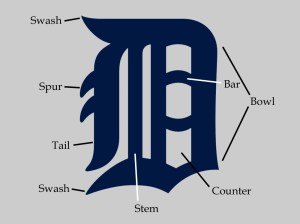
parts-of-the-dIn late January, the Detroit Tigers announced an alteration to their iconic home uniforms that, depending on your level of uniform awareness, was either a seismic change or a minor detail but unlikely to be anything in between. The Tigers’ Old English “D” is the second-oldest mark in baseball, trailing only the Athletics’ “A,” which can be traced back to 1866. However, for most of their history, the D on the Tigers’ caps has differed, at times slightly, at others quite drastically, from the D on their jerseys. This offseason, the Tigers decided to put an end to that discrepancy by replacing the D on their jerseys with the one on their caps.
The decision was superficially logical (the D’s should match), but disregarded the history of one of major league baseball’s classic uniforms. Not only had the two D’s never really matched (with the possible exception of the 1929 road uniform, though uniform manufacturing was so inconsistent then that even that could be called into question), but the now-discarded Jersey D (as I’ll call it from here on out) pre-dated the first use of the Cap D by 52 years.

By transferring the Cap D to their chests, the Tigers have removed a version of the D that dated back to 1908 in favor of one that has been in continuous use only since 1968. If anything, the discrepancy between the D’s was more representative of the Tigers’ uniform history than any single D could be, with the possible exception of the now-discarded Jersey D. … Read More

(via The Hardball Times)

Sympathy for Josh Rosen

We’re not really into class politics around here, but, in this day and age, one can’t help but ask: did you really make a good tweet if you didn’t thereafter blog that tweet? I don’t know but I’ll give it a shot, if for no other reason than to create an excuse to post some music on a Wednesday.

josh rosen is rich

___________________________________________________________________

Related
DraftJoshAllen.com

Shohei Ohtani boomerangs into spring training

Easily the most anticipated debut of the 2018 MLB season belongs to Shohei Ohtani, the two-way player from Japan who signed with the Angels as an international free agent this offseason. The twenty-three-year-old previously starred as both a starting pitcher and hitter for the Nippon Ham Fighters, a team in Japan’s top professional baseball league. During his five seasons with the Fighters, Ohtani posted a  2.52 ERA and .859 OPS. While his numbers don’t correlate directly to Ohtani’s expected performance with Los Angeles, they do suggest Ohtani could become both a very good pitcher and hitter here, something without recent parallel in the MLB ranks.

The presently ongoing spring training offers American audiences their first good look at Ohtani, who has made one appearance (1.1 IP) on the mound thus far. Can he pitch? Reader, he can pitch:

The Angels surprised many by racing to a second-place finish behind runaway success (and eventual World-Series champion) Houston in 2017, and they promise to be even more interesting in 2018, with a roster that adds Ohtani and a bunch of former Detroit Tigers (Cameron Maybin, Justin Upton, and Ian Kinsler, plus Brad Ausmus as a front-office assistant) to a group that already included Mike Trout, Andrelton Simmons, Zack Cozart, and compiler Albert Pujols.

What the new Yahoo!!! college basketball report says about Michigan State

germany-yahoo-7591

Yahoo!, which somehow still staffs a sports department and definitely isn’t a Jeb!-like holdover from the Web 1.9 days, has a new college basketball report out today that is Very Important. I know it’s Very Important because “federal investigation,” “meticulous,” “prominent,” and “underbelly” all appear in the first sentence.

Cutting through the heady haze of college athletics journalism, this is an article based on expense reports from a sports agency called ASM Sports. Those reports apparently document “cash advances, as well as entertainment and travel expenses for high school and college prospects and their families.”

The only document– and please know that the tireless staff of Yahoo! Sports “viewed hundreds of pages of documents,” according to Yahoo! Sports– mentioned that references Michigan State’s men’s basketball program in any respect is an expense reimbursement request Christian Dawkins, a former ASM agent, filed with the agency. One of those requests was dated May 3, 2016: “Redwood Lodge. Lunch w/Miles Bridges Parents [sic]. $70.05.” Another was from the same date: “ATM Withdrawl [sic]: Miles Bridges mom [sic] advance. $400.” The article also states: “According to the documents, Dawkins has dinners listed with plenty of boldface names in the sport – Tom Izzo . . . .” That’s everything on the Spartans.

As one possible starting point, we can acknowledge that the NCAA prohibits student-athletes from receiving money from agents. Whatever the wisdom behind or efficacy of that policy, I’m not sure we even have evidence of a payment to Bridges, the Spartans’ premier player, here.

First, despite that exhaustive (well maybe not quite that exhaustive: “Yahoo[!] did not view all of the documents in the three criminal cases tied to the investigation, but . . . .”) doc review, Yahoo! declined to publish the records referencing Bridges. They published multiple pages of reports mentioning other players but, for some undisclosed reason, decided not to publish those that mention Bridges (or Izzo). That means we have to take the authors’ word that the records they saw but did not include with their article said what they say they do.

Second, assuming those records exist and are as described, I don’t think they actually evidence payments to Bridges himself. A– and perhaps the only– reasonable reading of the two entries are for a lunch with Bridges’ parents and a payment to Bridges’ mother. The negative implication is that Bridges himself did not attend the lunch and did not receive the payment. This distinction is significant in light of the NCAA’s prior case against Cam Newton. There, the NCAA suspended Newton on multiple occasions arising out of allegations that Newton’s father, Cecil, tried to secure a pay-for-play agreement on Newton’s behalf with Mississippi State but ultimately reinstated him based on Auburn’s successful argument that Newton was unaware of his father’s efforts. If Dawkins, in treating Bridges’ parents to lunch and giving Bridges’ mother cash, acted without Bridges’ knowledge, there would appear to be no basis for the NCAA to punish Bridges.

Third, a technical but not legally insignificant point is that these records are, at most, indirect evidence of payments to Bridges’ family. They’re good evidence, but they aren’t direct evidence that the payments actually were made. Even if Dawkins had a receipt of the ATM withdrawal, for example, we don’t have direct evidence that he provided that cash to Bridges’ mother.

Finally on the direct issues, the passing reference to Tom Izzo obviously is meaningless, but it’s good for SEO. There is no indication or allegation that any MSU official had any knowledge of or involvement with these payments. Continue reading

2018 MLB rule changes less drastic than anticipated

baseball time

With the MLB and MLBPA finding it difficult to engage in substantive, productive conversations with each other, Commissioner Rob Manfred was poised to enact rule changes unilaterally in an effort to advance his ill-defined pace-of-play goals.

In his three years in office, Manfred already has made changes in this area, including a reduction in the time of the between-inning breaks and an informal request for hitters to remain in the batter’s box between pitches. More fundamentally, one year ago, he made what I still believe to be “the most significant change to the sport since 1879” when he eliminated the four-pitch intentional walk, an alleged pace-of-play reform he later conceded was merely “symbolic.”

Rumored to be chief among those new, unilateral rule changes for 2018 was the institution of a pitch clock, which the upper levels of the minor leagues have been using since 2015. While a less-fundamental change to the game than the intentional-walk rule, in my estimation, a pitch clock in the majors likely would have drawn a louder critical outcry from fans.

Thankfully, we’ve learned today, a pitch clock will not be a part of the game in 2018. Instead, Manfred has made what I think are very good choices, as first reported by the San Francisco Chronicle’s Susan Slusser:

In case those tweets are hard to read or disappear, that’s a cap on mound visits per nine innings at six (with limited exceptions for extra innings and other defined situations in the umpire’s discretion) and a reduction in inning breaks during the regular season to 2:05 (with scaled expansions for postseason games).

By further (although it’s unclear by how much) reducing the between-inning commercial breaks and limiting mound visits, Manfred tracked two important reform guidelines: a) avoid changes in the on-field game and b) keep the focus on the players. There’s plenty of time in a baseball game for pitcher coaching and coordinating, and I have no problem putting more pressure on pitchers (who, collectively, now are enjoying probably their greatest advantage relative to hitters in the game’s history) to work out struggles on their own.

More than anything, though, I’m glad that baseball, at least at the top level, remains an area of life not dictated by a clock, a space where anything is possible so long as you’re alive.

_____________________________________________________________

Related
Rob Manfred’s Use Your Illusion Tour