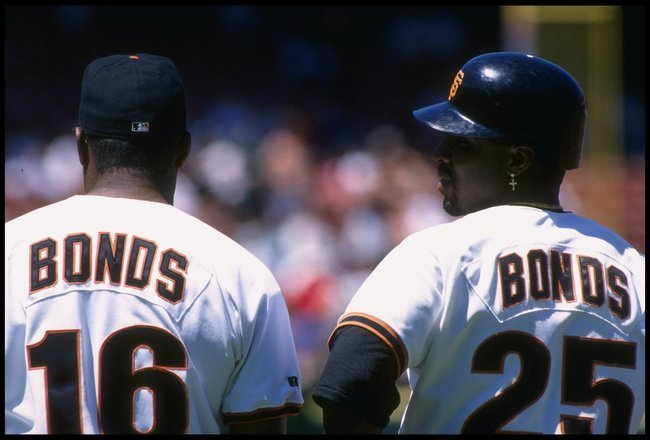
Earlier this year,* the Baseball of Fame passed an important threshold when Barry Bonds, Roger Clemens, Curt Schilling, and Sammy Sosa each failed to secure enough votes for induction on their final year of eligibility (though various mop-up committees conceivably could change that in the future). In other news, David Ortiz was the only player selected for enshrinement this year.
In the last decade or so, the online baseball social media community quickly and unequivocally came to the unwavering position that Bonds, allegations of wrongdoing cast far aside, belongs in the Hall.** Thus, any voter supporting Bonds’ candidacy is cheered as righteous, upstanding, intelligent, and correct, while any failing to do so is an unreconstructed hypocrite. These are the only choices.
As ever with these types of social movements, it isn’t enough to be “right.” One also must be right for the right reason. Naturally, herein also enters the discussion of identifying the right reason why the wrong are wrong, perhaps so as to convert them– upon receipt of the crowd’s wise and agreed critique– to being right. Among collective critics, few devices are more seductive than the critique of hypocrisy, and boy are people who think Barry Bonds should be in the baseball hall of fame enjoying lobbing that one over the barricade right now. As enunciated by ESPN baseball “insider” and live Pinocchio puppet Jeff Passan, the latest version goes like this:
The campaign against Bonds has spanned decades, involving malfunctions of fairness and logic across multiple cohorts.
It starts with Major League Baseball and the blind eye that Selig, his office and the game’s stewards turned toward PEDs. From there came the duplicity of riding the steroid wave to new stadiums and bigger TV deals and exponential revenue growth while villainaizing the very people who fueled it.
Perhaps ironically (irony being another too-seductive critique of people expressing themselves on the internet), Passan’s thesis contains some infirmities of its own. Omission of serial commas aside, this seems to ignore the fact that the Hall is a separate entity outside the control of MLB or its commissioner or club owners. Everyone associated with baseball profited from the game’s pharmacologically driven power boom in the second half of the 1990s, and MLB still recognizes all of the statistics posted and records broken during that era. Among “the game’s stewards,” only the Hall and its electors have tried to deny laudatory acknowledgement of this period of history. The facts do not support this particular smear of Bud Selig and the owners. (Readers of this site know there are plenty of other, valid reasons to engage in that exercise.)
Nor does logic support the levying of this charge. If player-driven, sport-wide profits should buoy the Hall-of-Fame credentials of the players whose playing pushed those profits, then, the theory would hold, more support is due to, for example, the non-serving players who kept the game going during World War II (vis-a-vis the likes of Hank Greenberg and Ted Williams) or the white players, simply by virtue of their skin color, during MLB racial segregation. As concerns this sort of parsing, the far-better and generally accepted view is, of course, the opposite. Passan’s contention is too reductive to be useful.
And none of this explains Ortiz’s first-ballot election. Let’s start with the case for Ortiz. He spent most of a twenty-season career with a very successful, popular, and visible Boston Red Sox team for which he was one of the most visible faces. He was a key part of three World Series championships, adding World Series and ALCS MVP honors to ten regular-season All-Star nods. Ortiz didn’t experience much of a decline as he aged, and, as a forty-year-old, he led all of baseball in slugging (.620), OPS (1.021), and doubles (48) in 2016, his final season. He finished with 2,472 hits and 541 home runs.
I don’t lose much sleep over first-ballot (or unanimous first-ballot) status; you’re either in or you’re out. That said, here, in reverse-chronological order, is the full list of players selected for enshrinement on their respective first ballot:
Continue reading →
 ALDLAND