The Weekend Interview: Roger Goodell

Roger Goodell has been the commissioner of the National Football League since August of 2006. During those five years, Goodell has sought to leave his mark on the game in a number of ways, first among them being his attempt to control and improve the image of the league through tough punishments for player misbehavior on and off the field. Other notable goals include increasing the global reach of the game– London, Mexico City, and Toronto all have hosted games– and expanding the regular season to from sixteen to eighteen games, something he failed to achieve during the summer’s labor disputes.

Goodell has been a controversial figure with players almost since the beginning of his tenure, and the summer’s labor disputes carried the natural consequence of ill will from fans. His most recent decision regarding supplemental draft hopeful Terrelle Pryor has drawn heavy criticism from players, fans, and media observers. Yet the game has done anything but flounder under his watch. For this imagined interview, I caught up with Goodell in the Mile High City, which he was visiting in advance of tonight’s Bills-Broncos game.  Keep reading…

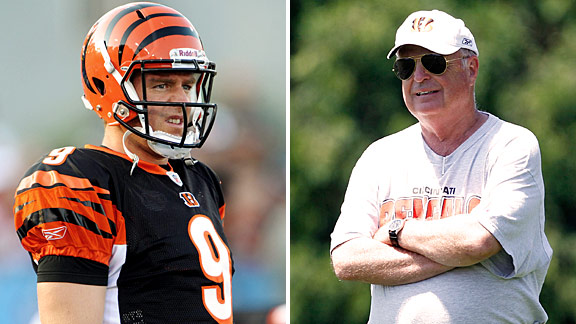
Horrible Bosses: Bengals’ Mike Brown (via ESPN.com)

Yes, Palmer has four years left on his nine-year, $118 million deal. You signed the contract, you say. Live up to it. In fact, that’s what Brown has said. “He gave his word. … He’s going to walk away from his commitment. We aren’t going to reward him for doing it.”

But Brown is a hypocrite. He has cut hundreds of players before their contract was up and given them nothing. Why should Palmer live up to a deal that works only one way? If Palmer should suddenly go blind, would Brown still give him the money? Are you kidding? Brown is cheaper than your local Goodwill. … Read More

via ESPN.com

Why is Roger Goodell carrying water for the NCAA?

After delaying the supplemental draft to hear ovations from disgraced former Ohio State University quarterback Terrelle Pryor, NFL Commissioner Roger Goodell decided, contrary to the apparent application of NFL rules, that Pryor would be allowed to enter that draft, and, contrary to ready explanation, that Pryor would be suspended for the first five games of the regular season.

That Goodell would allow Pryor into the supplemental draft was not a surprise. Despite a likely inability to make the requisite showing of “changed circumstances,” Pryor was too (in)famous to be left out, and some teams had whispered an interest in him.

What is surprising, though, is the condition Goodell imposed on Pryor’s eligibility: a five game suspension. Indeed, Pryor cannot even practice with the team that drafts him–assuming a team drafts him– until Week 6 of the regular season. Pryor’s high-profile agent, Drew Rosenhaus, appeared to accept the terms of admission graciously: “We accept that voluntarily. It’s a small price to pay for him to have a chance to pursue his dream of playing in the NFL.” Pryor’s attorney was less gracious: “Terrelle is going to [the] NFL because the NCAA mandated that he feed their families but he couldn’t feed his own.”

The five-week suspension just so happens to exactly mirror the suspension Pryor would have faced had he returned to play at Ohio State, assuming he would face no further sanctioning. It’s unlikely that this is a coincidence, since it is a disproportionately heavy punishment when compared with other NFL game suspensions.

The obvious and unanswered question about the conditions of Pryor’s eligibility is, “why?” Goodell’s reputation, as established early and often through his treatment of players like Pacman Jones and Michael Vick, is as a tough, paternalistic disciplinarian. Players who violate league policy or the law can expect to be punished by the NFL under Goodell’s watch.

What was completely unexpected, however, was that Goodell would act to enforce violations of NCAA policy. Pryor has violated no laws, and no policies of the NFL. Why, then, is Goodell punishing him?

The only answer can be that Goodell is punishing Pryor for violating NCAA policies, something that 1) is absolutely beyond his authority, and 2) sets an untenable and inappropriate standard as applied to events in the recent past and the potential near future.

For example, what of Seattle Seahawks head coach Pete Carroll, who fled Los Angeles as his USC program went down in NCAA-sanction flames (to say nothing of Reggie Bush)? What if the new NCAA investigation of the University of Miami finds that current NFL players who played there violated NCAA rules? What if the NCAA’s ongoing investigation of Auburn turns up infractions by Cam Newton, the Carolina Panthers’ new starting quarterback?

Does this new aspect of the Goodell Doctrine, the Pryor Precedent, mean that all NCAA rule breakers who go to the NFL now can expect to face punishment from the professional league as well? And why wasn’t Pryor himself entitled to notice of this new punishment policy?

Finally, it is notable just how transparent a departure the suspension was from anything resembling the norm. After hearing the news of Pryor’s conditional eligibility at lunch yesterday and going to post a 140-character version of this post on Twitter, I found the feed full of links to similar reactions. Even for those on board with Goodell’s “new sheriff in town” approach before this week, I imagine this is a departure too attenuated to justify. What, after all, was Goodell’s motive here?

By 2010 standards, Justin Verlander is having a Cy Young Award-winning season

During Justin Verlander’s 8K, 1 run, 7 2/3 inning retribution against the Twins last night that ended in a 7-1 Tiger victory, the Fox Sports Detroit crew ran a graphic comparing Verlander’s numbers so far this season with the 2010 final season numbers for Felix Hernandez, the reigning AL Cy Young winner. The comparison looked something* like this:

Verlander became this seasons’ first eighteen-game winner last night, his sixth straight win. There are about five weeks remaining in the regular season, during which time Verlander will try to cement his claim to the Cy Young Award against contenders Jered Weaver and C.C. Sabathia.

* It looked almost nothing like this, but it might if FSD’s on-air talent, Rod and Mario, had to do their own infographics too.

He said Said said: Why does Boris Said really want to fight Greg Biffle?

Fox Sports reports:

There is no love lost between Boris Said and Greg Biffle, as became increasingly clear at Watkins Glen International on Monday.

Biffle approached Said’s No. 51 Phoenix Construction Chevrolet in the garage while the window net was still up. A scuffle occurred between Said and Biffle’s crew once he was able to unstrap himself from the car.

“I’m upset with Greg Biffle,” Said said. “He is the most unprofessional little scaredy cat I’ve ever seen in my life. He wouldn’t even fight me like a man after. So, if someone texts me his address, I’ll go see him Wednesday at his house and show him what he really needs. He needs a … whooping and I’m going to give it to him. He was flipping me off, giving me the finger. Totally unprofessional. Two laps down. I mean he is a chump.

“I went over there to go talk to him. He wouldn’t even let me get out of the car. He comes over and throws a few little baby punches and then when I get out, he runs away and hides behind some big guys. But, he won’t hide from me long. I’ll find him. I won’t settle it out on the track. It’s not right to wreck cars, but, he’ll show up at a race with a black eye one of these days. I’ll see him somewhere.”

Said, who finished 22nd, clearly made contact with the No. 6 UPS Ford of Biffle’s teammate David Ragan on the last lap and collected David Reutimann in the process. Phoenix Racing crew chief Nick Harrison said there was history between Said and Biffle prior to the Glen. Harrison said that, according to Said, the No. 16 Ford raced his driver “dirty” during the race. Biffle was a circuit down after running out of gas on Lap 38. He finished 31st.

On Monday evening, Biffle called into ESPN’s “NASCAR Now” program to tell his side of the story, which included calling Said a “chump” and an “ass,” and emphasizing that Said generally was disrespectful when he drives in Cup races.

Maybe Said really was so upset about getting the finger from Biffle that he wants to meet him by the bike racks after school/the race, but I wonder whether the frustration that lead Said to come out firing after the race stems from a deeper, long-term frustration, with Biffle more or less in the wrong place at the wrong time.

Keep reading…

CD review: Rodrigo y Gabriela – Live in France

Live in France is the latest release from Rodrigo y Gabriela, a globe-trotting, genre-blending guitar duo from Mexico City. I first heard the group perform on David Letterman’s show a few years ago, picked up their 2006 self-titled release, and was hooked.

This new eleven-cut release is culled from five different stops on their recent tour in support of their 2009 studio album, 11:11. For all the excitement and commitment I attributed to myself in the previous paragraph, I actually lost track of these two after their self-titled album, so my ears had plenty of catching up to do when listening to this new album. Rodrigo y Gabriela have a signature sound, and longtime fans will immediately recognize the group on this release even if they too have fallen of the wagon, but they also will recognize the musical growth of these two over the last five years. Keep reading…

Week three in ALDLAND

Last week was another good week here, with readers especially enjoying a take on Bill Simmons’ new ESPN project, Grantland, a report on a stop on the Béla Fleck/Bruce Hornsby/Flecktones/Noisemakers tour, and the site’s first readers’ poll. We also featured Chris Johnson as the subject of the Weekend Interview and welcomed a new writer, who jumped headlong into the fray of SEC expansion and Big XII discord in his first post.

This week, we’re continuing to track what may remain of round two of the SEC-Texas A&M maiting dance. Also look for a new album review or two among the usual coverage.

Thanks for reading!