
Singer, guitarist, and songwriter Bob Weir died last weekend. He was the youngest member of the Grateful Dead, and he became the group’s energetic– if occasionally slow tempo’d– standard-bearer in the group’s legacy-cementing second chapter. Appearing on bandmate Oteil Burbridge’s podcast a few years ago, he described death as “the last and best reward for a life well-lived.” Weir certainly appeared to have wrung a lot of life out of his seventy-eight years, a large proportion of which he spent on stage and on the road. As those years wore on, he opened himself more and more to the audience, exposing his sparse-yet-nuanced guitar playing and the depth and breadth of his connection to the music. We should have known those things had been there all along, but being “the normal-looking guy” in the Grateful Dead apparently was enough to distract us from the fact that he was responsible for creating some of the band’s densest, most-complex songs: “The Other One,” “Weather Report Suite,” and “Estimated Prophet.” His final solo offering, 2016’s Blue Mountain, also is a dark horse gem of an album of cowboy songs recorded inside an ancient wormhole that opened up along a Teton mountainside, the last place Weir was spotted before he encountered Jerry Garcia and began the shoulder-grinding work of altering the axis of American music.
Weir’s passing, which follows those of Donna Jean Godchaux (November 2025), Phil Lesh (October 2024), Robert Hunter (September 2019), and John Perry Barlow (February 2018), marks the end of this second thirty-year chapter of the Dead. Billy Kreutzmann and Mickey Hart survive Weir. Kreutzmann previously left Dead & Co. and appears to be comfortable in semi-retirement in Hawaii. Hart continues to produce occasional, percussion-oriented projects. His ESPN special two years ago was excellent. I look forward to his next project, in which he promises to sort out what the color orange sounds like.
I had the good fortune to witness Weir in action on a number of occasions between 2007– with Ratdog at Utica’s Stanley Theater– and 2025– with Dead & Co. at Las Vegas’ Sphere. I’ve previously referenced Bonnaroo 2016, when Donna joined Dead & Co., as another highlight, and it certainly was. Photographs from those three shows follow.
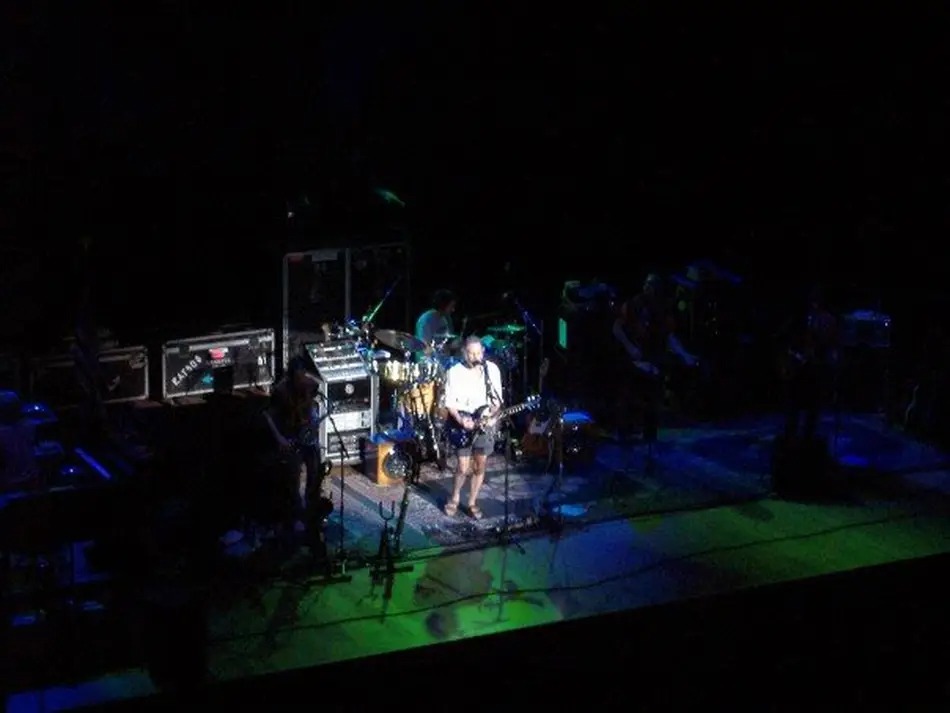

Weir was such an integral and prolific part of the Dead, it’s very difficult to select highlights to feature in a post as modest as this one. By some accounts, he has played more concerts– commonly estimated at around 4,500– than any other professional musician. Instead, I’ll direct readers to but one example, with which I recently reacquainted my ear: The Dead’s May 19, 1974 show in Portland, Oregon. I commend the official vinyl release, but audience tapes should work in a pinch. Structurally, the advantages of this show for the Weir hunter are trifold: (1) a setlist rife with Weir features; (2) a one-drummer lineup, exposing more of the band’s inner clockwork; and (3) a high-quality recording of an overall high-quality performance.
For a band that supposedly ended thirty years ago, Weir’s Dead breathed life into an artistic movement that longevity has shown to be much more an achievement than an innovation. The door they opened is massive, but subsequent history has shown that that doesn’t mean that many necessarily are able to walk through it.
The last word here belongs to Kreutzmann, who, I very much appreciate, does not deeply eulogize just anyone. Of all of the remembrances publicized over the past week, his generated the most resonance:
Jerry Garcia had already been playing music with Bob Weir in a jug band when he called me up to form a rock band with them. That’s how I first met Bob. We called ourselves the Warlocks, playing our first real shows at a pizza parlor in Menlo Park and, long story short (but with a few steps in between)… we became the Grateful Dead. Together, we embarked on a journey without a destination. We didn’t set out to change the world, or to become big stars, or to have our own counterculture — we didn’t know any of those things were actually possible and we wouldn’t have been very interested in them even if we did. Well, not too much, anyway. Just enough to dream. We were a “group” in the sense that we were five friends trying to have the most amount of fun we could think of as often as we could. That meant playing music and all the other things: taking acid, getting high, goofing around. During those first rehearsals, which were in the back of a music shop, Bob and I would smoke joints in the back alley, before, during, and after — we had to be careful because it was still taboo back then. Also, Bob and I were the younger guys in the band, so we liked to do weird shit. By that I mean, we just liked to play pranks and be silly and not take ourselves too seriously. Right when things really started clicking and the band was getting noticed, there was a period when I lived with Phil Lesh on Belvedere Street and Weir lived with Garcia just a couple blocks over on Ashbury. That part of San Francisco, the Haight-Ashbury district, was getting enough national notoriety that buses full of tourists would stop in front of the Ashbury house and take pictures: “To your left is the home of the Grateful Dead.” Bob and I used to enjoy throwing water balloons at each other so one day we started throwing them at the tourist buses. That didn’t end well, but it’s making me smile all these years later thinking about it, because it was a time when every day felt like a great American adventure. We used to listen to every new record that came out anywhere. We would go over to Phil’s place, but Bob and I would sit next to each other and we’d listen intently to the music, trying to figure out “How did they do that?” That was a really big thing we used to do together. It was basically like our religion. Sometimes we’d take STP and sit there and turn the lights down low and the back of the amplifier would glow like a cathedral as we’d listen to the music. Nothing was more important than having fun and nothing was more fun than playing music. Especially once audiences started coming and we could look out and see a sea of people dancing. Once that happened, it was all we wanted to do. We didn’t want to stop. That was our first real goal — to just keep going. And so for sixty years, the music never stopped. This was true for all of us, together and apart, but when Bob was off the road, all he wanted to do was get back on it. And in the meantime, he would stop by any bar or club where there was someone playing that would let him sit in. He seemed to always be on some stage, somewhere. Offstage, we were everything you’d expect from lifelong friends and bandmates. We fought together (both on the same side and opposing), we celebrated together (both personal and professional milestones), and we watched each other, both near and far, as we went from teenagers to old men and all the stops in between.I once heard Bobby refer to himself as “the greatest rhythm guitar player in the world” and it made me chuckle lightheartedly at my brother’s boastfulness. The thing is… he was probably right. Time has proven that nobody will ever be able to replace Jerry Garcia — or Phil Lesh — and time will prove the same for Bob Weir. They were the biggest influence on my own playing, more than any drummer, and they will continue to be the biggest influence on whatever I do next.
We used to listen to every new record that came out anywhere. We would go over to Phil’s place, but Bob and I would sit next to each other and we’d listen intently to the music, trying to figure out “How did they do that?” That was a really big thing we used to do together. It was basically like our religion.
Sometimes we’d take STP and sit there and turn the lights down low and the back of the amplifier would glow like a cathedral as we’d listen to the music.
Nothing was more important than having fun and nothing was more fun than playing music. Especially once audiences started coming and we could look out and see a sea of people dancing. Once that happened, it was all we wanted to do. We didn’t want to stop. That was our first real goal — to just keep going.
And so for sixty years, the music never stopped. This was true for all of us, together and apart, but when Bob was off the road, all he wanted to do was get back on it. And in the meantime, he would stop by any bar or club where there was someone playing that would let him sit in. He seemed to always be on some stage, somewhere.
Offstage, we were everything you’d expect from lifelong friends and bandmates. We fought together (both on the same side and opposing), we celebrated together (both personal and professional milestones), and we watched each other, both near and far, as we went from teenagers to old men and all the stops in between.
I once heard Bobby refer to himself as “the greatest rhythm guitar player in the world” and it made me chuckle lightheartedly at my brother’s boastfulness. The thing is… he was probably right.
Time has proven that nobody will ever be able to replace Jerry Garcia — or Phil Lesh — and time will prove the same for Bob Weir.
They were the biggest influence on my own playing, more than any drummer, and they will continue to be the biggest influence on whatever I do next. (Con’t) ↓ Continued) Their inspiration will continue to take on many forms, as is the very nature of inspiration, but just as those three brothers of mine took inspiration from others and made something new and original out of it, it’s now time for tomorrow’s artists and visionaries to do the same. Keep going forward. Take the inspiration and do something new.
There are so many people who can rightfully say that their life would not have been the same without Bob Weir. That’s been true for me since I was 17. And through it all, the high times and the low tides, my love for him will not, indeed can not, fade away.
In the end, what more was there for him to do? He played it all… and never the same way, twice. I think he had finally said everything he had to say and now he’s on to the next thing. I just hope he was able to bring his guitar with him or otherwise he’ll go crazy.
“Sleep in the stars.
Don’t you cry.
Dry your eyes on the wind.”And get there safely, old friend.
Love you forever,
Billy
 ALDLAND