The Day Negro Leagues Statistics Met the Major League Record Books (via FanGraphs)

Wednesday was a big day in the world of baseball statistics, albeit a more complicated one than initially met the eye. Major League Baseball announced that the statistics from seven professional Negro Leagues that operated between 1920 and 1948 have been officially incorporated into its database, the culmination of a process that began in late 2020, when MLB first recognized those circuits as major leagues. As a result, several longstanding seasonal and career records have officially changed hands; most prominently, Josh Gibson is now the single-season and all-time leader in batting average, slugging percentage, and OPS, supplanting Ty Cobb and Babe Ruth in the career categories. The grassroots effort to gather and audit the Negro Leagues data that made this possible has been laudable, even heroic. But while we can never do enough to acknowledge the greatness of Gibson and his peers — along with the pain and injustice that they faced both within and outside baseball — MLB’s announcement and the dissemination of the news did strike a few sour notes, just as in 2020.

However, it is a mistake to confuse the provenance of those accomplishments as belonging to MLB, and a misrepresentation to brand them as such. As Shakeia Taylor, deputy senior content editor at the Chicago Tribune and host of the historically-focused Society for American Baseball Research podcast Ballpark Figures, succinctly put it on Twitter, “[I]t’s really as simple as referring to [Gibson] as the ‘major-league record holder’ instead of ‘MLB record holder.’ These two things are not the same.”

Again, the semantics and nuances matter. Major League Baseball (MLB) in its capitalized form refers to the corporate and legal entity created by the 2000 merger of the AL and NL, whose histories and records it subsumed, warts and all. Part of their histories is the systemic racism that excluded Black players within the aforementioned period, and so it should not simply call those records part of MLB, for however well-intentioned the gesture may be.

Within MLB’s [press] release [announcing the statistical incorporation], the supportive statements of Thorn, Lester, fellow Negro Leagues expert Phil Dixon, and Elias Sports Bureau senior historian John Labombarda are thankfully much better [than that of MLB Commissioner Rob Manfred, which elided MLB’s legacy in the creation of the Negro Leagues and the nuance of the maintenance of their statistics], with Thorn pointedly acknowledging the league’s role in creating the difficult conditions in the first place. “Shortened Negro League schedules, interspersed with revenue-raising exhibition games, were born of MLB’s exclusionary practices,” he said in the statement. “To deny the best Black players of the era their rightful place among all-time leaders would be a double penalty.”

The designation of certain bygone leagues as majors dates back to 1968, when commissioner William Eckert convened a Special Baseball Records Committee. The effort was in conjunction with publisher Macmillan’s effort to produce The Baseball Encyclopedia, which would encompass the official statistics of the major leagues. The five-man committee, which consisted of officials from the AL and NL, the commissioner’s office, the Hall of Fame, and the BBWAA — all of them white men, of course — announced in 1969 that it had determined that the AL, NL and four defunct leagues met the criteria to be considered majors[.]

The SBRC did not formally consider the Negro Leagues, with Joe Reichler, who represented the commissioner’s office, saying in 1987 that the leagues’ lack of exhaustive statistics and volume of games against local semipro teams factored into that decision. “They played against whoever they could for whatever they could get,” he told Gannett News Service. “You can’t blame them, but they never played more than 40 or 50 league games. It just wasn’t a cohesive league. There’s no way that you could say they were major league.”

The year 2020 served as a catalyst for a reconsideration of that exclusion. . . . In December of that year, MLB announced its “long overdue” decision to bestow official recognition of seven professional Negro Leagues from the 1920–1948 period as major leagues. … Read More

(via FanGraphs)

Miguel Cabrera’s 3,000th Hit Put Him in Exclusive Company (via FanGraphs)

Miguel Cabrera had to wait a couple of extra days to make history, thanks to a hitless afternoon capped by a controversial managerial decision and then a rainout. Nonetheless, on Saturday afternoon he collected his 3,000th career hit with a single off the Rockies’ Antonio Senzatela. In doing so, he joined some elite company as not only the 33rd player to reach 3,000 hits, but also the seventh to do so as a member of the 500-homer club and the third to reach both of those round numbers with a career batting average of .300 or better. The other two? Hank Aaron and Willie Mays. You may have heard of them, and even if you don’t put much stock in batting average, you have to admit that’s about as cool as company gets.

What’s more, Cabrera actually owns the highest batting average and on-base percentage of the seven players who have both milestones, with a wRC+ that trails only Mays and Aaron[.]

For all of his struggles over the past half-decade, Cabrera would still have to go 0-for-352 to drop his batting average to .299. Even with those struggles and his lack of defensive value (he’s 102 runs below average in terms of Defensive Runs Saved, including 11 below in just 847.1 innings at first base since 2018), he ranks 11th in JAWS among first basemen (68.8/44.8/56.8), in no danger of slipping below Palmeiro (13th at 71.9/38.9/55.4) or Murray (16th at 68.7/39.2/53.9). And while he may be the last to reach 3,000 hits for some time given the dearth of candidates (Dan Szymborski put Jose Altuve, who has 1,783 hits, at 34% and Freddie Freeman, who has 1,723 hits, at 28% last September), he’s hardly the least.

Cabrera joined Ty Cobb and Al Kaline as the other players to reach 3,000 hits as Tigers. As ESPN’s Marly Rivera pointed out, he’s the first Venezuelan to reach 3,000 hits and the seventh Latino, after Roberto Clemente, Rod Carew, Palmeiro, Rodriguez, Adrián Beltré, and Pujols. … Read More

(via FanGraphs)

The week in baseball: 5/29/20

From the Increasingly Nocturnal Department:

  • I haven’t found it productive to follow each new return-to-play proposal for the 2020 MLB season in any detail, but public comments this week, especially from players including Max Scherzer and Trevor Bauer, point to the very real possibility that the entire season will be lost due to the inability of the owners and players union to reach final agreement on compensation arrangements for the year in a timely fashion. Although the calendar has not yet turned to June, keep in mind that any start date will need to allow a few weeks of lead time for pitchers to stretch out, undoubtedly among other logistical considerations. The viability of opening the season on or around July 4 therefore depends on what the sides can accomplish over the next couple of days. Of all the things Rob Manfred has screwed up in his brief tenure as MLB commissioner, the complete absence of baseball in America should other professional sports leagues find a workable way to resume action would be one of the most memorable.
  • Meanwhile, the 2020 Minor League Baseball season effectively ended this week following the announcement that teams are expected to begin releasing large numbers of players shortly. Some big-league veterans, including  Shin-Soo Choo and David Price, have responded by personally paying all of the monthly stipends of all of the minor-league players in their respective teams’ farm systems.
  • The CPBL and KBO seasons are rolling on, though a recent resurgence of COVID-19 cases in South Korea has delayed the expected return of fans to KBO stadiums. ESPN is continuing live telecasts of KBO games, often with replays on ESPN2 later in the afternoon.
  • The KBO appears to have earned itself a celebrity fan in Adam Eget, trusty sidekick of Norm Macdonald and manager of the world-famous Comedy Store, who said as much on a recent episode of Joe Rogan’s podcast. He and Rogan also discussed cults and Charles Manson, so listen at your own risk.
  • Japan’s professional baseball league, NPB, announced it will begin an abridged season on June 19. The prevalent view among those who follow foreign baseball leagues is that the NPB is the league that comes closest to MLB in terms of talent and competition levels.
  • Facing the prospect of the complete absence of MLB games this year, I’ve begun posting daily baseball landmarks that occurred on that day on ALDLAND’s twitter account. Some from the past week in baseball history, courtesy of Baseball-Reference:
    • 1904 – Dan McGann steals 5 bases in a game, a feat not matched until 1974 (Davey Lopes) or bested until 1991 (Otis Nixon, 6)
    • 1922 – Supreme Court rules baseball not subject to antitrust laws, interstate commerce regulations
    • 1925 – Ty Cobb becomes 1st major leaguer with 1,000 career extra-base hits
    • 1946 – 1st night game at Yankee Stadium
    • 1951 – Willie Mays gets his first hit, a home run off Warren Spahn
    • 1952 – Hank Aaron, then of the Indianapolis Clowns, signs with the Boston Braves
    • 1959 – Harvey Haddix pitches 12 perfect innings before an error in the 13th (“there has been never been anything like it” = more from Tim Kurkjian here)
    • 1968 – NL announces expansion to Montreal, San Diego
    • 1969 – Aaron becomes the 3rd major leaguer with 500 HR + 500 2B
    • 1976 – Pitcher Joe Niekro, batting against his brother, Phil, hit his only career home run
    • 1990 – Rickey Henderson breaks Cobb’s AL stolen-base record
    • 2004 – Mariano Rivera earns his 300th save
    • 2006 – Barry Bonds hits 715th home run
    • 2008 – Pedro Martinez, making a Single-A rehab start for the St. Lucie Mets, faces off against then-recent top pick David Price, then of the Vero Beach Devil Rays. (Price and the Rays win 2-0.) Price would make his major-league debut that September and his World-Series debut the following month.
    • 2010 – Roy Halladay pitches perfect game (ESPN is airing a program on Halladay’s career and too-short life tonight at 7:00 pm)
  • Whatever happens with baseball this year, Jersey City brewery Departed Soles wants to make sure we don’t forget what happened in the recent past, and therefore has released its newest beer, Trash Can Banger, a session IPA with a can styled after the Houston Astros’ classic 1970s uniforms. For now, the beer only is available in New Jersey.
  • Did the Astros cheat? They did. Did their cheating help? Running counter both to fan intuition and the public statements on the subject by professional pitchers, the latest look at that question, like some others before it, concludes that it didn’t make much of a difference. This analysis also set out to test Commissioner Manfred’s assertion that the Astros didn’t cheat in 2019 but was unable to reach a conclusion on that question.

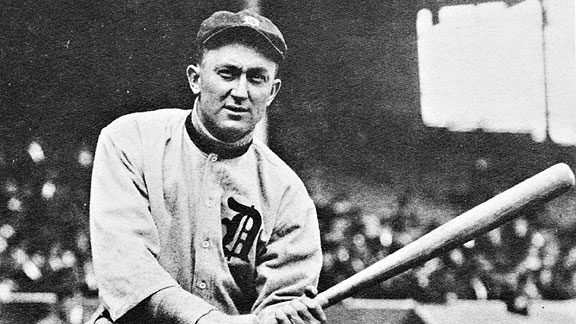
Ty Cobb as Detroit (via Grantland)

Like those who romanticize Cobb’s meanness, Detroit’s cheerleaders try to balance negative press by powering uncomplicated positive stories: a café opened here, an art installation opened there. Unfortunately, this is a story too simple and stagnant to be honest.

Ty Cobb can be a cruel man, and at the same time be a misunderstood hero. Detroit can be both a ravaged, bleeding city and an inspired place where creative people are imagining new ways for an urban center to be successful. In fact, that’s exactly what is true. … Read More

via Grantland